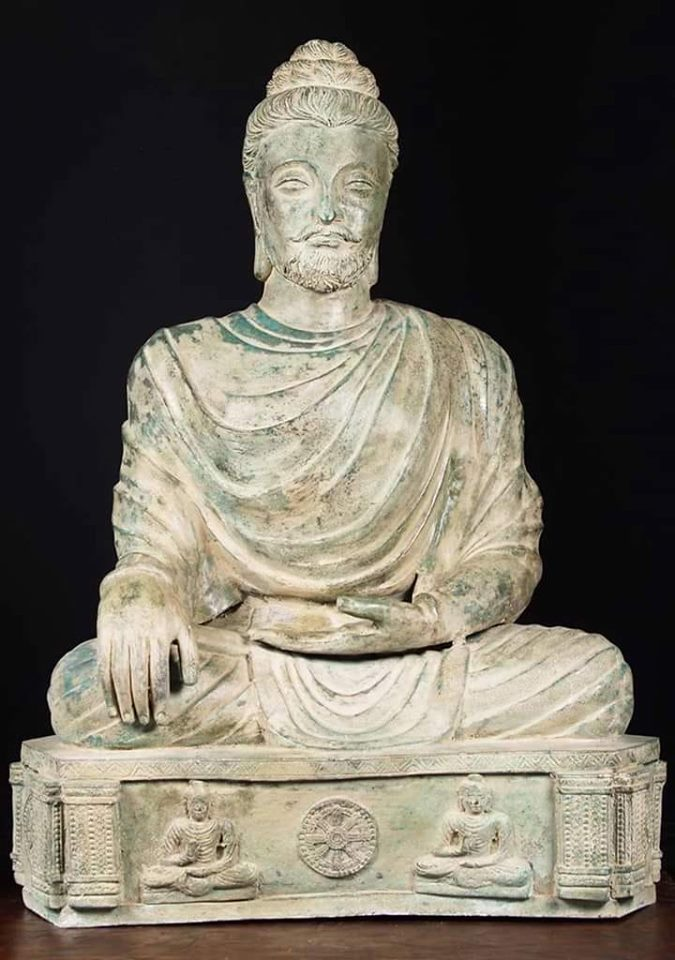
In antiquity, Gandhara was one of the most deeply-rooted hubs of Buddhism, and scholars have attempted to search for any possible encounters between Buddhists and the Greeks who settled in Central Asia and India. Fascinating pieces of evidence hint at these connections: the Pali text known as the Milindapañha ("The Questions of King Milinda") portrays the Indo-Greek king Menander I Soter as a Buddhist convert and saint swayed by the wisdom of the Sage Nagasena, while Emperor Ashoka dispatched missionaries to the Hellenistic kingdoms and ordered his beliefs to be inscribed in Greek on the rocks outside of Kandahar. Centuries later, the sculptors of Gandhara would adapt Greco-Roman mythology and designs to create beautiful works of art, resulting in the first known depictions of the Buddha in human form, and transforming the demigod Heracles into Heracles-Vajrapani, protector of the Buddha.
Showing posts with label GANDHARA. Show all posts
Tuesday, 31 January 2023
THE INDO - GREEKS :HERAKLES , MENANDER , AND THE BUDDHA
Tuesday, 24 January 2023
INTERVIEW- GRECO BUDDHISM IN CENTRAL ASIA AND INDIA WITH LEE CLARKE
In the wake of Alexander the Great, the traditions of Hellenism and Buddhism thought came into close contact in Central Asia and India. Lee Clarke, a PhD student in cross-cultural philosophy at Nottingham Trent University, joins the show to discuss the idea of “Greco-Buddhism”, tracing the origins of the Buddha and the establishment of his teachings in Gandhara, before comparing and contrasting the philosophical outlooks of Greek and Indian schools of thought like Pyrrhonian Skepticism and Mahayana Buddhism.
The video is taken from the YouTube channel The Hellenistic Age History Podcast. All credit goes to them.
Monday, 13 April 2020
THE POWER OF HERACLES IN GANDHARA ART AND BUDDHISM
Long before the 21st century adage that “the world is flat,” ancient empires and trade routes enabled cultural globalization of a kind quite familiar to us today. Modern buzzwords like ‘syncretism’ and
‘alterity/otherness’ apply to these ancient cultures as
much as they do to modern ones. The art of Gandhara in the 1st to 5th century CE Indian subcontinent offers many examples: coins, sculpture, and architecture depicting scenes from Indic mythologies, but sharing an iconographic vocabulary with Graeco-Roman and Iranian Zoroastrian arts and religions. This article examines Herakles’ iconographic journey to India and his transformation into Vajrapani, the bodyguard of the Buddha. In Gandharan sculptural reliefs depicting events from the life of the Buddha, the Heraklean Vajrapani serves as a sacred icon embodying the Buddhist community’s aspirations to royal patronage under the Kushan dynasty.
Royal Power and Luxury: The Image of Herakles in
Gandhara
The most striking fact about Gandharan art, both Buddhist and courtly, is its inclusion of Graeco-Roman and Iranian mythological figures and artistic styles. Gandharan Buddhist art also incorporates Hindu deities such as Shiva (Quagliotti 2011). The fusion of
such varied elements makes the study of Gandharan Art a vibrant field involving many cultures, but also can make it difficult to determine the provenance of particular iconographic motifs.
Graeco-Roman artistic culture first spread into Gandhara through the conquests of Alexander the Great (335–323 BCE) and the settlers he left behind in Bactria. The Hellenistic successor states declined, to be replaced in Bactria and Gandhara (territories encompassing northeastern Afghanistan and northern
Pakistan and India) by the Kushan empire. In the Kushan period, Classical artistic influence continued. The elite of Rome,in the beginning of the 1st century CE, developed a taste for Eastern luxuries—perfumes, spices and silks. Roman consumption of aromatics and spices became widespread; the volume of Rome’s eastern trade was substantial.
This trade has been documented by abundant archaeological evidence—e.g., Roman coin hoards and amphorae found in India—and from the Periplus Maris Eurythraei, a 1st-century CE trading manual for Greek-speaking merchants traveling the route from the Red Sea to northwestern India along the Indian Ocean.The Periplus mentions Gandhar and, fleetingly, the trade connections to China (Casson 1989, p. 47).
Legends of Roman citizens who travelled to India, such as the apostle Thomas and Apollonius of Tyana, as well as donative inscriptions in Buddhist monasteries crediting Yavanas (Greeks) and Raumakas (Romans) indicate that the exchange between Rome and India may have been cultural as well as mercantile (McLaughlin, 2010, p. 40).
Herakles’ most important attribute for the Classical world was his strength, which enabled him to slay many of the monsters who threatened human civilization. Naturally, Greek, Hellenistic, and Roman rulers adopted his imagery as part of their propaganda
of power (Vollkommer 1988, pp. 87–93). A striking,
if perhaps extreme, example is Antiochus I of Commagene (r. 70 BCE – 38 BCE), who placed himself in a pantheon that included Herakles at his burial site on Mount Nemrut in Anatolia and at nearby Arsameia,he erected a large relief showing him shaking
hands with Herakles . The coins of Bactrian and Kushan kings show that this visual lexicon of power spread into the South Asian world.
Heraklean iconography first made its way into Gandhara by way of Alexander the Great’s coinage. Alexander styled himself as both the descendent and brother of Herakles. In his campaign through Greece, Egypt, and Persia, he even re-enacted many of the
deeds of Herakles (Amitay). Fittingly, the obverse of Alexander's coinage depicts Herakles with lion skin on his head, an image one must assume was to be understood as Alexander himself . Coins from Alexander’s successors in Bactria also depict Herakles.
One coin of Euthydemus I (230–200 BCE) portrays Herakles reclining on his lion skin, while another issued by Bactrian king Agathocles (190–180 BCE) depicts Herakles standing in contrapposto with his club in the air .
In addition to these coins, we also have several small bronze figurines from Bactria depicting Herakles, perhaps used as votives
or decorative statues (Allchin et al. 1992, pp. 99-103).
As Cribb and Bopearachchi write (Ibid., p. 50):
The Gods chosen by the Greek kings of the Crossroads of Asia tended to be those who could also be used as symbols of royal power. So Zeus, King of the Gods; Herakles, the mortal hero who achieved divinity; and a martial representation of Athena,
daughter of Zeus, were the ones most frequently portrayed on these coins.
These portrayals of powerful Greek Gods made their way into Kushan coinage and other royal symbols. While most Kushan coins depicted Iranian deities, some coins of the
early Kushan kings Kujula Kadphises (r. 30 – ? CE) and Huvishka
(r. ca. 150 – ca. 190 CE) depict Herakles on the reverse , identifiable by his characteristic club.These coins represent the earliest and most easily tracked movement of Heraklean iconography into the Gandharan region. They convey Herakles’ embodiment of power, and his iconography of the club
and lion skin. Another image of Herakles in royal iconography is on a Kushan seal depicting him wrestling with one of the human-eating horses of Diomedes (Rosenfield 1967, pp. 78, 102). Herakles killed these horses as part of his Labors, protecting human civilization from dangerous monsters. So, it is not hard to see why a king would choose this iconography to represent his power. This seal suggests that Kushan artisans had a greater knowledge of Greek myths about Herakles than could be derived from the coinage of Alexander and Bactrian kings alone.
There is also a comedic Herakles, a libidinous figure whose
gluttony, drunkenness and sexual prowess were humorously exaggerated (Stafford 2010, pp. 105–17). In Aristophanes’comedy Frogs, Dionysus dressed as Herakles is accosted by a landlady who asks for payment for sixteen loaves of bread, twenty portions of meat, and generous portions of garlic, fish, cheese, and sausages —
all evidence of Herakles’ enormous gluttony (Stafford
2012, p. 108). Herakles’ gargantuan appetite extended not only to food, but to sex. Apollodorus records one legend that Herakles slept with all 50 daughters of King Thespios in the course of 50 nights, in the king’s hopes that the hero would impregnate all of
them (Apollodorus 1997, 2.4.10).
In Gandharan art, Herakles is similarly shown as a libidinous figure, someone often overpowered by his urges for women and drink. He is one of several figures from Greek Religion—among them Apollo and Daphne, Aphrodite and Eros, and various other mythical beings such as marine monsters—who appear on
shallow dishes used in Gandharan courts. Behrendt (2007, pp. 9–11) argues that these dishes “may have been used for ritual offerings of wine, perhaps to ensure a blissful afterlife for the dead” in Dionysiac rituals adopted by Gandharans. Galli (2011, p. 300) speculates that another possible use was to hold toiletries for
wealthy women. One dish portrays Herakles accompanied by both alcohol and women . Here Herakles leans in close and embraces the two women next to him. A tame lion, as on the wrestling weight, sits to the side. This dish portrays a comedic, light-hearted Herakles, enjoying wine and women — the luxuries of the courtly life — as he does in Greek Tradition. Whether
these dishes belong in the womens’ sphere of bathing or the transgressive femininity of Dionysiac cult, they connote the intimacy, privacy, and eroticism of the women’s sphere. In a woman’s private space of her own bath, she could admire (and perhaps be titillated by) the images of seduction and eroticism on these toilet-trays.
How can we best understand Gandharan depictions
of the drunken Herakles? Brancaccio and Liu (2009) argue for a Dionysian strand in Gandharan courtly culture. Not only was viticulture introduced into India at this time, but Dionysian art forms, such as Sanskrit drama and theatrical masks, developed under the Kushans as well. That Greek drama was popular earlier in Bactria can be seen at Ai Khanoum, which had a full Greek theater. Dionysian themes of drink and drama were one aspect of Bactrian cosmopolitan style, but also appear in Buddhist art, such as on a stair risers leading up to the entrance of a stupa. Brancaccio
and Liu (2011, p. 230) surmise that the bacchanalian
scenes of drunken revelry on these stair risers represent the life before embracing the dharma. Herakles, associated with drink in the Graeco-Roman world, was likely a part of the culture of wine in the Gandharan world. Herakles connects the powerful image of kingship with the drinking and revelry that can take place because of the peace won with Heraklean strength and protection.
Vajrapani’s enigmatic iconography
The depictions of Vajrapani analyzed here come from narrative reliefs on the sides of stupas depicting scenes from the life of the Buddha (Brown 1997 Behrendt 2009; Stoye 2011). According to Kurt Behrendt (2007, p. 32), this type of relief dates mainly to
the 2nd century CE. The production of these reliefs was part of a broader cultural renaissance of Buddhism in the Gandharan region, which took place under the Kushan dynasty from roughly the 1st to 5th centuries CE (Neelis 2014). Kushan Gandhara prospered and
urbanized thanks to the cross-Asian trade, which also provided the means to fund major Buddhist architectural and sculptural monuments. In return for large donations, wealthy lay donors earned positive karma in a sacred economy of money for merit (Schopen 2004; Liu 1994, pp. 103–23). The Buddhist community
also benefited from donations by pilgrims, who came to worship at stupas believed to contain relics of the Buddha. The sangha’s new wealth brought it social respectability and pushed it to expand roles for lay practitioners (Thapar 2002, p. 271).
The royal coinage and Buddhist art of Gandhara displays a syncretism of iconography from Hindu gods, Iranian deities, and
indigenous folk cults centered around chthonic deities (spirits of the underworld) such as yakshas and nagas. Vajrapani, the bodyguard of the Buddha, appears in the earliest Pali literature as a manifestation of Sakra/Indra, but in the early Common Era becomes an important and independent figure in post-Pali Buddhistliterature, such as the Mahavastu, Lalitavistara, the Mulasarvastivada Vinaya, and the avadanas (Lamotte 2003,pp. 7–9). He accompanies the Buddha and acts as an intimidating figure when the Buddha encounters anyone who is opposed to his mission. In Buddhist literature he is described as a yaksha, a chthonic deity tamed by the Buddha and his dharma (DeCaroli 2004, pp. 9-54; Lamotte 2003). Vajrapani wields his weapon, the vajra, to threaten those who attack the Buddha, or just those who refuse to hear his message. His vajra (Sanskrit: “diamond” or “thunderbolt”), originally an implement of the Vedic storm god Indra/Sakra, is made of the densest matter possible, and is imbued
with the power to shoot thunderbolts at enemies (Doniger 1975, pp. 75, 85; Zin 2009, pp. 81–84; Giuliano 2008). In the Ambattha Sutta, Vajrapani uses a “huge iron club” to threaten a student of a rival teacher who is trying to refute the Buddha’s teachings. Vajrapani’s intimidation makes Ambattha take refuge in the Buddha (Walshe 1995, p. 116; Lamotte 2003, p. 5). Vajrapani plays a similar role in opposing the heretics who try to stop Mendhaka from receiving the Buddha’s teachings in the first-century CE “Chapter on the Great Fortune of the Householder Mendhaka” (Rotman, 2008, p. 233).
Vajrapani also aids the Buddha in converting harmful chthonic deities. Many of these spirits are yakshas,tree-spirits, like Vajrapani, and others are nagas, spirits associated with rivers. Vajrapani used his strength and his vajra to intimidate and subdue these creatures. For example, the naga Apalala flooded a nearby town, prompting the Buddha to come rescue the townspeople from their distress. Using his vajra, Vajrapani frightened Apalala into converting to the dharma and discontinuing his malevolent flooding (Lamotte 2003,p. 21–22) . In the center of this image is a relatively large Buddha; close by him on his right is Vajrapani, always wielding his weapon with a tight fist, ready for attack. Apalala kneels in front of Shakyamuni Buddha in submission. This image
typifies the pattern of how the Buddha subdued malevolent spirits not by killing them, but rather by converting them so that they would act virtuously and no longer harm humans. These myths reinforced a social practice whereby the sangha acted as a broker
between humans and the spirit world, subduing spir its to protect humans from their harm (DeCaroli 2004, p. 38-53). In performing this social function, Vajrapani’s force complements the persuasive power of the Buddha’s dharma.
Vajrapani appears rarely in extant literature from the 1st to 5th centuries CE, but frequently in Gandharan art depicting scenes from the life of the Buddha (Zin2009, p. 81). Chronologically, he first appears in the Buddha’s life in reliefs of the Great Departure from Kapilavastu, and frequently is present in the scene
of Shakyamuni’s mahaparinibbana. In addition to reliefs such as that depicting the conversion of Apalala, he appears in depictions of the Dipankara Jataka, and Devadatta and Srigupta’s assassination attempts on Shakyamuni Buddha. Devadatta was a cousin of
the Buddha who became his disciple. Jealous of the popularity and fame of his teacher, he tried to kill the Buddha several times in different ways (Zwalf 1996,v. 2, p. 192). Only in the Gandharan-era Mulasarvastivada Vinaya does Vajrapani appear in the Devadatta
stories (Lamotte 2003, pp. 16–18). Fig. 11 depicts the first assassination attempt, in which Devadatta sent assassins to push a wall onto the Buddha. On the left the assassins push against the wall, and on the right the Buddha pushes back. A bearded and curly-haired Vajrapani stands next to the Buddha, helping keep
the wall standing. In the third assassination attempt, Devadatta sends a wild elephant to trample the Buddha. Shakyamuni Buddha does not use force to defend himself against the giant attacker, but calms the elephant with his tranquility and power over nature. Vajrapani again appears over the Buddha’s shoulder. What his action is supposed to be in this relief is unclear, but his mere presence is a powerful indicator of his protective power.
Scholars of Gandharan art have long known of the connection between Herakles and Vajrapani. The connection is based on a strong similarity between the bearded, muscular images of Vajrapani and similar images of Herakles conveyed into India numismatically, such as the Lysippan Weary Herakles. In the
transformation of Herakles into Vajrapani, Herakles’club becomes Vajrapani’s vajra. One image clearly connecting the two is a relief found in the British Museum. The figure in the lower left is Vajrapani, holding his diamond-shaped vajra and wearing a lion skin. We do not know the original context of this piece, though Zwalf speculates (1996, v. 2, pp. 230-31)that it is part of a larger relief depicting a scene from the life of the Buddha. The lion skin, ubiquitous in Graeco-Roman iconography of Herakles and coins of
Alexander, substantiates the connection between Herakles and Vajrapani. The lion skin was also favored in the iconography of rulers who adopted Herakles as ancestor or patron deity, including Antiochus I of Commagene, Commodus, and Caracalla (Hekster
2001; Hekster 2005; Vermeule 1975; Marvin 1983).
This unique relief reminds us that where we cannot correlate text with image, it sometimes is difficult to know what Vajrapani is doing in these contexts, or more generally what his importance is in Gandharan Buddhist art. Several scholars have analyzed the use of Heraklean iconography for Vajrapani in terms of parallels between these two figures. This research on the Herakles-Vajrapani connection has focused mainly on their shared roles as protectors and bodyguards (Zin 2009;Schwab 1998; Flood 1989; Tanabe 2005). Filigenzi (2006, p. 275) has noted that Herakles, like Vajrapani, is a “suffering hero who through his labors transfigures himself, taming his own nature and thus elevating and civilizing the entire sphere of human nature.”
Just as Herakles redeems his homicide of his wife and children through his great labors protecting Greek civilization, so Vajrapani reforms his capricious, amoral yaksha nature through following the Dharma and redeems himself by serving Shakyamuni Buddha
so closely. Tanabe (2005, pp. 372–79) notes a further parallel in the roles of Herakles and Vajrapani:Herakles as a guide for the souls of the dead and guide to and from the underworld for figures like Alcestis, and Vajrapani as mythological guide of the Buddha throughout his travels. However, these scholars overlook one crucial connection: the implications of Vajrapani, and his Heraklean iconography, for the construction of royalty and royal patronage in Gandhara.
Even though the Buddha renounces his kingship, depictions of him often emphasize it (Liu 1994, p.92–102). Kings and other nobles have bodyguards and attendants; for the Buddha, Vajrapani is one of these.The iconography of Vajrapani adds another dimension: the display of wealth. Vajrapani’s implement, the vajra, with the dual meaning in Sanskrit of “diamond” and “thunderbolt,” might be used as a thunderbolt but would also connote wealth and luxury
(Zin 2009, p. 83–84). This association with royalty is underscored by the fact that Indra, the Vedic god who first carried a vajra, was king of the Vedic gods (Doniger 1975, p. 71).
The Legend of the Buddhist Kanishka: Propaganda
for Patronage of the Sangha
At first glance, one might think that the artistic interchange between the courtly and religious spheres of Gandharan visual cultures indicates that the Kushan kings were fervent patrons of the sangha. Certainly by the time of Xuanzang, long after the Kushan empire had fallen, Buddhists in Gandhara made this claim.Yet this claim appears to be more an invention of Buddhist legend than documentable fact. Xuanzang, a 7th-century Chinese Buddhist monk, went on a pilgrimage to India to gather Buddhist texts.
His travelogue, composed after his return, contains several anecdotes about Kanishka (r. ca. 127–?149 CE), the Kushan king who conquered the Gandharan region. These stories, told to Xuanzang by the Buddhist communities he encountered, depict Kanishka as another Ashoka (r. ca. 269–232 BCE), the Mauryan ruler renowned for his role in spreading Buddhism. The
Buddha himself prophesies Kanishka as a great Buddhist king, who will erect a stupa that contains that remains of Shakyamuni Buddha himself (Xuanzang 1996, p. 71). A similar story is told in the Mulasarvastivadin Vinaya, in which the Buddha also adds that “after my Parinirvana, he will do Buddha deeds” (Lamotte 2003, pp. 26-27). Xuanzang reports that Kanishka sponsored the compilation of Buddhist scriptures and convened the Fourth Buddhist Council (Xuanzang 1996, pp. 102–04; Thapar 2002, pp. 222–73). Like the Buddha, Kanishka used the power of the dharma to win malevolent spirits over to Buddhism, protecting his people from the effects of capricious yakshas and nagas (Χuanzang 1996, pp. 44, 82; DeCaroli 2004, p. 61). Even though such claims that Kanishka was a Buddhist king were recorded long after the end of the Kushan era, it is plausible that that they originated in Kushan times, when Vajrapani was part of the visual lexicon of royalty and wealth. By adopting the royal iconography of Herakles into Buddhist iconography, the sculptors of the sangha asserted that their religion was a religion of royalty. Just as Vajrapani protects the Buddha, so the Kushan kings protect the Buddha’s sangha, and endow it with great wealth for stupas, monasteries, and the art carved into their walls. Indeed, Kushan patronage is attested in inscriptions on reliquaries.
For a religion dependent on patronage, projecting an image of being sponsored by the king would have been advantageous. However, questions remain as to whether Buddhism occupied as important a place for the Kushan rulers as the later narratives suggest. The Buddha seldom appears on Kushan coins, apart from
some issued by Kanishka. In contrast, there are numerous images of Iranian deities (Jongeward 2003, pp. 24–26). If they were projecting an image of themselves as a dynasty of Buddhist kings à la Ashoka, would they not have put the Buddha on their coins more
frequently? Even if the Kushana kings were donating money to the Buddhist sangha, their coins suggest that they may not have favored the Buddhist community over any other, wanting to ensure support from the several religious communities which they ruled
Conclusion
We have traced how the image of Herakles traveled east thanks to cultural contact between the Classical world and ancient India. His image conveyed not just strength and protection, but also the wealth and luxury of the royal court. The Kushans, invading nomads, included Herakles in the cosmopolitan imagery theydeveloped as they incorporated urban centers into their empire. The Buddhist sangha responded to this royal usage of Herakles by inserting him into their artistic lexicon, both as a figure of protection for the Buddha and as a subtle claim of royal patronage of the sangha. The Herakles-Vajrapani connection, then, tells a tale not only of interchange between East and West, but of a dialogue in art between sacred and secular cultural realms. As with many other aspects of Silk Road exchange, the example of Gandharan art
demonstrates the human capacity creatively to reinterpret others’ symbols and myths in the process of shaping one’s own identity.
Acknowledgements
This paper derives from an undergraduate thesis written atSanta Clara University under John Heath and David Gray,
and owes much to the feedback from them, April Flowers,
Pia Brancaccio, and several members of the Santa Clara University Department of Classics. I also benefitted from comments on my presentation of the material at the American
Academy of Religion, Pacific Northwest Region (especially
from Kristin Schieble), and the San Jose State Art History
Symposium. Finally, the biggest thanks of all goes to Michelle Runyon for her endless patience.
About the author:
Jonathan Homrighausen graduated from Santa Clara University with a double major in Religious Studies and Classics. He is now pursuing Biblical Studies as an MA student at
the Jesuit School of Theology, Berkeley. His article, “Spiritually Bilingual: Buddhist-Christians and the Process of Dual
Religious Belonging,” is forthcoming in Buddhist-Christian
Studies. E-mail: <jdhomrighausen@gmail.com>.
http://www.silkroadfoundation.org/newsletter/vol13/Homrighausen_SR13_2015_pp26_35.pdf
Monday, 20 January 2020
GANDHARA ART ~ TERRACOTTA STATUE OF HERACLES
A monumental Heracles terracotta statue. Ancient region of Gandhara, 4th- 5th c. CE. Its height is 91cm, without the base.
This almost life-size Kushan period Gandharan statue depicts Heracles seated in royal ease. He shows an expressive, dominating face with bulging eyes, vividly curled hair and long beard. During the Kushan period, this type of bearded head was used for several male deities or heroes. such as Atlas or Dionysos and rarely, as in our example, for Heracles. Apart from a loincloth Heracles is naked, as is the small female human figure next to him, who is holding a loincloth up to cover her lower body.
The Kingdom of Gandhara stretched across parts of present-day Afghanistan and Pakistan. Gandhara is noted for its distinctive style in Buddhist art,which flourished and achieved its peak during the Kushan period, from the 1st to the 5th century. In the first century CE, Gandhara was the birthplace of the earliest Buddhist images.
Fired clay was an expensive material in the area, because the wood needed for the firing process was scarce. Therefore, such an expensive sculpture would have been a highly meritorious Buddhist offering. Only very few terracotta statues from this period and size have ever been recorded.
Source: Gallery Zacke
Sunday, 15 September 2019
GRECO-BUDDHISM : THE GREEK INFLUENCE IN ASIA
Greco-Buddhism is the term used for the cultural syncretism between Hellenistic culture and Buddhism, which developed between the 4th century BCE and the 5th century CE in Bactria and the Indian subcontinent, namely the territories of modern-day Afghanistan, India, and Pakistan. It was a cultural consequence of a long chain of interactions initiated by Greek forays into India from the time of Alexander the Great, carried further by the establishment of the Indo-Greek Kingdom and extended during the flourishing of the Kushan Empire. Buddhism was then adopted in Central and Northeastern Asia from the 1st century CE, ultimately spreading to China, Korea, Japan, Philippines, Siberia, and Vietnam. In 326 BCE, Alexander conquered the Northern region of India. King Ambhi of Taxila, known as Taxiles, surrendered his city, a notable Buddhist center, to Alexander. Alexander fought the famous Battle of Hydaspes against King Porus of Pauravas in the Punjab, in 326 BCE. Several Greek philosophers, such as Pyrrho, Anaxarchus and Onesicritus, are said to have been selected by Alexander to accompany him in his eastern campaigns. During the 18 months they were in India, they came in contact with Indian ascetics, who are known as Gymnosophists.
Pyrrho (360-270 BCE) returned to Greece and became the first Skeptic and the founder of the Pyrrhonism school. The Greek biographer Diogenes Laërtius explained that Pyrrho's equanimity and detachment from the world were acquired during his stay in India. Few of his quotes are directly known, but they are clearly reminiscent of śramanic, possibly Buddhist, thought: "Nothing really exists, but human life is governed by convention. ... Nothing is in itself more this than that". Strabo informs us that Onesicritus, a Cynic, is said by Strabo to have learnt in India the following precepts: "That nothing that happens to a man is bad or good, opinions being merely dreams. ... That the best philosophy [is] that which liberates the mind from [both] pleasure and grief". The Indian emperor Chandragupta Maurya, founder of the Maurya Empire, took back the northwest Indian territory which Alexander had taken over in 322 BCE. Emperor Seleucus I Nicator came to a marital agreement as part of a peace treaty, and several Greeks, such as the historian Megasthenes, resided at the Mauryan court. Chandragupta's grandson Ashoka embraced the Buddhist faith and became a great proselytizer in the line of the traditional Pali canon of Theravada Buddhism, insisting on non-violence to humans and animals (ahimsa), and general precepts regulating the life of common people. According to the Edicts of Ashoka, set in stone, some of them written in Greek and some in the Achemenid script, he sent Buddhist emissaries to the Greek lands in Asia and as far as the Mediterranean. Alexander had established several cities in Bactria,such as Ai-Khanoum and Bagram; the administration which was formed under his rule and under the Seleucids and the Bactrian Kingdom, lasted firmly for more than 200 years. During all this time, the contacts with the Indian territories were constant and direct.
The Greeks sent ambassadors to the court of the Maurya Empire, such as the historian Megasthenes under Chandragupta Maurya, and later Deimachus under his son Bindusara, who reported extensively on the civilization of the Indians. The Greco-Bactrians maintained a strong Hellenistic culture at the door of India during the rule of the Maurya Empire in India, as exemplified by the archaeological site of Ai-Khanoum. When the Maurya Empire was toppled by the Shunga Empire around 180 BCE, the Greco-Bactrians expanded into India, where they established the Indo-Greek Kingdom, under which Buddhism was able to flourish.The Greco-Bactrians conquered parts of North India from 180 BCE, whence they are known as the Indo-Greeks.
They controlled various areas of the northern Indian territory until 10 CE. Buddhism prospered under the Indo-Greek kings, and it has been suggested that their invasion of India was intended to protect the Buddhist faith from the religious persecutions of the Shungas (185–73 BCE), who had overthrown the Mauryans. According to Ptolemy, Greek cities were founded by the Greco-Bactrians in northern India. Menander established his capital in Sagala (Sialkot, Punjab, Pakistan) one of the centers of the blossoming Buddhist culture. A large Greek city built by Demetrius and rebuilt by Menander has been excavated at the archaeological site of Sirkap near Taxila, where Buddhist stupas were standing side-by-side with Hindu and Greek temples, indicating religious tolerance and syncretism. The Kushan Empire, one of the five tribes of the Yuezhi, settled in Bactria around 125 BCE, displacing the Greco-Bactrians and invading the northern parts of Pakistan and India from around 1 CE. By that time they had already been in contact with Greek culture and the Indo-Greek kingdoms for more than a century. They used the Greek script to write their language, as exemplified by their coins and their adoption of the Greek alphabet.
The absorption of Greek historical and religious culture is suggested by Kushan sculptures representing Dionysian scenes or even the story of the Trojan Horse and it is more than probable that Greek communities remained under Kushan rule. The Kushan king Kanishka, who honored Zoroastrian, Greek and Brahmanic deities as well as the Buddha and was famous for his religious syncretism, convened the Fourth Buddhist council around 100 CE in Kashmir in order to redact the Sarvastivadin canon. Some of Kanishka's coins bear the earliest representations of the Buddha on a coin (around 120 CE), in Hellenistic style and with the word "Boddo" in Greek script. The Kanishka casket, dated to the first year of Kanishka's reign in 127 CE, was signed by a Greek artist named Agesilas, who oversaw work at Kanishka's stupas (cetiya), confirming the direct involvement of Greeks with Buddhist realizations at such a late date. Numerous works of Greco-Buddhist art display the intermixing of Greek and Buddhist influences, around such creation centers as Gandhara. The subject matter of Gandharan art was definitely Buddhist, while most motifs were of Western Asiatic or Hellenistic origin.
The first anthropomorphic representations of the Buddha himself are often considered a result of the Greco-Buddhist interaction. Before this innovation, Buddhist art was "aniconic": the Buddha was only represented through his symbols. Many of the stylistic elements in the representations of the Buddha point to Greek influence: himation, the contrapposto stance of the upright figures ( 1st–2nd century Gandhara standing Buddhas ), the stylized curly hair and ushnisha apparently derived from the style of the Apollo Belvedere(330 BCE) and the measured quality of the faces, all rendered with strong artistic realism. A large quantity of sculptures combining Buddhist and purely Hellenistic styles and iconography were excavated at the modern site of Hadda, Afghanistan. The curly hair of Buddha is described in the famous list of the physical characteristics of the Buddha in the Buddhist sutras. The hair with curls turning to the right is first described in the Pāli canon. Greek artists were most probably the authors of these early representations of the Buddha, in particular the standing statues, which display "a realistic treatment of the folds and on some even a hint of modelled volume that characterizes the best Greek work. This is Classical or Hellenistic Greek, not archaizing Greek transmitted by Persia or Bactria, nor distinctively Roman." The Greek stylistic influence on the representation of the Buddha, through its idealistic realism, also permitted a very accessible, understandable and attractive visualization of the ultimate state of enlightenment described by Buddhism.
EDITED FROM: Wikipedia
Saturday, 14 September 2019
WHY WAS HERACLES THE FIRST PROTECTOR OF BUDDHA ?
The connection between early Western and Eastern civilizations is far closer than most people realize. The earliest depictions of the Buddha, from the area around ancient Gandhara in Pakistan, depict him like the statue of a Greek God. Greek culture and influence remained in the areas of Afghanistan and northern India long after the conquests of Alexander the Great; the large Greek population retained the art and philosophy of ancient Greece while marrying into the local population. A beautiful early example of Gandharan art shows the Buddha protected by a hovering Heracles, the Greek hero and semi-god.
In his book The Shape of Ancient Thought, the late scholar Thomas McEvilley details astonishing parallels between ancient Greek and Indian philosophy and spirituality. The similarities in outlook between Socrates and Plato on the one hand, and Upanishad-derived beliefs on the other, are far too great to put down to coincidence. For example, McEvilley describes what he calls the “tripartite doctrine of reincarnation” that held sway amongst philosophers and spiritual leaders in both Greece and India, an idea that played a key role in Buddhism’s outlook and development. He calls it “tripartite” because it contains three key parts: 1) the process of reincarnation, or rebirth; 2) the moral laws governing this process; and 3) the goal of escape from the cycle. McEvilley points out that while belief in reincarnation is found in some form in many cultures, this particular three-aspect set of beliefs was unique, indicating a clear link between the two regions.
Plato, who wrote in detail about this process of reincarnation, was the teacher of Aristotle, who in turn was the teacher of Alexander the Great. After Alexander's conquests and his presence in those lands, Greeks in south Asia embraced Buddhism, and Indians and Greeks both nurtured the religion’s development. Some of Ashoka the Great’s famous Edicts, from which we know of his Buddhist empire, were also written in Greek.
Early Mahayana Buddhism developed in the area where Greek and Indian civilizations came together. I mentioned in a previous blog that early statues at the Dunhuang caves show Gandharan influence. Although the textual evidence of exactly how Buddhism developed in that ancient cultural melting pot are frustratingly absent, the artistic record reveals a profound coming together of East and West in those ancient times.
Source ~ Andy Ferguson~ Tricycle
Thursday, 15 August 2019
THE TROJAN HORSE OF GANDHARA
A relief carving showing the Trojan Horse on wheels. Gandhara School,from the Hellenistic Kingdom of Kushan( c.2nd-3rd century), British Museum.
The Greek presence in Asia continued for many centuries after Alexander's death. Greek art became associated with Buddhism and Hinduism, which effectively received great influence from Europe through the Greeks.
Greek sculpture became the mother of Buddhist art. Statues of Greek Gods and pieces of Greek History were created in Asia, making the presence of the Greeks truly immortal in all those regions.
The above relief which shows a scene from Homer's Iliad is a demonstration of the fact that Greek History had become a popular artistic theme in Asia.
Wednesday, 10 July 2019
HADDA ~ THE CITY OF THE 23,000 GRECO-BUDDHIST SCULPTURES AT AFGHANISTAN
Greek clothes, instruments and wine amphorae. Indo-Greek banquet depicted in Hadda.
Haḍḍa is a Greco-Buddhist archeological site located in the ancient region of Gandhara, 10 kilometers south of the city of Jalalabad, in the Nangarhar Province of eastern Afghanistan.Some 23,000 Greco-Buddhist sculptures, both clay and plaster, were excavated in Hadda during the 1930s and the 1970s. The findings combine elements of Buddhism and Hellenism in an almost perfect Hellenistic style. Although the style of the artifacts is typical of the late Hellenistic 2nd or 1st century BCE, the Hadda sculptures are usually dated -although with some uncertainty-, to the 1st century CE or later( one or two centuries later). This discrepancy might be explained by a preservation of late Hellenistic styles for a few centuries in this part of the world. However it is possible that the artifacts actually were produced in the late Hellenistic period.
Greek Titan Atlas, supporting a Buddhist monument. Hadda.
Given the antiquity of these sculptures and a technical refinement indicative of artists fully conversant with all the aspects of Greek sculpture, it has been suggested that Greek communities were directly involved in these realizations, and that "the area might be the cradle of incipient Buddhist sculpture in Indo-Greek style".
The style of the works at Hadda is highly Hellenistic, and can be compared to sculptures found at the Temple of Apollo in Bassae, Greece.The above sculptural group was known as the “Hadda Triad.” It was excavated at the Hadda site of Tapa-i-Shotor, and represents Buddha surrounded by perfectly Hellenistic Heracles and Tyche holding a cornucopia. The only adaptation of the Greek iconography is that Heracles holds the thunderbolt of Vajrapani rather than his usual club.It was dated at about 2nd-5th century CE. This statue was destroyed in the 1990s by the Taliban. Only photographs and illustrations survive.
Other attendants to the Buddha have been excavated which display Hellenistic styles, such as the "Genie au Fleur", today in Paris at the Guimet Museum.
It is believed the oldest surviving Buddhist manuscripts-indeed the oldest surviving Indian manuscripts of any kind-were recovered around Hadda. Probably dating from around the 1st century CE, they were written on bark in Gandhari using the Kharoṣṭhī script, and were unearthed in a clay pot bearing an inscription in the same language and script. They are part of the long-lost canon of the Sarvastivadin Sect that dominated Gandhara and was instrumental in Buddhism's spread into central and east Asia via the Silk Road. The manuscripts are now in the possession of the British Library.
Portraits from Hadda, 3rd century CE.
Hadda is said to have been almost entirely destroyed in the fighting during the civil war in Afghanistan.There were also many works of art lost as a result of the civil war. One of the worst of the casualties was the loss of two statues. The Red Mountain range in Bamiyan that once housed two giant statues of the Buddha, on cliff faces, besides smaller structures of archaeological significance. The two big statues, dating back to the 5th or 6th century CE, were the largest of all Buddhist statues so far attested in the world. Only remnants of these statues were left behind. Also, a large number of Haddan artifacts which were kept in the National Archaeological Museum of Afghanistan were smashed. Experts are now trying to restore them.Friday, 5 July 2019
HERACLES ~ THE GREEK PROTECTOR OF THE BUDDHA
The mark of the Indo-Greek kingdoms on Buddhism, is well known. From King Menander, who protected and promoted Buddhism, to the art of Gandhara, the Greek influence is undoubted.
Before Hellenistic times, the Buddha and other deities were never depicted in art in a human form. Greek artisans innovated and gave the Buddha his first actual image.
Moreover, it was very common for Greek deities to be incorporated in foreign religions. Members of the Greek pantheon became very popular with foreign people, such as Atlas who appears on Buddhist monuments.
Also,the Hellenistic period saw Buddhism’s adoption of the Greek hero Heracles as a club- wielding protector of the Buddha.
After the death of Alexander, who honoured Heracles and considered him one of his bloodline ancestors, Heracles was frequently depicted in eastern religion and art. From coins to sculptures, the Greek hero's presence in the conquered territories was striking. His story became deep knowledge and inspired the artists of Gandhara. His connection with the Buddha could easily have taken place due to Heracle's epic achievements, his physical and mental strength and his history of travelling to numerous foreign lands.
It has also been suggested that since Heracles was particularly honoured by the Greco-Bactrian Kings,he provided a sense of royalty to Buddhism; and this attracted the attention of the Kushan Kings. It should also be noted that Heracles is the role-model of the great man who achieves immortality and divine status.These qualities, earned through trial and experience, are greatly admired and,at the same time, fit perfectly with the spiritual sovereignty of the Buddha.This is seen in art from India, before eventually he was transported to Japan as a guardian deity (Nio). Heracles is easily recognizable in these depictions, and he was called Vajrapani.
Subscribe to:
Posts (Atom)
-
Bronze Corinthian helmet found in 5th century BCE burial mound in Taman Peninsula, Russia. Source: Institute of Archaeology of Russi...
-
One of Greece’s Ancient Missing Link Found: An Inquiry into Ethnic Identity, Ideology and Historical Revisionism among Contemporary Pash...
-
This very interesting Google map includes a lot of major Ancient Greek archaeological sites in various countries and it is regularly updated...
-
The Battle at the Gravia Inn (Greek: Μάχη στο Χάνι της Γραβιάς) took place in May 8th, 1821 and was fought between Greek revolutionaries...
-
The Ancient Greeks called the weekdays ' Days of the Gods.' They named each day after the Sun ,the Moon, and five of the Gods. Roma...
-
During excavations in the Hellenistic city of Ai- Khanoum, French archaeologists discovered a giant marble foot in the main temple, carv...
-
Alexander the Great and his army began a massive military campaign in 334 BCE, which resulted in Macedonians establishing many Greek citi...
-
Greek clothes, instruments and wine amphorae. Indo-Greek banquet depicted in Hadda. Haḍḍa is a Greco-Buddhist archeological site ...
-
The God Dionysos was the first to campaign to India 6451 years before alexander 154 king before androcotos ( also known as Chandragupta)...
-
The mark of the Indo-Greek kingdoms on Buddhism , is well known. From King Menander , who protected and promoted Buddhism, to the art o...