Saturday, 28 October 2023

STATUETTE OF HERACLES ~ AI KHANUM ~ AFGHANISTAN


Statuette of Heracles. Around 150 BCE. This beardless Heracles, crowning himself with leaves, resonates with numismatic finds of the Greco-Bactrian king, Demetrius (190-175 BCE) . The piece provides some evidence for continuity in the first half of the second century in Aï Khanoum due to the Gymnasium’s dedication to Heracles.

Tuesday, 17 October 2023

THE HONOUR OF DYING FOR YOUR COUNTRY SPARTAN WAR POETRY BY TYRTAEUS


It is a fine thing for a brave man to die when he has fallen among the front ranks while fighting for his homeland, and it is the most painful thing of all to leave one’s city and rich fields for a beggar’s life, wandering about with his dear mother and aged father, with small children and wedded wife.

 For giving way to need and hateful poverty, he will be treated with hostility by whomever he meets, he brings disgrace on his line, belies his splendid form, and every indignity and evil attend him. If then there is no regard or respect for a man wanders thus, nor yet for his family after him, let us fight with spirit for this land and let us die for our children, no longer sparing our lives.

 Come, you young men, stand fast at one another’s side and fight, and do not start shameful flight or panic, but make the spirit in your heart strong and valiant, and do not be in love of life when you are fighting men. Do not abandon and run away from elders, whose knees are no longer nimble, men revered. For this brings shame, when an older man lies fallen among the front ranks with the young behind him, his head already white and his beard grey, breathing out his valiant spirit in the dust, clutching in his hands his bloodied genitals—this is a shameful sight and brings indignation to behold—his body naked.

 But for the young everything is seemly, as long as he has the splendid prime of lovely youth; while alive, men marvel at the sight of him and women feel desire, and when he has fallen among the front ranks, he is fair. Come, let everyone stand fast, with legs set well apart and both feet fixed firmly on the ground, biting his lip with his teeth. (Translation by  Douglas E. Gerber)

Τεθνάμεναι γὰρ καλὸν ἐνὶ προμάχοισι πεσόντα

ἄνδρ’ ἀγαθὸν περὶ ᾗ πατρίδι μαρνάμενον,

τὴν δ’ αὐτοῦ προλιπόντα πόλιν καὶ πίονας ἀγροὺς

πτωχεύειν πάντων ἔστ’ ἀνιηρότατον,

πλαζόμενον σὺν μητρὶ φίλῃ καὶ πατρὶ γέροντι

παισί τε σὺν μικροῖς κουριδίῃ τ’ ἀλόχῳ.

ἐχθρὸς μὲν γὰρ τοῖσι μετέσσεται οὕς κεν ἵκηται,

χρησμοσύνῃ τ’ εἴκων καὶ στυγερῇ πενίῃ,

αἰσχύνει τε γένος, κατὰ δ’ ἀγλαὸν εἶδος ἐλέγχει,

πᾶσα δ’ ἀτιμίη καὶ κακότης ἕπεται.

εἰ δ’ οὕτως ἀνδρός τοι ἀλωμένου οὐδεμί’ ὤρη

γίνεται οὔτ’ αἰδὼς οὔτ’ ὀπίσω γένεος,

θυμῷ γῆς πέρι τῆσδε μαχώμεθα καὶ περὶ παίδων

θνήσκωμεν ψυχέων μηκέτι φειδόμενοι.

ὦ νέοι, ἀλλὰ μάχεσθε παρ’ ἀλλήλοισι μένοντες,

μηδὲ φυγῆς αἰσχρῆς ἄρχετε μηδὲ φόβου,

ἀλλὰ μέγαν ποιεῖσθε καὶ ἄλκιμον ἐν φρεσὶ θυμόν,

μηδὲ φιλοψυχεῖτ’ ἀνδράσι μαρνάμενοι·

τοὺς δὲ παλαιοτέρους, ὧν οὐκέτι γούνατ’ ἐλαφρά,

μὴ καταλείποντες φεύγετε, τοὺς γεραιούς.

αἰσχρὸν γὰρ δὴ τοῦτο, μετὰ προμάχοισι πεσόντα

κεῖσθαι πρόσθε νέων ἄνδρα παλαιότερον,

ἤδη λευκὸν ἔχοντα κάρη πολιόν τε γένειον,

θυμὸν ἀποπνείοντ’ ἄλκιμον ἐν κονίῃ,

αἱματόεντ’ αἰδοῖα φίλαις ἐν χερσὶν ἔχοντα—

αἰσχρὰ τά γ’ ὀφθαλμοῖς καὶ νεμεσητὸν ἰδεῖν—

καὶ χρόα γυμνωθέντα· νέοισι δὲ πάντ’ ἐπέοικεν,

ὄφρ’ ἐρατῆς ἥβης ἀγλαὸν ἄνθος ἔχῃ,

ἀνδράσι μὲν θηητὸς ἰδεῖν, ἐρατὸς δὲ γυναιξὶ

ζωὸς ἐών, καλὸς δ’ ἐν προμάχοισι πεσών.

ἀλλά τις εὖ διαβὰς μενέτω ποσὶν ἀμφοτέροισι

στηριχθεὶς ἐπὶ γῆς, χεῖλος ὀδοῦσι δακών.

(Tyrtaeus, fr. 10)


Tyrtaeus ( Greek: Τυρταῖος Tyrtaios; fl. mid-7th century BCE) was a Greek elegiac poet from Sparta whose works speculated to fill five books. His poetry survives from quotations and papyri, and include 250 lines or parts of lines. He wrote at a time of two crises affecting his city: a civic unrest threatening the authority of kings and elders, later recalled in a poem named Eunomia ("Law and Order"), where he reminded citizens to respect the divine and constitutional roles of kings, council, and demos; and the Second Messenian War, during which he served as a sort of "state poet", exhorting Spartans to fight to the death for their city. In the 4th century BCE, when Tyrtaeus was an established classic, his poerty was recited to the Spartan armies on campaign.  It is also known that he wrote martial songs; these were important in Spartan festivals and were done through anapaestic and iambic chants that accompanied armed dances and processions.

Thursday, 12 October 2023

WHEN THE TURKS USED A GREEK- BASED SCRIPT

Turks have changed writing systems throughout their history, such as the Arabic, the Ottoman, Latin, etc.However, it is not widely known that they also used the Bactrian alphabet, which is a Greek- based alphabet, made for Central Asia.

Following the conquest of Bactria by Alexander the Great in 323 BCE, for about two centuries Greek was the administrative language of his Hellenistic successors, that is, the Seleucid and the Greco-Bactrian kingdoms.

The Kushan Empire initially retained the Greek language for administrative purposes, and later began to use Bactrian.

The Bactrian alphabet was a lightly modified version of the Greek one, used for the  Bactrian language. It seems that this writing system was in use from about 120-900 CE.


The Bactrian alphabet was very similar to Greek, containing 22 Greek-based letters and one additional letter. It was written left to right.


The Bactrian script appears also on some  Hunnic coinage. A good example of this  is the trilingual coinage of the Turk Shahis, a dynasty of Turkic or Hunnic people that ruled in Central Asia. Two interesting drachms were issued by the rulers Vakhu Deva and Tegin Shah. The drachm of Vakhu Deva has Bactrian around the rim on both sides, with late Brahmi in the obverse fields and Pahlavi in the reverse fields. The drachm of Tegin Shah has Brahmi around the obverse rim, with Bactrian in the obverse fields and Pahlavi in the reverse fields.


Edited from Wikipedia , Aqib Jahangir
Pakistan Coins Collectors Forum


Sunday, 1 October 2023

ALEXANDRIA ARACHOSIA ~ THE MODERN KANDAHAR OF AFGHANISTAN


Alexandria in Arachosia (Greek: Ἀλεξάνδρεια Ἀραχωσίας) also known as Alexandropolis (Ἀλεξανδρόπολις), was an ancient city that is now called Kandahar in Afghanistan. It was one of more than twenty cities founded  by Alexander the Great. It was founded around 330 BCE, on the foundations of an earlier Achaemenid fortress. Arachosia is the Greek name of an ancient province of the Achaemenid, Seleucid and Parthian empires. The province of Arachosia was centered around the Argandab valley in Kandahar. It did not reach the Hindu Kush, but it apparently extended east as far as the Indus River, although its exact extents are not yet clear.

After the conquests of Alexander the Great, Arachosia was ruled by the Satrap Sybirtius. In the 3rd century BCE, it is thought that the ambassador to the Indian court Megasthenes departed from the city to visit India:


Megasthenes lived with Sibyrtius, satrap of Arachosia, and often speaks of his visiting Sandracottus, the king of the Indians. Arrian, Anabasis Alexandri.


Isidorus of Charax in his 1st century CE "Parthian stations" itinerary described an "Alexandropolis, the metropolis of Arachosia", which he said was still Greek even at such a late time:


Beyond is Arachosia. And the Parthians call this White India; there are the city of Biyt and the city of Pharsana and the city of Chorochoad and the city of Demetrias; then Alexandropolis, the metropolis of Arachosia; it is Greek, and by it flows the river Arachotus. As far as this place the land is under the rule of the Parthians.

The remains of Alexandria in Arachosia are today found in the tell of Old Kandahar citadel in the western portion of the modern city. The citadel tell was excavated by the British Society for South Asian Studies through the 1970s and with the relative improvement in security from 2008 to 2009.


These excavations indicate that the Islamic walls were based on those from classical times, indicating what might be a square (tetragonis) shaped town, but one highly modified by the unusual topography. A triangular-shaped portion of the tell adjoining the Greek town is from the Buddhist era.


Alexander appears to have founded his town on the site of a 6th-century BCE Persian garrison point. The pass, river and junction of three long-distance trade routes made the location of strategic importance. To date, no Greek buildings have been found, but numerous coins, inscriptions and graves have been discovered. Further discoveries are anticipated as excavation reaches deeper strata of the tell.


The citadel walls have been shown to have contained circular towers similar to those at Farah, Balkh and Nadi Ali Sorkh Gdagh, although these could be Islamic in age.

 Edited from WIKIPEDIA

Thursday, 28 September 2023

IMAGES OF THE GREEK GODS IN THE KOREAN LANGUAGE

 A series of images of the Greek Gods in the Korean language for our Korean speaking readers. If you wish to download the pictures, right click on each image.


GREEK ASIA FLAG NOW AVAILABLE


 The flag of Greek Asia is now available for purchasing, along with some other amazing accessories . You can find them at the Greek webshop Γαλαζιο Καταστημα. The link for the Greek Asia items is the following .  https://galaziokatastima.gr/product-category/greek_asia/

Wednesday, 20 September 2023

THE LEGACY OF HELLENISM IN ASIA


Alexander the Great campaigned to India in 328 BCE. He left behind Greek forces in India, establishing the first Hellenistic populations near the Ganges and opening up the east to Greek immigration. Around 180 BCE, a Greco-Bactrian king, Demetrius, invaded India. It was the start of what would come to be known as the Indo-Greek Kingdom, a cluster of dynasties that would cover the northwestern parts of the Indian subcontinent for roughly the next hundred years. The last Indo-Greek king died in 10 BCE. But long after the Greek Kings left, their legacy remained.

Their system of coinage was adopted by contemporary Buddhist kingdoms. Kings also followed Hellenic fashions in numismatics, such as having themselves represented in profile on coins, with  legends, which carry the year of minting and other details, in Greek characters forming a halo around their heads.


The Greek language continued to appear on coins during Kushan rule, from 1 to 4 CE, and the Greek script appeared for centuries afterwards.The Indians were influenced by the Greeks, since they were exposed to so much of their culture, philosophy, art, and architecture. The artists who worked in Bactria also worked in Gandhara as well.

 We can see the influence of Greek artists on Indian sculptures in that region. Buddhist sculptors were either Greeks or learned from the Greeks. The same people worked in Bactria and Gandhara and we can see that by comparing the art on the coins, because both places had the same Indo-Greek monarch.


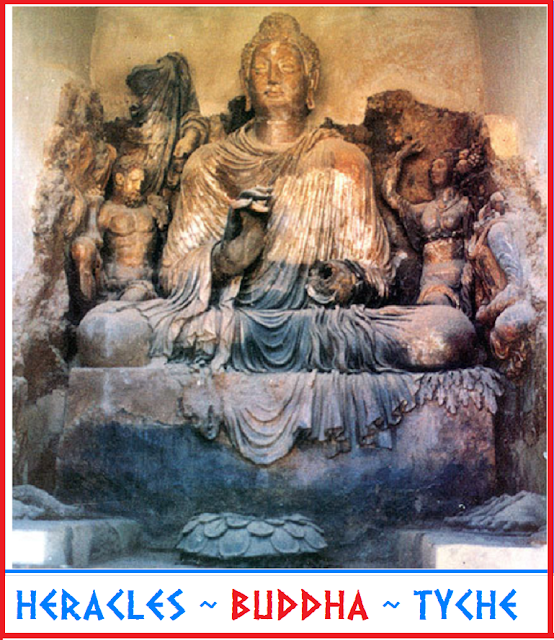
All the Buddhist sculptures of the 3rd century BCE depicted Buddha in the form of a symbol, such as a Dharma Chakra (Wheel of the Dharma), a throne, a pair of footprints or a Bo (or bodhi or papal) tree. It was only in the Hellenistic era that the Buddha was shown in a human form. . The earliest statues, in fact, may have been idealised versions of King Demetrius himself. Some historians have placed these early statues in the western tradition of representing the man-god in human form, much like the Gods of Greece.


Gandhara and Mathura Schools of Art

Both Gandhara and Mathura schools of art became well-known as centers of Buddhist sculptures. One of the main characteristics of this style of art was the anthropomorphic representation of Buddha and Bodhisattvas, especially in its sculptural manifestations. In both Gandhara and Mathura, human images of the Buddha began to appear at about the same time, but can be distinguished from one another. The Mathura images resemble Indian male fertility gods, with shorter, curlier hair and lighter, more transluscent robes. They also are not shown to be as sensual as their Gandhara counterparts.


The Gandhara school is different from the Mathura school because of the heavy influence of Hellenistic features. The figures are clearly  inspired by Greek figures, as they have similar wavy hair texture and heavily pleated, body-hugging garments. The Hellenistic ideal human form was slender with visible muscles. The ideal body type to them was one of a Greek athlete who was very fit. The heavily pleated garments on these bodies were inspired by Greek dress styles.The Buddha of the Gandhara school has wavy hair and a long nose set in an oval face. The drape of his garment recalls the togas of Hellenistic sculpture, the divine figure often acquires humanistic details such as jewellery and a moustache. Since these were among the earliest anthropomorphic images of the Buddha, the Gandhara school has been influential in how he came to be depicted.


Human representations of the Buddha were made centuries after his death. Therefore, certain attributes, such as the elongated earlobes and the ushnisha on top of his head were used to identify him when he was made in human form. The ushnisha on his head was modeled after Greek hairstyles from Hellenistic times. This concept of characteristic features was a Hellenistic tradition, as the Greeks created symbols to represent their divinities and heroes. The Nimbus or aureole indicated on the figures represent a transcendent status which was similar to solar deities. Buddha was modeled after Apollo, the Greek God of the sun. It was also through image sizes that certain characters were deemed to be more important than others.

Greek art styles  have influenced India as a whole and there is definitely abundant evidence that proves that. 

Edited from  prinseps.com and scroll.in