Wednesday, 22 May 2019

DEMETRIUS OF BACTRIA ~ THE INVINCIBLE


Demetrius I (Greek: Δημήτριος Α΄), also called Dharmamita or Damaytra, was a Greco-Bactrian/Indo-Greek (Yona in Pali language, "Yavana" in Sanskrit) king (reigned c. 200–180 BCE), who ruled areas from Bactria to ancient northwestern India. He was the son of the Greco-Bactrian ruler Euthydemus I and succeeded him around 200 BCE, after which he conquered extensive areas in what is now Afghanistan and Pakistan.

He was never defeated in battle and was posthumously qualified as the Invincible (Aniketos) on the pedigree coins of his successor Agathocles. Demetrius I may have been the initiator of the Yavana era, starting in 186–185 BCE, which was used for several centuries thereafter.
"Demetrius" was the name of at least two and probably three Greek kings of Bactria. The much debated Demetrius II was a possible relative, whereas Demetrius III (c. 100 BCE), is known only from numismatic evidence.


Demetrius I, son of Euthydemus I.
While he was still crown prince of Bactria, Demetrius conducted, on behalf of his father, negotiations with the Seleucid Antiochus III in 206-05 BCE. Antiochus considered Demetrius “worthy of kingship because of his distinction, conversational rapport, and capacity for leadership” and promised him one of his own daughters in marriage.The term used for "young prince" is neaniskos (νεανίσκος), suggesting an age around 16, which in turn gives a birth date for Demetrius around 222 BCE.


 Having succeeded to the throne of Bactria, Demetrius campaigned in India, making apparently extensive conquests (Polybius, 11.39). 

Demetrius started the invasion of northwestern India in 180 BCE, following the destruction of the Mauryan dynasty by the general Pushyamitra Shunga, who then founded the new Indian Shunga dynasty (185–78 BCE). The Mauryans had diplomatic alliances with the Greeks, and they may have been considered as allies by the Greco-Bactrians.The Greco-Bactrians may also have invaded India in order to protect Greek populations in the subcontinent.

Demetrius may have first started to recover the province of Arachosia, an area south of the Hindu Kush already inhabited by many Greeks but ruled by the Mauryas since the annexation of the territory by Chandragupta from Seleucus. In his "Parthian stations", Isidorus of Charax mentions a colony named Demetrias, supposedly founded by Demetrius himself:

"Beyond is Arachosia. And the Parthians call this White India; there are the city of Biyt and the city of Pharsana and the city of Chorochoad and the city of Demetrias; then Alexandropolis, the metropolis of Arachosia; it is Greek, and by it flows the river Arachotus. As far as this place the land is under the rule of the Parthians.
"Parthians stations", 1st century BCE

A Greek dedication inscribed on stone on an altar of Greek Goddess Hestia and discovered in Kuliab, 100 kilometers northeast of Ai-Khanoum, also mentions the victories of the prince Demetrius during the reign of his father:
"Heliodotos dedicated this fragrant altar (...) so that the greatest of all kings Euthydemus, as well as his son, the glorious, victorious and remarkable Demetrius, be preserved of all pains, with the help of the Fortune with divine thoughts". More information about the altar of Hestia in Kuliab here.


"Those who came after Alexander went to the Ganges and Pataliputra" (Strabo, XV.698)
"The Greeks who caused Bactria to revolt grew so powerful on account of the fertility of the country that they became masters, not only of Ariana, but also of India, as Apollodorus of Artemita says: and more tribes were subdued by them than by Alexander — by Menander in particular (at least if he actually crossed the Hypanis towards the east and advanced as far as the Imaüs), for some were subdued by him personally and others by Demetrius, the son of Euthydemus the king of the Bactrians." (Strabo 11.11.1[13])

It is generally considered that Demetrius ruled in Taxila (where many of his coins were found in the archaeological site of Sirkap). The Indian records also describe Greek attacks on Saketa, Panchala, Mathura and Pataliputra (Gargi-Samhita, Yuga Purana chapter). By c. 175 BCE, the Indo-Greeks ruled parts of northwestern India, while the Shungas remained in the Gangetic, Central, and Eastern India.


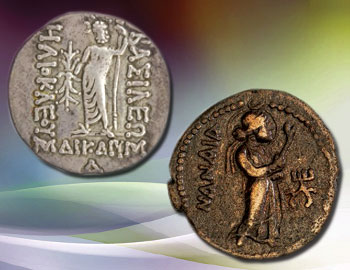
On the obverse of his silver coins, Demetrius is portrayed wearing the elephant-scalp headdress of Alexander the Great,

with the reverse type of a youthful Heracles crowning Himself with a garland. On a commemorative “pedigree coin” of the later Euthydemid king Agathocles, presumably a son of Demetrius, Demetrius bears the title Aníkētos (invincible), a title held by Alexander himself. After the appearance of the rival prince Eucratides in Bactria, at around 175 BCE, Demetrius returned from India (Justin, 41.6, where he is described as king of India) and besieged Eucratides’ small escort, with an army said to have numbered 60,000.


Honouring his title, Demetrius truly was never defeated in battle and was posthumously qualified as the Invincible (Aniketos) on the pedigree coins of his successor Agathocles.

 Demetrius I died of unknown reasons, and the date 180 BCE is merely a suggestion aimed to allow suitable regnal periods for subsequent kings, of which there were several. Even if some of them were co-regents, civil wars and temporary divisions of the empire are most likely.


SOURCES:Encyclopedia Iranica, Wikipedia

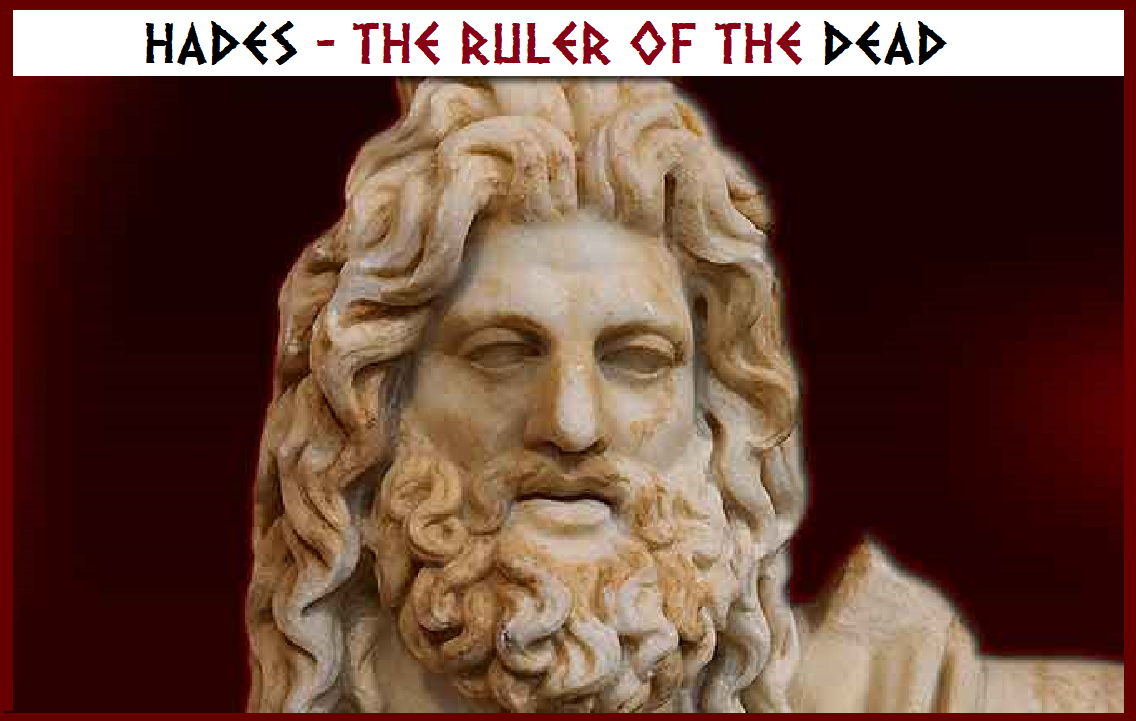
HADES ~ THE RULER OF THE DEAD


In the ancient Greek Religion, Hades ( Άδης) is the God of the dead and the king of the Underworld, with which his name became synonymous. Hades is the eldest son of Cronus and Rhea, although the last son regurgitated by His father. He and his brothers, Zeus and Poseidon, defeated their father's generation of Gods, the Titans, and claimed rulership over the cosmos. Hades received the Underworld, Zeus the sky, and Poseidon the sea, with the solid earth, long-time the province of Gaia, available to all three concurrently. Hades is often portrayed with His three-headed guard dog Cerberus.

Perhaps from fear of pronouncing his name, around the 5th century BCΕ, the Greeks started referring to Hades as Plouton, with a root meaning "wealthy", considering that riches come from the soil below (e.g., fertile crops, metals and so on).

Hades is the first-born son of the Titans Cronos and Rhea. His three older sisters, Hestia, Demeter, and Hera, as well as a younger brother, Poseidon, had been swallowed whole by their father as soon as they were born. Zeus was the youngest child and through the machinations of their mother, Rhea, He was the only one that had escaped this fate. Upon reaching adulthood, Zeus managed to force His father to disgorge His siblings. After their release, the six younger Gods, along with allies they managed to gather, challenged the elder Gods for power in the Titanomachy, a Divine War. The war lasted for ten years and ended with the victory of the younger Gods. Following their victory, Hades and his two brothers, Poseidon and Zeus, drew lots in order to share the different among them. Zeus received the sky, Poseidon received the seas, and Hades received the Underworld; the unseen realm, to which the souls of the dead go upon leaving the world. The Underworld includes all things beneath the earth. Some stories suggest that Hades was dissatisfied with his turnout, but He had no choice and moved to His new Kingdom.

Despite modern connotations of death as evil, Hades is actually more altruistically inclined in Greek Religion. He is often portrayed as passive rather than evil; His role is often to maintain relative balance. That said, He is also depicted as cold and stern, and He holds all of his subjects equally accountable to His laws. Any other individual aspects of his personality are not given, as Greeks refrained from giving Him much thought in order to avoid attracting His attention.

Hades rules the dead, assisted by others over whom He has complete authority. The House of Hades is described as full of "guests," though He rarely leaves the Underworld. He cares little about what happens in the world above, as His primary attention is ensuring none of His subjects ever leaves.
He strictly forbids his subjects to leave his domain and can become quite enraged when anyone tries to do so , or if someone tries to steal the souls from His realm. His wrath is equally terrible for anyone who tries to cheat death or otherwise cross Him.Hades is depicted outside of the Underworld only once, and even that is believed to have been an instance where He had just left the gates of the Underworld, which was when Heracles shot him with an arrow, as Hades was attempting to defend the city of Pylos. After He was wounded, he traveled to Mount Olympus to heal. Besides Heracles, the only other living people who ventured to the Underworld were also heroes: Odysseus, Aeneas (accompanied by the Sibyl), Theseus with Pirithus, and Orpheus. Hades showed unusual mercy towards Orpheus; Persephone had been deeply moved by Orpheus' music and persuaded Hades to let Euridice to her husband, on specific terms. None of those living visitors were were pleased with what they witnessed in the Realm of the Dead. 

Hades obtained his wife and queen, Persephone, through abduction at the behest of Zeus. This story is the most important one Hades takes part in; it also connected the Eleusinian Mysteries with the Olympian pantheon, particularly as represented in the Homeric Hymn to Demeter, which is the oldest story of the abduction.

Epithets of Hades include Agesander (Αγήσανδρος) and Agesilaos (Αγεσίλαος), describing Hades as the God who carries away all. 


He is also referred to as Zeus katachthonios (Ζευς καταχθόνιος), meaning "the Zeus of the Underworld", by those avoiding his actual name, as he had complete control over the Underworld.

There are several sections of the realm of Hades, including Elysium, the Asphodel Meadows, and Tartarus. This otherwise dark and gloomy place also includes a bit of beauty-  the Garden of the Hesperides, often identified with the Isles of the Blessed, where the blessed heroes may dwell.

Sunday, 19 May 2019

APOLLO ~ THE GREEK GOD OF LIGHT


Apollo ( Greek: Aπόλλων) is one of the most important and complex  the Olympian deities in classical Greek and Roman religion. The national divinity of the Greeks, Apollo has been variously recognized as a God of archery, music and dance, truth and prophecy, healing and diseases, the sun and light, poetry, and more. Apollo is the son of Zeus and Leto, and has a twin sister, the chaste huntress Artemis. Seen as the most beautiful God and the ideal of the kouros (a beardless, athletic youth), Apollo is considered to be the most Greek of all Gods. 

Apollo is the son of Zeus and Leto, his previous wife, or one of his mistresses. After his birth, Apollo was nursed by the nymphs Korythalia and Aletheia, the personification of truth.

When Zeus' wife Hera discovered that Leto was impregnanted by Zeus, she banned Leto from giving birth on terra firma. In her wanderings, Leto sought shelter on many lands, only to be rejected by them. Finally, she saw Delos, a floating island, which was neither a real island nor a mainland. It is said that Apollo, still in Leto's womb, had informed his mother about Delos to put an end to her suffering. Leto, when welcomed by Delos, gave birth there, clinging to a palm tree.

It is also stated that Hera kidnapped Eileithyia, the Goddess of childbirth, to prevent Leto from going into labor. Goddess Iris managed to get Eileithyia to Delos, sneaking Her out of Olympus.


Apollo's birth fixed the floating Delos to the earth. This island later became sacred to Apollo. Mythographers agree that Artemis was born first and subsequently assisted with the birth of Apollo, or that Artemis was born on the island of Ortygia and that she helped Leto cross the sea to Delos the next day to give birth to Apollo.

As a child, Apollo is said to have built a foundation and an altar on Delos using the horns of the goats that his sister Artemis hunted. Since he learnt the art of building when young, he later became Archegetes, the founder of towns and god who guided men to build new cities.


In his young years when Apollo spent his time herding cows, he was reared by Thriae, the bee nymphs, who trained him and enhanced his prophetic skills. Apollo is also said to have invented the lyre, and along with Artemis, the art of archery. He then taught to the humans the art of healing and archery. Phoebe, his grandmother, gave the oracular shrine of Delphi to Apollo as a birthday gift. Themis inspired him to be the oracular voice of Delphi thereon.


Python, a chthonic serpent-dragon, was a child of Gaea and the guardian of the Delphic Oracle.
Python was sent by Hera to hunt the pregnant Leto to death, and had assaulted Leto. To avenge the trouble given to his mother, the young Apollo, with his bow and arrows that he had received from Hephaestus, went in search of Python and killed it in the sacred cave at Delphi with his arrows. In most of the traditions, Apollo was still a child when he killed Python.

 As Zeus' favorite son, Apollo has direct access to the mind of Zeus and is willing to reveal this knowledge to humans. A divinity beyond human comprehension, he appears both as beneficial and  wrathful.
As the patron of Delphi (Pythian Apollo), Apollo is an oracular God—the prophetic deity of the Delphic Oracle.

Medicine and healing are associated with Him, whether through the God himself or mediated through his son Asclepius. Yet, Apollo is also a God who could bring ill-health and deadly plague with his arrows.

As the God of Music (art of Muses) , Apollo presides over all music, songs, dance and poetry. He is the inventor of string-music, and the frequent companion of the Muses, functioning as their chorus leader in celebrations.
As the protector of young, Apollo is concerned with the health and education of children. He presides over their passage into adulthood.
Apollo is an important pastoral deity. He is the patron of herdsmen and shepherds. Protection of herds, flocks and crops from diseases and pests are his primary duties.
Apollo encourages founding new towns and establishment of civil constitution, and is associated with dominion over colonists. He is also the giver of laws, and his oracles were consulted before setting laws in a city.


In literary contexts, Apollo represents harmony, order, and reason—characteristics contrasted with those of Dionysos, God of wine, who represents ecstasy and disorder.  However, the Greeks thought of the two qualities as complementary: the two Gods are brothers, and when Apollo travels to Hyperborea in winter, he leaves the Delphic oracle to Dionysos. 

Apollo is the God who affords help and wards off evil. He delivers men from the epidemics. As the patron of seafarers, he is also the God of foreigners, the protector of fugitives and refugees.

In Hellenistic times, especially during the 5th century BCE, as Apollo Helios he became identified among Greeks with Helios, Titan God of the sun.

Apollo's chief epithet is Phoebus ( Φοίβος), literally "bright". It was very commonly used by both the Greeks and Romans for Apollo's role as the god of light. Like other Greek deities, he has a number of others applied to him, reflecting the variety of roles, duties, and aspects ascribed to the god. 

Helius, literally "Sun".

Lyceus, "light". The meaning of the epithet "Lyceus" later became associated with Apollo's mother Leto, who was the patron goddess of Lycia (Λυκία) and who was identified with the wolf (λύκος).

Didymaeus , "twin", as Artemis' twin.
Pythius , from the region around Delphi.
Acesius,  "healing".
Iatrus, literally "physician".
Alexicacus, literally "warding off evil".
Loxias, "ambiguous".
Hecebolus, "far-shooting".

Apollo's most common attributes are the bow and arrow. Other attributes of his include the kithara, an advanced version of the common lyre. Another common emblem is the sacrificial tripod, representing his prophetic powers.


The palm tree is also sacred to Apollo because he had been born under one in Delos. Animals sacred to Apollo include wolves, dolphins, roe deer, swans, cicadas -symbolizing music and song-, hawks, ravens, crows, snakes -referencing Apollo's function as the god of prophecy- mice and griffins.


SOURCE: Wikipedia

Saturday, 18 May 2019

GAITANAKI DANCE ~ GREECE ~TIBET~ KOREA


The Greek Carnival has its roots in ancient Greece. It is connected with the worship of Dionysos, God of wine and fun. It was meant to worship Him, as well as to help the earth put forth shoots-hence the various leaping dances and the various kinds of disguise in order to banish harmful spirits and summon the fertility of Nature.

Gaitanaki is a traditional Carnival dance. One of the dancers holds a pole from which 12 ribbons start . The dancers hold the colorful ribbons and dance around the pole. The dance symbolizes the 12 Major Greek  Gods.

Friday, 17 May 2019

ANCIENT GREEK CITIES IN MESOPOTAMIA


 Mesopotamia is a historical region of Western Asia situated within the Tigris–Euphrates river system, in the northern part of the Fertile Crescent, in modern days roughly corresponding to most of Iraq, Kuwait, the eastern parts of Syria, Southeastern Turkey, and regions along the Turkish–Syrian and Iran–Iraq borders.

The Sumerians and Akkadians (including Assyrians and Babylonians) dominated Mesopotamia from the beginning of written history (c. 3100 BCE) to the fall of Babylon in 539 BCE, when it was conquered by the Achaemenid Empire. It fell to Alexander the Great in 332 BCE, and after his death, it became part of the Greek Seleucid Empire.

The regional toponym Mesopotamia  comes from the ancient Greek root words μέσος (meso) "middle" and ποταμός (potamos) "river" and translates to "(Land) between two/the rivers". It is used throughout the Greek Septuagint (c. 250 BCE) to translate the Hebrew and Aramaic equivalent Naharaim. An even earlier Greek usage of the name Mesopotamia is evident from The Anabasis of Alexander, which was written in the late 2nd century CE, but specifically refers to sources from the time of Alexander the Great. In the Anabasis, Mesopotamia was used to designate the land east of the Euphrates in north Syria.
The map above shows cities in Mesopotamia,  based on Ptolemy's coordinates.

SOURCE: Wikipedia
Thursday, 16 May 2019

INDO~GREEK KINGDOM


Indo-Greek Kingdom or Greco-Indian Kingdom was ruled by more than 30 Hellenistic kings at the various parts of the northwest and northern Indian subcontinent during a period from the 2nd century BCE to the beginning of the 1st century CE. They were often in conflict with each other.

The Greco-Bactrian king Demetrius invaded India early in the second century BCE; and formed the kingdom, in this context at the boundary of India. There were numerous cities, such as Taxila, Pakistan's Punjab, or Pushkalavati, Sagala and a number of dynasties in their times based on Ptolemy's Geography and the nomenclature of later kings.
The Indo- Greeks remained in India for two centuries (up to the 1st century CE) and later paving the way for the Shakas (Scythians), Pahlavas (Parthians) and the Kushanas (Yuezhi).

Demetrius, son of the Greco-Bactrian king Euthydemus I, led his troops across the Hindu Kush around 200 BCE when the invasion of northern India, and the establishment of "Indo-Greek kingdom" started. Apollodotus, may have made advances in the south, while Menander, led later invasions further east.

The Bactrian king Euthydemus and his son Demetrius crossed the Hindu Kush and began the conquest of Northern Afghanistan and the Indus valley. They wielded great power: a great Greek empire seemed to have arisen far in the East. But this empire was fallen off by internal argument and continual usurpations. When Demetrius advanced far into India, one of his generals, Eucratides, made himself king of Bactria, and soon in every province there arose new usurpers, who proclaimed themselves kings and fought one against the other. 
Most of them were from Afghanistan, Pakistan and India and known only by their coins. By these wars, the dominant position of the Greeks was weakened even more quickly than would otherwise have been the case. After Demetrius and Eucratides, the kings abandoned the Attic standard of coinage and introduced a native standard, no doubt to gain support from outside the Greek minority.

In India, Milinda/ Menander I the Indo-Greek king, converted to Buddhism. His successors managed to cling to power until the last known Indo-Greek ruler, a king named Strato II, who ruled in the Punjab region until around 55 BCE. However, other sources place the end of Strato II's reign as late as 10 CE.

Written evidence of the initial Greek invasion survives in the Greek writings of Strabo and Justin and in Sanskrit in the records of Patanjali, Kālidāsa, and in the Yuga Purana, among others. Coins and architectural evidence also attest to the extent of the initial Greek campaign.


They ruled for two centuries, combined the Greek and Indian languages and symbols which can be seen on their coins, and blended ancient Greek, Hindu and Buddhist religious practices, as seen in the archaeological remains of their cities.

The Indo-Greeks ultimately disappeared as a political entity around 10 CE following the invasions of the Indo-Scythians, although pockets of Greek populations probably remained for several centuries longer under the subsequent rule of the Indo-Parthians and Kushans.


Literature
Various Indian records describe Yavana attacks on Mathura, Panchala, Saketa, and Pataliputra. The term Yavana is thought to be a transliteration of "Ionians" and is known to have designated Hellenistic Greeks (starting with the Edicts of Ashoka, where Ashoka writes about "the Yavana king Antiochus"), but may have sometimes referred to other foreigners as well after the 1st century CE.

Patanjali, a grammarian and commentator on Panini around 150 BCE, describes in the Mahābhāsya, the invasion in two examples using the imperfect tense of Sanskrit, denoting a recent event: "Arunad Yavanah Sāketam" and "Arunad Yavano Madhyamikām".
Also the Brahmanical text of the Yuga Purana, which describes Indian historical events in the form of a prophecy, but is thought to be likely historical, relates the attack of the Indo-Greeks on the capital Pataliputra, a magnificent fortified city with 570 towers and 64 gates according to Megasthenes, and describes the ultimate destruction of the city's walls.
After the Greco-Bactrians militarily occupied parts of northern India from around 180 BCE, numerous instances of interaction between Greeks and Buddhism are recorded. 

Religion
Besides the worship of the Classical pantheon of the Greek deities found on the coins (Zeus, Herakles, Athena, Apollo), the Indo-Greeks were involved with local faiths, particularly with Buddhism, but also with Hinduism and Zoroastrianism.
Menander I, converted to Buddhism, and is described as a great benefactor of the religion, on a par with Ashoka or the future Kushan emperor Kanishka. The wheel he represented on some of his coins was probably Buddhist, and he is famous for his dialogues with the Buddhist monk Nagasena, transmitted to us in the Milinda Panha, which explain that he became a Buddhist arhat
Another Indian text, the Stupavadana of Ksemendra, mentions in the form of a prophecy that Menander will build a stupa in Pataliputra. Plutarch also presents Menander as an example of benevolent rule, and explains that upon his death, the honour of sharing his remains was claimed by the various cities under his rule, and they were enshrined in "monuments" (μνημεία, probably stupas), in a parallel with the historic Buddha.


Art

In general, the art of the Indo-Greeks is poorly documented, and few works of art (apart from their coins and a few stone palettes) are directly attributed to them. The coinage of the Indo-Greeks however, is generally considered as some of the most artistically brilliant of Antiquity. The Hellenistic heritage (Ai-Khanoum) and artistic proficiency of the Indo-Greek world would suggest a rich sculptural tradition as well, but traditionally very few sculptural remains have been attributed to them. On the contrary, most Gandharan Hellenistic works of art are usually attributed to the direct successors of the Indo-Greeks in India in 1st century CE, such as the nomadic Indo-Scythians, the Indo-Parthians and, in an already decadent state, the Kushans. In general, Gandharan sculpture cannot be dated exactly, leaving the exact chronology open to interpretation.

The possibility of a direct connection between the Indo-Greeks and Greco-Buddhist art has been reaffirmed recently as the dating of the rule of Indo-Greek kings has been extended to the first decades of the 1st century CE, with the reign of Strato II in the Punjab. Also, Foucher, Tarn, and more recently, Boardman, Bussagli and McEvilley have taken the view that some of the most purely Hellenistic works of northwestern India and Afghanistan, may actually be wrongly attributed to later centuries, and instead belong to a period one or two centuries earlier, to the time of the Indo-Greeks in the 2nd-1st century BCE.

This also seems to be corroborated by Ranajit Pal's suggestion that the Indo-Greek king Diodotus I was the great Ashoka.


Afghanistan, an area which "might indeed be the cradle of incipient Buddhist sculpture in Indo-Greek style" 
Referring to one of the Buddha triads in Hadda, in which the Buddha is sided by very Classical depictions of Herakles/Vajrapani and Tyche/Hariti, Boardman explains that both figures "might at first (and even second) glance, pass as, say, from Asia Minor or Syria of the first or second century BCE (...) these are essentially Greek figures, executed by artists fully conversant with far more than the externals of the Classical style".


Alternatively, it has been suggested that these works of art may have been executed by itinerant Greek artists during the time of maritime contacts with the West from the 1st to the 3rd century CE.

The Greco-Buddhist art of Gandhara, beyond the omnipresence of Greek style and stylistic elements which might be simply considered as an enduring artistic tradition, offers numerous depictions of people in Greek Classical realistic style, attitudes and fashion (clothes such as the chiton and the himation, similar in form and style to the 2nd century BCE Greco-Bactrian statues of Ai-Khanoum, hairstyle), holding contraptions which are characteristic of Greek culture (amphoras, "kantaros" Greek drinking cups), in situations which can range from festive (such as Bacchanalian scenes) to Buddhist-devotional.


Uncertainties in dating make it unclear whether these works of art actually depict Greeks of the period of Indo-Greek rule up to the 1st century BCE, or remaining Greek communities under the rule of the Indo-Parthians or Kushans in the 1st and 2nd century CE. Benjamin Rowland thinks that the Indo-Greeks, rather than the Indo-Scythians or the Kushans, may have been the models for the Bodhisattva statues of Gandhara.

Σχετική εικόνα Î‘ποτέλεσμα εικόνας για INDO GREEK SOLDIER WARRIOR
Economy
Very little is known about the economy of the Indo-Greeks, although it seems to have been rather vibrant. The abundance of their coins would tend to suggest large mining operations, particularly in the mountainous area of the Hindu-Kush, and an important monetary economy. The Indo-Greek did strike bilingual coins both in the Greek "round" standard and in the Indian "square" standard, suggesting that monetary circulation extended to all parts of society. The adoption of Indo-Greek monetary conventions by neighbouring kingdoms, such as the Kunindas to the east and the Satavahanas to the south, would also suggest that Indo-Greek coins were used extensively for cross-border trade.


Trade with China 

An indirect testimony by the Chinese explorer Zhang Qian, who visited Bactria around 128 BCE, suggests that intense trade with Southern China was going through northern India. Zhang Qian explains that he found Chinese products in the Bactrian markets, and that they were transiting through northwestern India, which he incidentally describes as a civilization similar to that of Bactria.


Indian Ocean trade

Maritime relations across the Indian ocean started in the 3rd century BCE, and further developed during the time of the Indo-Greeks together with their territorial expansion along the western coast of India. By the time Indo-Greek rule was ending, up to 120 ships were setting sail every year from Myos Hormos to India.


Armed forces

The coins of the Indo-Greeks provide rich clues on their uniforms and weapons. Typical Hellenistic uniforms are depicted, with helmets being either round in the Greco-Bactrian style, or the flat kausia of the Macedonians (coins of Apollodotus I).
Military technology

Their weapons were spears, swords, longbow (on the coins of Agathokleia) and arrows. The recurve bow becomes a standard feature of Indo-Greek horsemen by 90 BCE, as seen on some of the coins of Hermaeus.


Generally, Indo-Greek kings are often represented riding horses, as early as the reign of Antimachus II around 160 BCE. The equestrian tradition probably goes back to the Greco-Bactrians, who are said by Polybius to have faced a Seleucid invasion in 210 BCE with 10,000 horsemen. War elephants were never represented on their coins.

Source ~History of India

Wednesday, 15 May 2019

GREEK DEITIES ON KUSHAN COINS


The name Kushan derives from the Chinese term Guishang, used in historical accounts to describe one branch of the Yuezhi tribe. Kujula Kadphises (30-80 CE) established the Kushan dynasty in 78 CE by taking advantage of the lack of unity between the existing dynasty of Pahalava (Parthian) and Scytho-Parthians. Gradually, Kujula Kadphises created his kingdom in the southern affluent region, which was the north-western part of ancient India, traditionally known as Gandhara (now in Afghanistan).

Αποτέλεσμα εικόνας για KUSHAN ART GREEK GODS

The Kushans gradually became one of the prosperous Empires of India and ruled over a vast territory in the northwest of India from 30 CE to 375 CE. The dynasty reached its zenith during the reign of the great king Kanishka I. Under Kanishka’s rule, Kushans controlled a large area, ranging from the Aral Sea through lands that include present-day Uzbekistan, Afghanistan, and Pakistan into northern India as far east as Benares and as far south as Sanchi.

The foundation of the Kushan Empire in Bactria and India was the result of a long series of ethnic migrations, a fact evident in their coinage. It was also an era of great wealth, marked by extensive trade activities and a flourishing of urban life, Buddhist thought, and  visual arts. The Kushans are also credited to have struck the first ever Indian Gold coins.
Different groups of people believed in different Gods and had shaped their own views . Every religion had assigned specific roles to the Gods that formed its pantheon. The kings of that era had a large number of gods mentioned in their inscriptions, and represented through their art. Yet, the most significant place where these gods were represented were the coins. 

Αποτέλεσμα εικόνας για KANISHA COINS

These Gods and Goddesses on the coins are an essential piece of  evidence about the religious beliefs of those kings, and the changes in the patterns of the deities appearing on the coins also give an insight into the acceptance and merging of different religions, as well as into the attempt of the kings to blend in with the locals of their newly conquered lands.
A total of 34 gods and goddesses appear on the coins of the entire Kushan Empire. This divine diversity on the Kushan coins is a testimony of the wide cultural connections of this dynasty. One can find coins depicting the gods and goddesses from the Mesopotamian, Zoroastrian, Greek,  and Indian pantheons.
Out of the many Gods and Goddesses, few have very mysterious origins and their worship seems to have been long forgotten.
Many of the deities appearing on the earlier coins are adopted from the Greek or the Hellenistic Religion and culture.

The   Greek deities on Kushan coins,  are the following:


Zeus

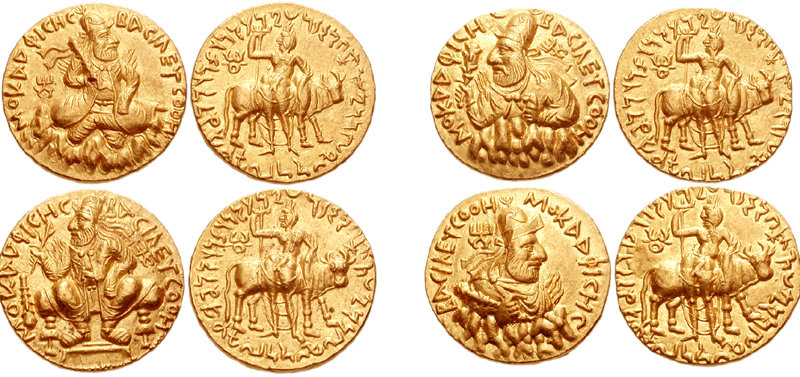
Zeus is found on the coins of the early Da Yuezhi coins and on the coins of Kujula Kadphises and Vima Takto (Soter Megas).
The chief of the Gods is the sky and thunder God in ancient Greek Religion. He is attributed holding a thunderbolt and a sceptre (adoption of an Ancient Near East iconographic attribute). As the King of Gods and humankind, Zeus is generally depicted as seated on a throne in the coins of Kujula Kadphises.

HeraclesΑποτέλεσμα εικόνας για KUSHAN ART GREEK COINS NIKE
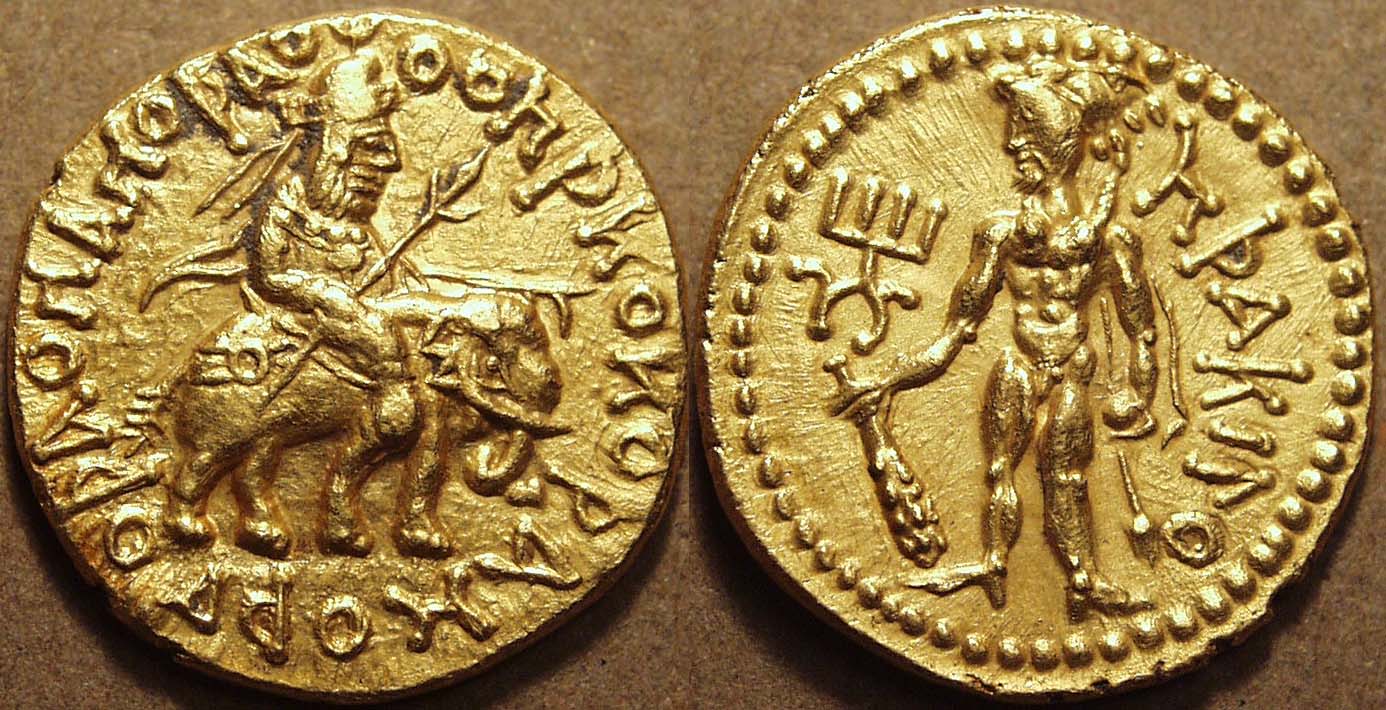
The Greek God Heracles is found extensively on the coins of the early Da Yuezhi coins and on the coins of Kujula Kadphises and Huvishka.

Αποτέλεσμα εικόνας για KUSHAN COINS GREEK DEITIES

Heracles is known for his masculinity and heroic Labours, and he is considered as the champion of the Olympian order. He generally represents the transition from mortality to immortality. He is shown with a club and lion skin.He is also identified with the Iranian god of victory and protector of royalty, ‘Verethragna’, the giver of victory.


Nike
Nike is the winged Goddess of speed, strength and victory, and She appears on the coins of Kujula Kadphises.Nike is the Divine charioteer and is often accompanies Athena and Zeus in the Greek Religion.On the Kushan coins, Nike is mostly shown flying behind the king’s head with a diadem held in Her right hand.


Helios

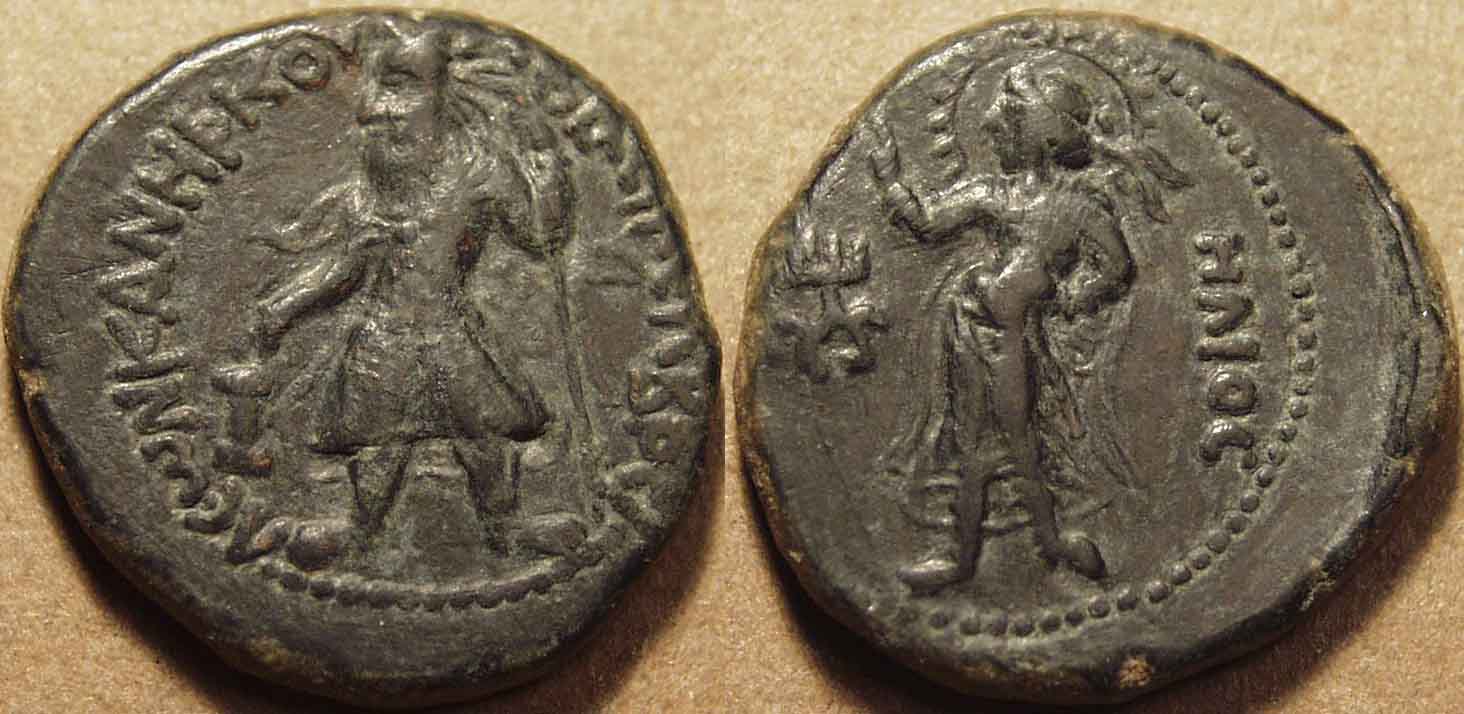
Helios is the Greek Sun God  and He appears on the coins of Kanishka I.Helios is closely associated  and identified with Apollo, the Greek God of music and light.Helios was also linked with Parthian ‘Mithra’.

Selene

Selene is the Greek  Goddess of the moon. She is depicted on the coins of Kanishka I and Huvishka.

She is linked with ‘Mah’ (Mao), the Zoroastrian lunar god.
Selene is also identified with Artemis and Hecate. All three are  regarded as lunar Goddesses, with Selene being the personification of the moon itself.

Dioscuri
The Dioscuri, Castor and Polydeukes, are worshiped by the Greeks and Romans (5th century BC onwards) alike. They can be recognized by the skull-cap they wear and they can be seen in the early Da Yuezhi coinage of the Kushan dynasty. Both Dioscuri are excellent horsemen and hunters. Castor and Polydeukes are the twins of the Gemini constellation and are regarded as the patrons of the sailors.


Sarapo:


Αποτέλεσμα εικόνας για KUSHAN ART GREEK COINS HELIOSSerapis, Sarapis and Sarapo is a Greco-Egyptian god whose cult can be traced back to 3rd century BCE on the orders of Ptolemy I of Egypt. The cult of Serapis was introduced by Ptolemy I in hope of unifying the Greeks and Egyptians in his realm. Serapis derived from the worship of the Egyptian Osiris and Apis (Osiris + Apis = Oserapis/Sarapis). The cult continued to spread even during the Roman times and with some cultural migrations slipped into the Kushan pantheon as well.

Tuesday, 14 May 2019

MEGASTHENES THE FATHER OF INDIAN HISTORY ~ INDICA BOOK PDF


Megasthenes (Μεγασθένης, ca. 350 – 290 BCE) was the first foreign Ambassador to India and recorded his ethnographic observations in a volume known as INDIKA. For his pioneering work, he is regarded as the Father of Indian History.

The term “Indika” (Greek Ινδικά) was used in ancient Greece to mean various India-related things, including the historical and ethnographic accounts of Ctesias, Megasthenes, Arrian and others.
Greek Ambassador Megasthenes presents credentials to Chandragupta Maurya, who seats with Helena, the daughter of Seleucus Nikator, and the philosopher and royal advisor Chanakya in his court in Pataliputra (modern-day Patna)

The Indo-Hellenic Society for Culture and Development following the ancient tradition has chosen this title for its online forums that aim to the advancement of the Indian and Indo-Greek Studies in the Hellenic world.

Download Megasthenes’ Indika in  English HERE

Sunday, 12 May 2019

ANCIENT GREEK CITIES IN INDIA


The God Dionysos was the first to campaign to India 6451 years before alexander 154 king before androcotos ( also known as Chandragupta).

The Greeks did three major campaigns in India-Heracles followed Dionysos and Alexander the Great was the last one. The successors of Alexander the Great continued the conquests in India, with the various Kingdoms which they created there.