Showing posts with label TEMPLES. Show all posts

Friday, 2 April 2021

JANDIAL ~ AN ANCIENT GREEK TEMPLE IN PAKISTAN


Jandial is located near the city of Taxila in Pakistan, and it is the site of an ancient temple, well known for its Ionic columns. The temple is located 630 meters north of the northern gate of Sirkap and it was excavated in 1912–1913 by the Archaeological Survey of India under John Marshall. It has been called the most Hellenic structure yet found on Pakistani soil.


Temple structure

The Temple is considered as a semi-Classical temple. Its design is essentially that of a Greek Temple, with a naos, pronaos and an opisthodomos at the back. Two Ionic columns at the front are framed by two anta walls as in a Greek distyle in antis layout. It seems that the temple had an outside wall with windows or doorways, in a layout similar to that of a Greek encircling row of columns (peripteral design). The dimensions of the Temple were around 45 x 30 meters.


However, inside the Temple, between the naos and the opisthodomos, there is a heavy wall with stairs, which has led some authors to consider that it was designed to support a ziggurat as in a Zoroastrian or Magian temple.


Besides the Pataliputra capital (3rd century BCE), the Ionic style is a rare occurrence in the Indian subcontinent, and it almost disappeared afterwards, apart from a pillar in Ahin Posh, which seems to be more Parthian than truly Hellenistic. It seems to have disappeared with the weakening of direct Greek presence in India, to be exclusively replaced by the numerous instances of Corinthian art that can be found in the Indo-Corinthian capitals of Gandhara.


The Ionic capitals of the Jandial temple seem to be a rather provincial and dry version of the Ionic Temple of Artemis in Ephesus. However, the design of the bases is quite pure, as are the wall moldings. Also the drums are finely joined with dowels. All this suggests work which was done under Greek supervision, or maybe by Greeks directly.


Dating

The Temple may have been built in the 2nd century BCE under the Greeks in India (Indo-Greeks). The exact alignment of the Temple with Sirkap leads some authors to think that it may have been built during the main occupation period of the Greek city, and that it may have been the work of an architect from Asia Minor, or from Greece or an architect trained in Greek techniques.


Alternatively, it may have been built under the Indo-Parthians in the 1st century BCE in order to practice the Zoroastrian faith, possibly right after their invasion of Hellenistic lands, using Greek manpower and expertise. Alternatively, it may be the construction of a Greek devotee of Zoroastriasm, at it is known that in India the Greeks practised alternative religions, as examplified by the dedication to Garuda made by a Greek envoy on the Heliodorus pillar in Besnagar.


The Jandial Temple may have been the one visited by Apollonius of Tyana during his visit of the subcontinent in the 1st century CE.


"Taxila, they tell us, is about as big as Nineveh, and was fortified fairly well after the manner of Greek cities; and here was the royal residence of the personage who then ruled the empire of Porus. And they saw a Temple, in front of the wall, which was not far short of 100 feet in size, made of stone covered with stucco, and there was constructed within it a shrine, somewhat small as compared with the great size of the Temple which is surrounded with columns, but deserving of notice. For bronze tablets were nailed into each of its walls on which were engraved the exploits of Porus and Alexander."


— "Life of Appolonius of Tyana", Philostratus 2.16-20


Jandial D

On another mound (Mound D),a little to the west of Jandial, foundations of another temple (Jandial D) which may have been built in the 2nd century BCE under the Greeks as well, were excavated in 1863-64.The temple which has a plan very similar to Jandial had a large front porch measuring 58 feet. Between Jandial and Jandial D ran most probably the ancient high-road to Gandhara.


Edited from: Wikipedia 

Friday, 8 November 2019

THE WORSHIP OF APOLLO, ARTEMIS AND LETO IN LYCIA


In Lycia, Leto, Apollo and Artemis were worshiped above all other Gods. The most important religious sanctuary in Lycia was located in the Xanthos valley.It was dedicated to Leto and was named Letoon after Her. In later times, Leto's twin children, Apollo and Artemis were given equal importance at the sanctuary. Letoon's history may go back to the 7th century B.C.E. Three temples stand here, dedicated to Leto and Her twins, the national Gods of Lycia, as well as a Nymphaeum, a theatre, and a more recent Byzantine church. National festivals were held here and the sanctuary’s priests held the highest status in the Lycian Union. There were other Lycian shrines to Leto in Calinda and Psychus (northwest Lycia) but neither of them were as famous or significant as that of Letoon, which was well-known in the ancient world.


The Cult of Leto was mostly concentrated along the western regions of Anatolia’s southern shore.  In Lycia, She was worshiped as a national and domestic Goddess, as well as a Guardian of the Tombs.

According to Greek Religion, Leto was loved by Zeus and persecuted by His wife, Goddess Hera. Fleeing from Hera's wrath, Leto fled to Delos where She gave birth to Her twins. In one story, Leto is harrassed by some Lycian shepherds at a spring as they try to drive Her away from the water. She punishes them by turning them into frogs.  In another story, the persecuted Leto is aided by wolves, who guide Her to the river Xanthos, where She quenches Her thirst and washes Her children. In memory of this occasion, Leto changes the name of the country from Termilis to Lycia; "lykos" is  the Greek world for "wolf". This story of Leto and the wolves existed for a long time in western Anatolia - coins depicting the fleeing Leto with Her children were minted even under the Roman rule.  The cult of the Goddess also existed in Halicarnaussus, Cnidus, Phrygia, Caria and Cilicia.


In the Iliad, Homer mentions Apollo as 'the famous Lycian archer.' Apollo along with his sister, Artemis, aided the Trojans. The name 'Lycia' may have also meant 'illuminated nation' in ancient times, as its God Apollo is the God of Light.

The importance of Leto and Her children in Lycia can also be seen at the capital city of Xanthos, where the northern door to the city bears the inscription "The Great King Antiochus dedicates the city to Leto, Apollo and Artemis".

Telmessos, an important Lycian city (present-day Fethiye), was famous for its soothsayers, who were dedicated to Apollo and were said to have greatly influenced  the course of history.

The existence of a temple of Apollo at the Lycian site of Patara is indicated by the discovery of a large bust of Apollo.  Many temples have been found at Patara, but the exact location of the Apollo temple is unknown. Archaeologists have found the remains of a temple under a basilica, but since it has been largely destroyed, they are not sure about whether this was the temple of Apollo.

Patara’s oracle at this renowned but undiscovered temple of Apollo was said to rival that of Delphi and the temple equaled the reputation of the famous temple on the island of Delos.

We can see another Apollo temple at the small Lycian settlement of Sura, a dependency of Myra.  The temple's location is known, erected directly on the harbor of Sura but today stands upon marshy ground.  It was known for its strange oracle ceremonies, which involved live fish. Inside the temple, there are inscriptions which record devotions paid by devotees not to Apollo Surius, but to Sozon- the Anatolian horse-man god and Zeus Atabyrius, the Rhodian deity. At the southwest corner of Sura's acropolis, there is a row of rock-cut stelae with lists of priests attached to the cult of Apollo Surius.

  Pliny tells us:
"At Myra in Lycia, at the fountain of Apollo whom they call Surius, the fish, summoned three times on a pipe, come to give their augury.  If they tear the pieces of meat thrown to them, this is good for the client, if they wave it away with their tails, it is bad."

Atheanaios describes the fish oracle ceremony in detail:
"I don't want to ignore the people of Lycia who know the art of the fish oracle.  Of them, Polycharmus writes in the second book of his Lycian history. '...when they come to the sea, where is the grove of Apollo by the shore, on which is the whirlpool in the sand, the clients present themselves holding two wooden spits, on each of which are ten pieces of roast meat.  The priest takes his seat in silence by the grove, while the client throws the spits into the whirlpool and watches what happens.  After the spits are thrown, the pool fills with seawater, and a multitude of fish appear as if by magic, and of a size to cause alarm. The prophet announces the species of the fish and the client accordingly receives his answer from the priest.  Among the fish there appear sea bass and bluefish and sometimes whales and sawfish and many strange and unknown kinds."

Plutarch and Artemidorus also give us similar offer similar descriptions of the ceremonies at the Apollo Surius temple.
Apollo's sister, Goddess Artemis, had a cult center in the important Lycian city of Myra. Myra's main cult was dedicated to Artemis Eleuthera. Her temple in Myra was truly magnificent, but it was severely damaged by earthquake,in 141 CE.  An inscription on the heroon of the Lycian leader Opramoas, indicates that he gave the necessary money for the reconstruction of the temple, which was celebrated as Lycia's largest and most spendid building. It occupied large grounds with beautiful gardens and had an inner court defined by columns, an altar and a statue of the Goddess.

Goddess Artemis was also worshipped (among other places) at Arycanda, in the forms of Artemis Kombike, Lagbene, Tharsenike and Eleuthera.


 Nicholaos, the christian bishop of Myra, took strong measures against paganism. The temple of Artemis was among many other temples in the region that were savagely destroyed during his administration. 

SOURCE:lycianturkey.com

Saturday, 12 October 2019

THE ANCIENT GREEK TEMPLES OF LETO, ARTEMIS AND APOLLO IN LETOON ASIA MINOR


The ancient site of Letoon ( Greek: Λητώον ) lies 4 km south of Xanthos and was the leading Lycian religious center. The principal Gods of ancient Lycia were Leto and her twin children, Artemis and Apollo. Letoon was a sacred cult center and venue for Lycian national festivals, administered by Xanthos rather than a city in its own right. It was also the assembly place for the Lycian League.

Archaeological finds date back to the 7th century BCE. Alexander the Great received a prophecy here, according to which he was destined to destroy the Persian Empire. In 88 BCE Mithridates VI of Pontus rebelled against Rome, besieged nearby Patara and started to cut down a grove of sacred trees at Letoon to use as siege engines.


Letoon remained a religious center well into the 5th century CE when a church was built at the site, doubtless to hasten the Christianization of the local population. The area by the sacred spring was lain out during the Classical Period and three temples were built in the names of Apollo, Artemis and Leto.


Lycians came to the Letoon religious complex along a Sacred Road to worship Apollo, Leto and Artemis in temples erected on podiums. To the west, the largest and best preserved is the 3rd century BCE temple of Leto (30 x 16 m) surrounded by Ionic columns. The temple of Leto was built of fine, clear colored limestone. An Ionic portico surrounded the cella, which was decorated with a Corinthian colonnade. The Artemis temple in the middle was the oldest (early 4th century BCE) and smallest (18 x 9 m) with the north part of the structure incorporated into a large rock and rough stone blocks.

The Doric 4th century BCE temple of Apollo to the east was almost the same size (28 x 15 m) as the temple of Leto and decorated with half-columns. During excavations a remarkable mosaic was unearthed depicting a bow and quiver, a rosette and a lyre, attributes of God Apollo. To the south-west of the temples, there was a large 3rd century BCE nymphaeum with a semi-circular pool. A sacred spring supplied water to the Nymphaeum and the pool was used for religious ceremonies.


Further to the north of the complex is the 2nd century BCE Hellenistic theatre built into the hillside. This theatre was used to hold religious performances for pilgrims from the entire region. The entrance is decorated with a row of sixteen carved theatrical masks, including Dionysos and Silenos.

https://turkisharchaeonews.net/

Tuesday, 17 September 2019

MARBLE COLUMN FROM THE TEMPLE OF ARTEMIS IN SARDIS


The section of a fluted Ionic column in the center of this room stood over fifty-eight feet high in its original location at the Temple of Artemis. The delicate foliate carving on the capital is unique among extant capitals from the temple, and the torus (foliated base), with its vegetal scale-like pattern, is also exceptionally elaborate. This capital is slightly smaller than others found at the site, indicating that it does not belong to the outer colonnade. Two similar pairs of columns stood in the east and west porches. The column, displayed here with most of the shaft omitted, was probably originally from one or more of those pairs. Alternatively, it may be from the cella (inner room) or from the inner back porch. Parts of the fluted shaft are restored, and the profiled base below the torus is a copy of the original.


SOURCE: THE MET MUSEUM

Sunday, 8 September 2019

TEMPLE OF ARTEMIS IN EPHESOS ~ ASIA MINOR


The Temple of Artemis in Ephesos is one of the 7 Wonders  of the world and the first marble temple of the Ancient world. Like all the  other Artemis temples, it was faced to the west. The Temple was designed and constructed in the 6th c. BCE. Early construction was built at the expense of  Croesus, the wealthy king of Lydia.
The rich foundation deposit of more than a thousand items has been recovered: it includes what may be the earliest coins of  the silver-gold alloy, electrum. Marshy ground was selected for the building site as a precaution against future earthquakes. The temple became a pilgrimage site and tourist attraction, visited by merchants, kings, and travelers. Many paid homage to Artemis in the form of jewelry and various goods.

The temple was a widely respected place of refuge, a tradition that was linked in tradition with the Amazons who took refuge there, both from Heracles and from Dionysos. The temple  of Artemis in Ephesos was destroyed on July 21, 356 BC in an act of arson  committed by Herostratos. According to the story, his motivation was fame at any cost, thus the term 'herostratic fame'. That very same night, Alexander the Great  was born. A noble Ephesian remarked that Artemis was too busy with Alexander's  delivery to save her burning temple. Years later, Alexander offered to pay for the  Temple's rebuilding, but the Ephesians refused. Eventually, the temple  was  restored after Alexander's death, in 323 BCE. This reconstruction was itself destroyed during a raid by the Goths in 262.The Ephesians rebuilt the temple again. Following the next two centuries, the majority of Ephesians converted to Christianity. In 401, the temple was finally destroyed by a mob led by St. John Chrysostom, and the stones were reused in construction of other buildings. Including the Church of Hagia Sophia located 450 miles north of Ephesus in the city of Constantinopolis (Istanbul today). Some of the green columns located in Hagia Sophia originaly belonged to the Temple of Artemis.
Most of the physical description and art within the Temple of Artemis comes from Pliny,a traveller who visited Anatolia, Greece and North Part of Africa in the 3rd century BCE. He wrote a book describing the 7 largest buildings of the ancient world and named them as the "7 wonders of the  ancient world". Pliny described the temple as 377 feet long and 180 feet wide- as large as a soccer stadium and made almost entirely of marble. The Temple  consisted of 127 Ionic-styled columns, each 60 feet in height.

The Temple of Artemis housed many fine artworks. Sculptures by  renowned Greek sculptors adorned the temple, as well as paintings and gilded columns of gold and silver. The sculptors often competed at creating the finest sculpture. Many of these sculptures were of Amazons, who are said to have founded the city of Ephesus.The Temple of Artemis was located at an economically  robust region, seeing merchants and travellers from all over Asia Minor. The  temple was influenced by many beliefs, and can be seen as a symbol of faith for  many different peoples. The Ephesians worshipped Cybele, and incorporated many  of their beliefs into the worship of Artemis. Artemisian Cybele became quite  contrasted from her Roman counterpart, Diana. The cult of Artemis attracted  thousands of worshippers from far-off lands. They would all gather at the site  and worship her.
Artemis is the Greek goddess, daughter of Zeus and Leto, the twin sister of Apollo. Believed to be born in Ephesus. She is the goddess of fertility and birth. Many breasts which are considered to be bulls' testicles of her denote her fertility. The Greek Artemis was dressed in a long garment, holding a bow and arrows like her brother Apollo, which killed the pregnant woman. Each year a feast was organized in the spring,dedicated to Artemis. During the feast days, there were live sacrifices, athletic games and speech competitions. The feast was also a national holiday for the Ionians of the Asia Minor.


Today, visitors at the site can see only a column  which has been re-erected by the Austrian Archaeologists. It is a spiritually  important site. You would see 3 different religions meeting in the same block. A  Greek  temple, christian church (basilica of st. John) and a muslim mosque (isa bey mosque).

SOURCE: ephesustravelguide.com

Sunday, 25 August 2019

TEMPLE OF ARTEMIS IN SARDIS ~ ASIA MINOR


Soon after Sardis was liberated by Alexander the Great, the construction of the Temple of Artemis began in about 334 BCE. The original temple was probably a dipteros - a temple with two rows of columns around an enclosed inner section. Unusually, the entrance was on the west side; a feature required by the nature of the site.

Just outside the entrance, there was an altar of Artemis much older than the temple itself,dating from the 6th century BCE. In the Hellenistic period, the altar was incorporated into a large stepped platform that still exists.

Construction on the temple was abandoned during the late Hellenistic period, probably due to the decline of Seleucid patronage in Lydia. Construction resumed c.175 BCE but it was again abandoned before its completion. The temple was then damaged by an earthquake in 17 CE.

At some point during this period, Artemis shared Her temple with Zeus. This is based on an early inscription at the site honoring both Artemis and Zeus, and a large head of Zeus that was discovered in the temple.

The third and most impressive stage of construction began during the Roman period, in about 150 CE. The project started after Sardis' gained the prestigious title of neokoros, "temple-warden." This newly acquired status meant that Sardis had to have a temple dedicated to the imperial family. The Temple of Artemis was thus divided into essentialy two separate temples: one half for Artemis and the Empress Faustina and the other half for Zeus and Emperor Antoninus Pius (138-61).


Most of what is left today at the site of the Temple dates from the Roman rebuild in the 2nd century.On the western side of the temple is a freestanding altar to Artemis that dates from the 6th-5th century BCE. Only two complete columns and a few partial ones still stand from the temple; however, it still remains an impressive site, reminiscent of the long and fascinating history of these lands. 


SOURCE: sacred-destinations.com

Thursday, 15 August 2019

THE GREEK TEMPLE OF APOLLO AT DIDYMA ~ ASIA MINOR

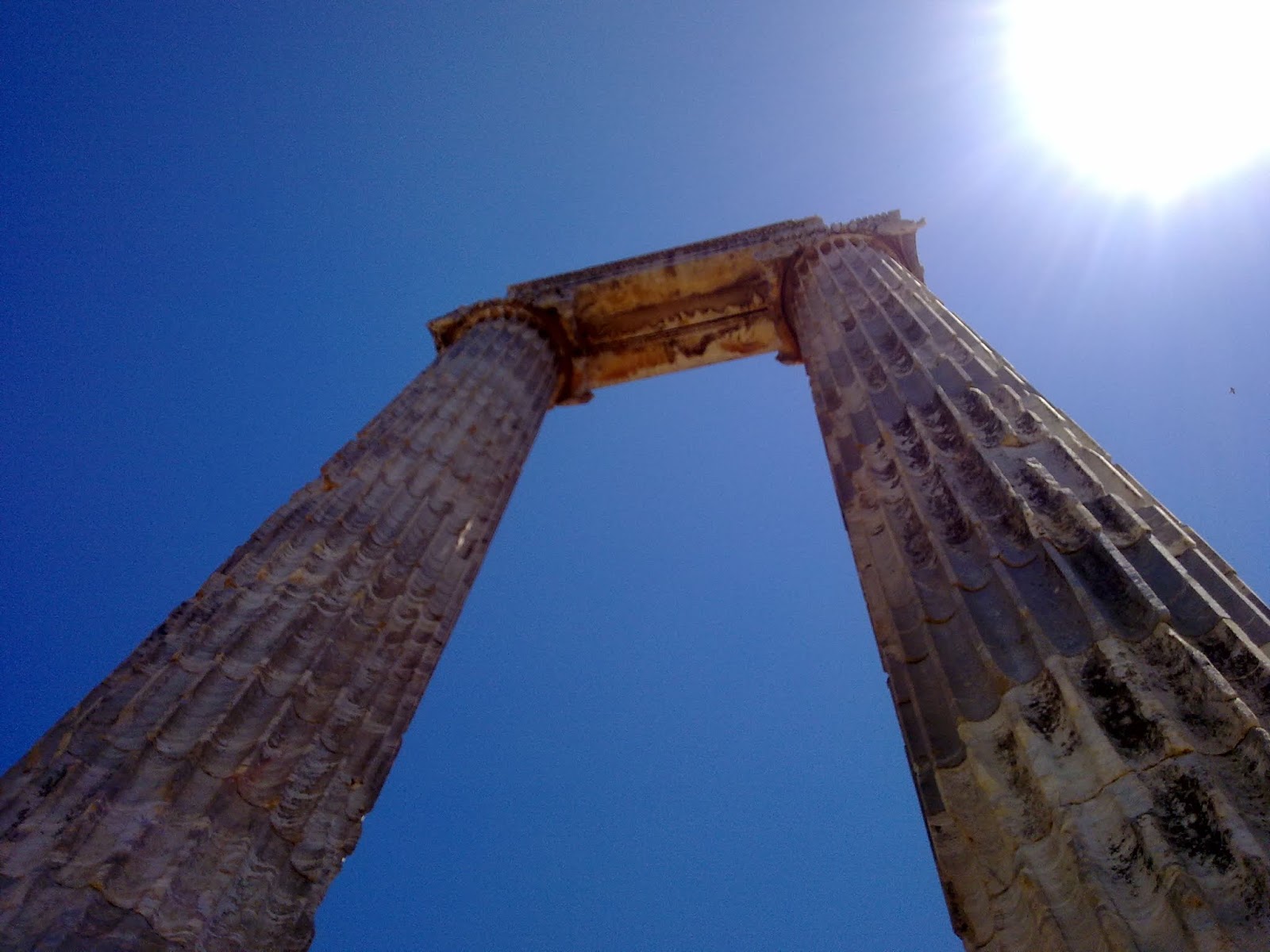
11 miles south of the ancient port city of Miletus on the western coast of modern-day Turkey, the Temple of Apollo at Didyma or Didymaion was the 4th largest temple in the ancient Greek world. The temple’s oracle, second in importance only to that at Delphi, played a significant role in the religious and political life of both Miletus and the greater Mediterranean world; many rulers, including Alexander the Great, visited or sent delegations to this oracle seeking the guidance and favor of Apollo. In its heyday, Didyma was not a city, but a place of worship, connected with Miletus by the so-called Sacred Way. This road was used by the pilgrims who arrived at Didyma, seeking answers to nagging questions.
The Didymaion was the 3rd and largest temple that the Greeks built around the site of a natural spring, which they believed to be the source of the oracle’s prophetic power. The first temple was a humble structure that replaced a much earlier Carian sanctuary. In the 6th century BCE, the people of nearby Miletus began construction on a second, much larger temple. Wider than and as long as the Parthenon in Athens, this second temple reflected the growing fame and influence of the oracle. This temple, however, was plundered and destroyed, either in 494 BCE by the Persian king Darius or in 479 BCE by his son and successor Xerxes. It is said it that the sacred spring ceased to flow until Alexander the Great passed through on a conquest of his own and re-consecrated the site in 331 BCE.
While Alexander reopened the site at Didyma, his siege left Miletus heavily damaged and the tariffs levied against the citizens as punishment for their resistance financially crippled the city for decades. When Miletus finally began to recover - some thirty years after Alexander’s conquest - the citizens began construction on yet another temple at the site of the sacred spring. It is this third and final temple that is known today as the Temple of Apollo at Didyma or the Hellenistic Didymaion. As was common for Greek temples of such an immense size, construction continued for centuries and the temple was never completed; even in the late 4th century CE the temple lacked a pediment or a cornice and much of the sculptural ornamentation and even several of the massive columns remained unfinished. Nevertheless, the temple must have been a magnificent sight as even the ruins can leave the modern-day visitors awestruck.

The Hellenistic Didymaion

Like the Temple of Artemis in Ephesos, the Didymaion was built to resemble from the outside an ordinary, albeit huge, Greek temple. The Didymaion possessed an enormous temple platform or podium that created a level building area of over 5,500 square meters. Upon this raised platform rested 122 massive columns, each 2.5 meters in diameter, which in turn supported an elaborate coffered roof that extended out over the entire platform. In its nearly finished state, the walls of the temple rose to a towering height of nearly 28 meters above the ground.


While the exterior of the Didymaion appeared similar to an ordinary Greek temple, the interior was quite unique. The inner chamber or adyton of a traditional Greek temple was built directly on top of the temple platform or podium. The temple at Didyma, however, was built around a sacred spring and so the floor of the adyton had to be at ground level. The architects of the Didymaion came up with an ingenious solution; they constructed two long and narrow vaulted tunnels, each over 21 meters long and just over 1 meter wide, that led from the top of the temple platform back down to the grassy floor of the adyton. This clever “hollow” design allowed the Milesians to build a traditional-looking temple that rivaled the Artemision in Ephesus while also preserving the natural spring that had long been considered the sacred source of the oracle’s power. Moreover, while from the outside the temple appeared fully roofed, the inner chamber of the Didymaion was open to the sky. This allowed the temple staff to cultivate a grove of sacred trees on the adyton floor. In this idyllic environment, amidst the trees and beside the sacred spring, stood a much smaller temple or naiskos that held the cult statue of Apollo.


The Political & Religious Significance of the Didymaion

The Temple of Apollo at Didyma played a critical role in the religious and political life of ancient Miletus. The temple complex served as the site of important religious festivals, sacrifices, and votive offerings while the oracle exercised a significant influence on Milesian civic statutes, treaties, public enterprises, and was relied upon to provide protection against enemies and to help direct public and foreign affairs.
Archaeological research
The Society of Dilettanti sent two expeditions to explore the ruins, the first in 1764 under Richard Chandler, the second in 1812 under William Gell. The first excavations in Didyma were carried out in 1858, in the area of the Sacred Way, under the direction of the British archaeologist Charles Thomas Newton.

The grounds of the Temple of Apollo were studied for the first time by French archaeologists, Olivier Rayet and Albert Thomas, in 1872. Their goal was to find the statue of Apollo, and the excavations took two years. The statue was not found. However, the dimensions of the temple were determined, and its plan was reconstructed.

In the years 1895-1896, the French team worked in Didymaion again, this time under the supervision of Bernard Haussoullier. The focus was on the northern part of the temple, but this project was quickly abandoned for economic reasons.
More time was spent in Didyma by German archaeologists who worked there on behalf of Berlin Museums from 1905 to 1937. Thanks to them, almost the entire temple was excavated. The work was resumed under the supervision of the German Archaeological Institute in 1962 and it lasts until today, with particular attention devoted to the Sacred Way.
The most surprising discovery was made by German researchers in 1979. On the inner wall of the courtyard, some barely visible lines were discovered. Upon closer examination, these lines turned out to be the plans for the temple. They survived thanks to the fact that Didymaion was never finished, and the walls were not polished. From these sketches, the researchers have learned a lot about the planning and construction of the temple.

SOURCE:Ancient History Encyclopedia

Thursday, 8 August 2019

THE GREEK TEMPLE OF ATHENA IN ASSOS ~ASIA MINOR


On the coast of Asia Minor in Turkey, opposite the Greek island of Lesvos, one can still see the ruins of the Greek city of Assos. A strong and rich city, protected by the Goddess Athena. The inhabitants of Assos built a magnificent temple in Her honour. The Temple of Athena stands at the top of a hill, 236 metres high. 
It is believed to have been built in 525 BCE. It is the only specimen of archaic Doric architecture in the entire Asia Minor. What makes this temple even more unique, is that it is the only building where the Doric style was mixed with the decorative elements of the Ionian tradition.

Surrounded by 34 columns, the building had a pronaos and a main temple, where the altar and the statue of Athena stood. Only priests were allowed to enter the building, while the offerings   were done outside. The altar did not survive, since it was destroyed by the christians in the Byzantine period. However, some interesting decorations were preserved - the creators of the Temple added scenes from the adventures of Heracles with the Centaurs, as well as decorations with bulls, sphinxes and plant motifs. The images that are preserved are quite crude and perhaps simpler, compared to other Greek temples, but they show us the willingness of the artists to combine different elements and create an elegant space to honor their  Goddess.
During the Byzantine era, the Temple and other buildings of the city were destroyed and their fragments were used for the construction of other buildings. Many of the Byzantine towers that exist in the area were built from pieces of the Temple of Athena. Nowadays, archaeologists are trying to collect as many pieces as they can find in order to rebuild the Temple - an effort that began in 1981 and continues to this day. Some of the surviving reliefs are in the Louvre and Boston Museum. The facade of the Temple has been restored and is taken to the Museum of Constantinople.
Parts of this temple still stand impressive, despite its destruction-  a powerful reminder of the Greek history of Ionia and of the respect of the Greeks for Athena, their Warrior Goddess. 


Wednesday, 8 May 2019

THE TEMPLE OF ZEUS IN AIZANOI ~ KUTAHYA ~ ASIA MINOR


One of the best preserved temples of Zeus is located in Western Anatolia, in the area of Aizanoi in Kutahya. In antiquity, the Greek city of Aizanoi thrived there and in later times it was occupied by the Romans. In the 2nd century CE, the Roman emperor Hadrian commissioned the building of this majestic religious sanctuary. 

The temple is built upon a podium with many steps. Originally,it was surrounded on all sides by ionic columns, creating a kind of porch called 'peristasis', which served for ceremonial processions. The peristasis consisted of 15 columns along the length of the building and 8 columns along its width- nowadays, only the columns of the northern and western sides remain standing. The podium on which the temple stands measures 33x37 meters. The influences of Greek architecture are clearly seen both in the design of the building and its decorations.
This imposing building was the most important religious center of the region, and it honoured two deities- Zeus was worshipped in the section above ground, and the underground part was dedicated to Cybele. 
During the 13th century CE, the Tatars added battle scenes on the walls of the structure. However, neither these additions nor time have managed to reduce the splendour of the Temple, which stands as a monument to Zeus, the Ruler of  Gods and mortals.