Showing posts with label TURKEY. Show all posts

Saturday, 23 November 2024

THE INSCRIPTION OF ALEXANDER THE GREAT ~ PRIENE, ASIA MINOR


Many inscriptions have been found in the ancient city of Priene, but only one of them is called the ‘Priene Inscription’. This inscription owes its fame largely to Alexander the Great and the story of Strabo.

First of all  of all, some archeology and geography notes on the subject:

The subject of our article takes place in the new city of Priene with a Hippodamian (grid) plan in the Hellenistic period. The exact location of old Priene, which was originally a Carian settlement before the Ionians, is unknown.

This temple is one of the rare Hellenistic temples that have survived (not standing) to the present day without being renovated by the Romans.

Another outstanding feature is that the Temple of Athena Polias is the work of Pythius of Priene, who was also the architect of the Halicarnassus Mausoleum.


It is accepted that each city state embraced one or more protective god or goddess cults in the stony-metallic ages, archaic and ancient periods, and they opened temples and altar-function areas or built structures for them inside or outside the city. The Goddess of Athens, Athena, is also the natural Goddess of the city of Priene, which is said to be an Athenian colony, but Minerva is the counterpart of Athena in Roman mythology. Therefore, the ‘Athena Polias’ and the ‘Minerva Polias’ are the same temple.

Judging by the Strabo narrative, the dedication by Alexander the Great of the new temple for Athena Polias in Priene is a rather interesting story. 

334 BCE: Alexander of Macedon, who inherited a large army from his father Philip II, after winning the battle with the Achaemenids on the banks of the Granikos River (modern Biga River) which opened the gates of Asia to his army, visits the nearby Troy. He asks for permission from the graves of the heroes of the Trojan war to bless the war he waged against the Persian domination in Asia Minor. From there, he proceeds his advance from the west coast to the south, and continues to repel the Persians and Persian defenders who stand in his way.


When he reaches Ephesus, he learns that a Temple of Artemis will be built. The story is that the previous Temple of Artemis was destroyed by fire on the very day he was born. He sends a message to the leaders of the city at once. He promises to pay all of the construction cost in exchange for the engraving of his name on the wall of the new temple to be built. His offer was wisely declined, saying, “It is not fit that a god should provide temples in honor of gods.” Flattered, Alexander says, ‘thank you’ and goes about his business. The Ephesians would not have denied the honor of Augustus in a similar later situation.


Continuing his campaign, Alexander stumbles upon the construction of the temple of Athena Polias in Priene. He must not have given up on his wish to have his name inscribed on a temple wall. His offer will be accepted this time. According to epigraphic sources, Alexander gave Priene its freedom in 334 BCE. “He showered gifts on the city and the temple”.

After the temple was excavated in 1869–70 by the Society of Dilettanti, this block and several others from the adjacent wall were removed to London. We learn from the publications that started with the book of Chandler in 1769 that the in situ location of the inscription block was one of the antae of the temple.  It is still in the British Museum.


This inscription is also remarkable in that it is the first known example of the name Alexander the Great carved into history on a stone because such examples will become more numerous in the future, and even cities are named with him.


The dedication inscription placed in the name of Alexander represents an innovation in the history of Greek architecture and religion. Temples were previously built by societies or individuals solely for the Gods, and although there are exceptions, their walls are usually not inscribed with the names, images, human qualities (such as heroism) or frailty (such as arrogance) of mortals. In Hellenistic culture, there is the concept of heroon (hero cult) for this. People can be heroized, but not deified. The concept of deification should not to be confused with sublimation. It is true that temples were built for the Gods. What leads to error is to interpret whether the tombs are temples or not, based on their external appearance. In Anatolia, the situation is just the opposite, and this inscription is not the only example attesting this.


Inscription:

ΒΑΣΙΛΕΥΣ ΑΛΕΞΑΝΔΡΟΣ ΑΝΕΘΗΚΕ ΤΟΝ ΝΑΟΝ ΑΘΗΝΑΙ ΠΟΛΙΑΔΙ

Translation:

King Alexander dedicated the Temple to Athena Polias.
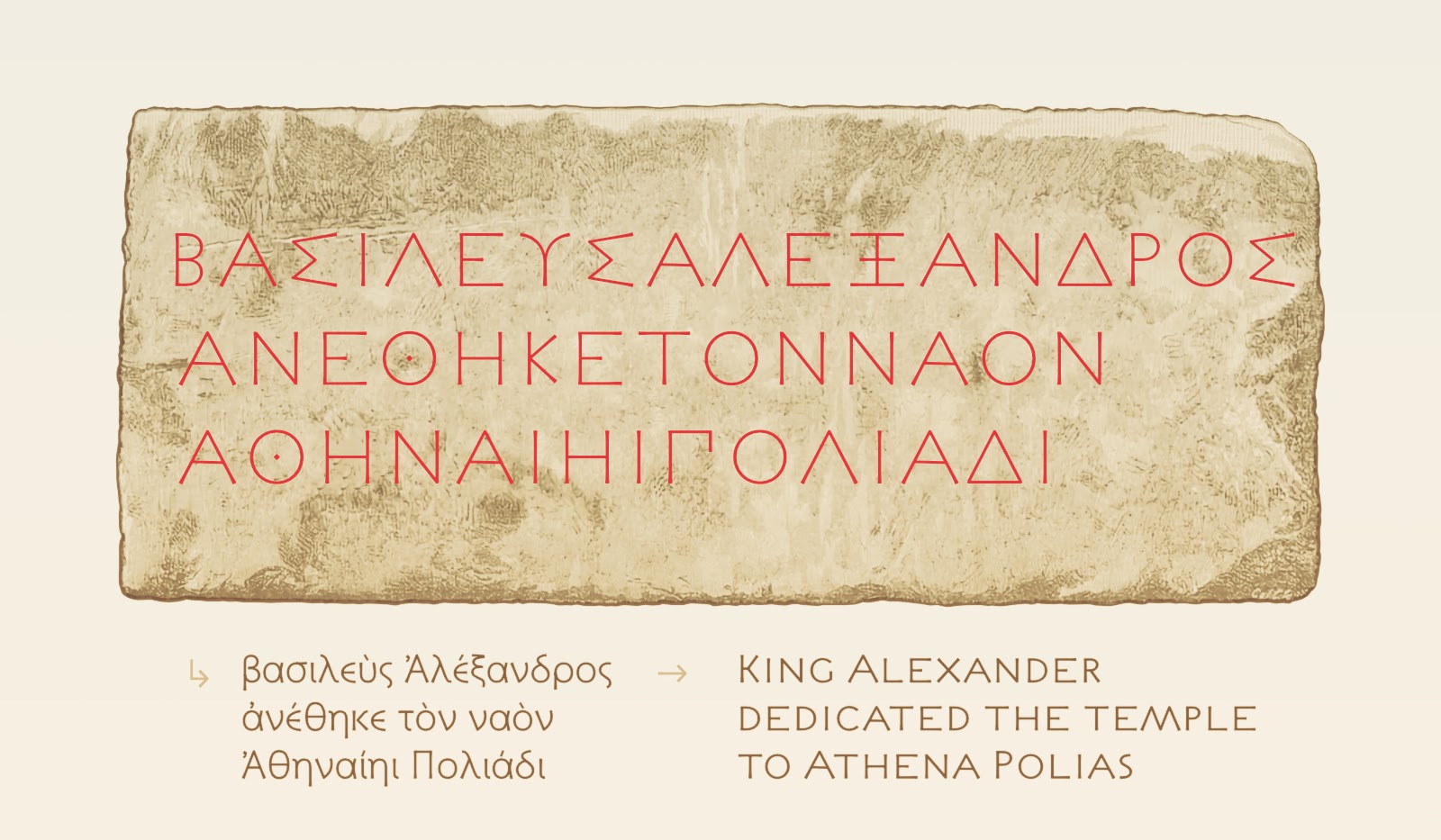

EDITED FROM https://esintype.com/research/priene-inscription/


Thursday, 12 October 2023

WHEN THE TURKS USED A GREEK- BASED SCRIPT

Turks have changed writing systems throughout their history, such as the Arabic, the Ottoman, Latin, etc.However, it is not widely known that they also used the Bactrian alphabet, which is a Greek- based alphabet, made for Central Asia.

Following the conquest of Bactria by Alexander the Great in 323 BCE, for about two centuries Greek was the administrative language of his Hellenistic successors, that is, the Seleucid and the Greco-Bactrian kingdoms.

The Kushan Empire initially retained the Greek language for administrative purposes, and later began to use Bactrian.

The Bactrian alphabet was a lightly modified version of the Greek one, used for the  Bactrian language. It seems that this writing system was in use from about 120-900 CE.


The Bactrian alphabet was very similar to Greek, containing 22 Greek-based letters and one additional letter. It was written left to right.


The Bactrian script appears also on some  Hunnic coinage. A good example of this  is the trilingual coinage of the Turk Shahis, a dynasty of Turkic or Hunnic people that ruled in Central Asia. Two interesting drachms were issued by the rulers Vakhu Deva and Tegin Shah. The drachm of Vakhu Deva has Bactrian around the rim on both sides, with late Brahmi in the obverse fields and Pahlavi in the reverse fields. The drachm of Tegin Shah has Brahmi around the obverse rim, with Bactrian in the obverse fields and Pahlavi in the reverse fields.


Edited from Wikipedia , Aqib Jahangir
Pakistan Coins Collectors Forum


Tuesday, 15 August 2023

HERACLES SHAKING HANDS WITH ANTIOCHUS I OF COMMAGENE


Stone relief from Arsameia (Nemrut region, Turkey) depicting Antiochus I of Commagene shaking hands with Heracles (r. 70–38 BCE). The Commagenian ruler is shown wearing a belted tunic, cloak and a four-lobed dagger. Herakles carries His club and the skin of the Nemean Lion.


Saturday, 3 June 2023

STATUE OF GREEK GOD PAN FOUND DURING EXCAVATIONS IN CONSTANTINOPLE


The excavation works which are being carried out at Saraçhane Archaeology Park in Constantinople, have revealed a new artifact:  a fragment of a statue depicting Pan, the Greek God of shepherds and flocks.

In a statement by the Constantinople Metropolitan Municipality (IBB), it was reminded that excavation works have been ongoing at Saraçhane Archaeology Park, where the Church of Saint Polyeuktos is located, since June 8, 2022.

The statement mentioned that the excavation works were being conducted on the northwest side of the main structure.

"At a depth of approximately 2,60 m from the surface, within the backfill soil, a fragment of a marble statue depicting Pan, known as the God of shepherds and flocks in ancient Greek mythology, was found. The statue, measuring 20 centimeters in height and 18 centimeters in width, was identified to have a broken left arm and the lower part of the body. It is believed to date back to the Roman period, and after the expert examination, further dating will be conducted," the statement read.


"While this description gives Pan a pastoral nature due to his direct association with nature, his depiction as a half-goat, half-human figure in all myths has made him a frightening character. In fact, Pan's sudden appearance in front of people in the fields, frightening them with his image, inspired the word 'panic.' Despite being the God of shepherds, Pan is often depicted in sources as a lovable figure who roams the meadows playing the flute, contrasting with his intimidating appearance. However, in many sources, Pan is described as having the ability to scream and frighten enemies, causing panic," the statement added.


It was reported that the fragment of the Pan statue was taken by the Constantinople Archaeology Museums Directorate and transferred to the museum's storage facility.


EDITED FROM the Daily Sabah

Saturday, 29 April 2023

IMAGES OF THE GREEK GODS IN THE TURKISH LANGUAGE


A series of images of the Greek Gods in Turkish script for our Turkish speaking readers. If you wish to download the pictures, right click on each image.