Showing posts with label ALEXANDER THE GREAT. Show all posts

Thursday, 7 May 2026

ΒΑΣΙΛΕΩΣ ΑΛΕΞΑΝΔΡΟΥ — “OF KING ALEXANDER”


ΒΑΣΙΛΕΩΣ ΑΛΕΞΑΝΔΡΟΥ ~ VASILEOS ALEXANDROU ~“OF KING ALEXANDER”

The inscription ΒΑΣΙΛΕΩΣ ΑΛΕΞΑΝΔΡΟΥ, meaning “of King Alexander,” is one of the most iconic marks of ancient Greek coinage from the Hellenistic period. These coins were minted during and after the reign of Alexander the Great, whose conquests reshaped the known world.

Typically found on silver tetradrachms and other denominations, the inscription often accompanies the image of Heracles — symbolizing strength and divine lineage — or Zeus, representing kingship and authority.

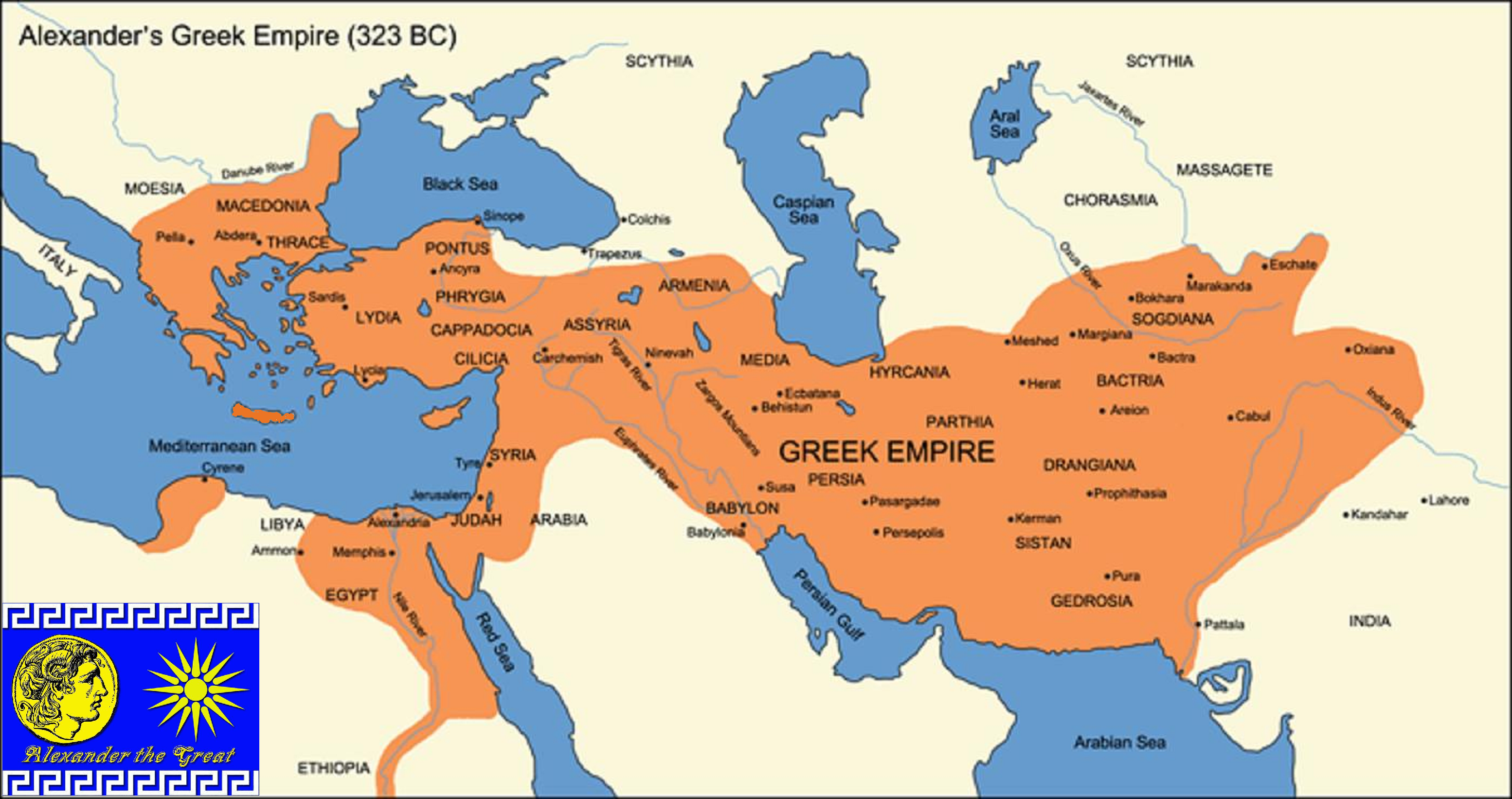
Circulating from Greece to India, these coins became the standard of trade and trust, their consistent weight and design ensuring use long after Alexander’s death.

Today, they endure as glittering relics of empire, offering historians and collectors a direct connection to the era of Hellenistic expansion, unity, and cultural exchange.


Source ~ The archaeologist official

Thursday, 8 May 2025

ALEXANDER'S CAMPAIGN AGAINST THE ASSACANI AND QUEEN CLEOPHIS


Cleophis (Sanskrit: Kripa) was an Assacani queen and key figure in the war between the Assacani people and Alexander the Great. Cleophis was the mother of Assacanus, the Assacanis' war-leader at the time of Alexander's invasion in 326 BCE. After her son's death in battle, Cleophis assumed command and negotiated a settlement that allowed her to retain her status. Later accounts claim Cleophis had a son by Alexander, a notion dismissed by historians.


The Assacani (called Ashvakas in Sanskrit, from the word Ashva, meaning "horse") were an independent people who lived in parts of the Swat and Buner valleys in ancient Gandhara. These highlanders were rebellious, fiercely independent clans who resisted subjugation.


in the Major Rock Edicts of Ashoka, Asvakas are described as Gandhāras (Gandharians), who are recorded separately from Kambojas. Ancient Greek historians who documented the exploits of Alexander the Great referring to the Aspasioi and Assakenoi (Ἀσσακηνοί) tribes among his opponents. The historian RC Majumdar considers these words to be corruptions of Asvaka.  It is possible that the corruption of the names occurred due to regional differences in pronunciation. Rama Shankar Tripathi thinks it possible that the Assakenoi were either allied to or a branch of the Aspasioi. The Greeks recorded the two groups as inhabiting different areas, with the Aspasioi in either the Alishang or Kunar Valley and the Assakenoi in the Swat Valley. 

Alexander's war with the Assacani

In 326 BCE, Alexander's campaigns west of the Indus River brought him into conflict with the Assacani. In defense of their homeland, they assembled an army of 20,000 cavalry, 38,000 infantry, and 30 elephants, according to classical writer Quintus Curtius Rufus. Their army included a contingent of 7,000 Kamboj mercenaries recruited from Abhisara. 


After being defeated in the field, the Assacani fell back to the fortified city of Massaga, where the fighting continued for five days (or nine days, according to Curtius.) It was during this battle that Assacanus was killed. After her son's death, Cleophis assumed command, mustered the Assacani women to fight, and led the continued defense of the city. Rule of the Assacani fell to Cleophis.


Eventually, however, Cleophis judged that defeat was inevitable. She came to terms with the invaders and abandoned Massaga with her followers. Diodorus Siculus says: "Cleophis sent precious gifts to Alexander with a message in which she expressed her appreciation of Alexander's greatness and assured him that she would comply with the terms of the treaty." According to Curtius and Arrian, Cleophis was captured along with her young granddaughter. Alexander allowed Queen Cleophis to maintain her throne as his vassal.


Alexander's retaliation against the defeated Assaceni was severe. He had Massaga burned. Victor Hansen writes: "After promising the surrounded Assaceni their lives upon capitulation, he executed all their soldiers who had surrendered. Their strongholds at Ora and Aornus, were also similarly stormed. Garrisons were probably all slaughtered."


Additionally, Alexander pursued the Kamboj mercenaries, surrounded them on a hill, and killed them all. Diodorus describes the event in detail: "...The women, taking up the arms of the fallen, fought side by side with their men. Accordingly, some who had supplied themselves with arms did their best to cover their husbands with their shields, while others, who were without arms, did much to impede the enemy by shooting themselves upon them and catching hold of their shields."

Later classical writers, including Curtius and Justin, claim that Alexander fathered a child with Cleophis. Historians dismiss this notion as a much later romantic invention. On Alexander's relatively generous terms, which allowed Cleophis to retain her status, Curtius says, "...some believed that this indulgent treatment was granted rather to the charms of her person than to pity for her misfortunes. At all events, afterwards she gave birth to a son who received the name Alexander whoever his father may have been..." Earlier writers do not mention this.

The Asvayanas have been attested to be good cattle breeders and agriculturists by classical writers. Arrian said that, during the time of Alexander, there were a large number of bullocks - 230,000 - of a size and shape superior to what the Macedonians had known, which Alexander captured from them and decided to send to Macedonia for agriculture.

Edited  from Wikipedia

Monday, 23 December 2024

ALEXANDER THE GREAT COMMEMORATIVE COLUMN ~ HUND MUSEUM ~ PAKISTAN


 Hund is the oldest city in the Swabi district, located on the right bank of the Indus River. It has a rich history and has experienced different eras such as the Gandhara civilization, the Hindu Shahi dynasty, and the Muslim period. Alexander the Great passed by this place in 327 BCE and spent a night in the village before entering the Indian plains. 

Arrian, the second century CE military historian, records in Anabasis that Alexander and his conquering army of 50,000 men and all their animals crossed the Indus at Hund on a bridge of boats specially built for them by Alexander's commander, Hephaestion, in 326 BCE. When he arrived at the river, Alexander made animal sacrifices and held athletic games and a horse show. The omens proved favourable, so the army crossed. More sacrifices of thanksgiving were made on the other side, where King Ambhi of Taxila was waiting to surrender to Alexander. And so Alexander entered India. A Corinthian column, an example of Greek architecture, was recently added to the Hund museum to symbolize the presence of Alexander the Great.

Today Hund is a humble, run-down village, beautifully situated on the bank of the Indus and the passage of Alexander the Great has never been forgotten there.


Saturday, 23 November 2024

THE INSCRIPTION OF ALEXANDER THE GREAT ~ PRIENE, ASIA MINOR


Many inscriptions have been found in the ancient city of Priene, but only one of them is called the ‘Priene Inscription’. This inscription owes its fame largely to Alexander the Great and the story of Strabo.

First of all  of all, some archeology and geography notes on the subject:

The subject of our article takes place in the new city of Priene with a Hippodamian (grid) plan in the Hellenistic period. The exact location of old Priene, which was originally a Carian settlement before the Ionians, is unknown.

This temple is one of the rare Hellenistic temples that have survived (not standing) to the present day without being renovated by the Romans.

Another outstanding feature is that the Temple of Athena Polias is the work of Pythius of Priene, who was also the architect of the Halicarnassus Mausoleum.


It is accepted that each city state embraced one or more protective god or goddess cults in the stony-metallic ages, archaic and ancient periods, and they opened temples and altar-function areas or built structures for them inside or outside the city. The Goddess of Athens, Athena, is also the natural Goddess of the city of Priene, which is said to be an Athenian colony, but Minerva is the counterpart of Athena in Roman mythology. Therefore, the ‘Athena Polias’ and the ‘Minerva Polias’ are the same temple.

Judging by the Strabo narrative, the dedication by Alexander the Great of the new temple for Athena Polias in Priene is a rather interesting story. 

334 BCE: Alexander of Macedon, who inherited a large army from his father Philip II, after winning the battle with the Achaemenids on the banks of the Granikos River (modern Biga River) which opened the gates of Asia to his army, visits the nearby Troy. He asks for permission from the graves of the heroes of the Trojan war to bless the war he waged against the Persian domination in Asia Minor. From there, he proceeds his advance from the west coast to the south, and continues to repel the Persians and Persian defenders who stand in his way.


When he reaches Ephesus, he learns that a Temple of Artemis will be built. The story is that the previous Temple of Artemis was destroyed by fire on the very day he was born. He sends a message to the leaders of the city at once. He promises to pay all of the construction cost in exchange for the engraving of his name on the wall of the new temple to be built. His offer was wisely declined, saying, “It is not fit that a god should provide temples in honor of gods.” Flattered, Alexander says, ‘thank you’ and goes about his business. The Ephesians would not have denied the honor of Augustus in a similar later situation.


Continuing his campaign, Alexander stumbles upon the construction of the temple of Athena Polias in Priene. He must not have given up on his wish to have his name inscribed on a temple wall. His offer will be accepted this time. According to epigraphic sources, Alexander gave Priene its freedom in 334 BCE. “He showered gifts on the city and the temple”.

After the temple was excavated in 1869–70 by the Society of Dilettanti, this block and several others from the adjacent wall were removed to London. We learn from the publications that started with the book of Chandler in 1769 that the in situ location of the inscription block was one of the antae of the temple.  It is still in the British Museum.


This inscription is also remarkable in that it is the first known example of the name Alexander the Great carved into history on a stone because such examples will become more numerous in the future, and even cities are named with him.


The dedication inscription placed in the name of Alexander represents an innovation in the history of Greek architecture and religion. Temples were previously built by societies or individuals solely for the Gods, and although there are exceptions, their walls are usually not inscribed with the names, images, human qualities (such as heroism) or frailty (such as arrogance) of mortals. In Hellenistic culture, there is the concept of heroon (hero cult) for this. People can be heroized, but not deified. The concept of deification should not to be confused with sublimation. It is true that temples were built for the Gods. What leads to error is to interpret whether the tombs are temples or not, based on their external appearance. In Anatolia, the situation is just the opposite, and this inscription is not the only example attesting this.


Inscription:

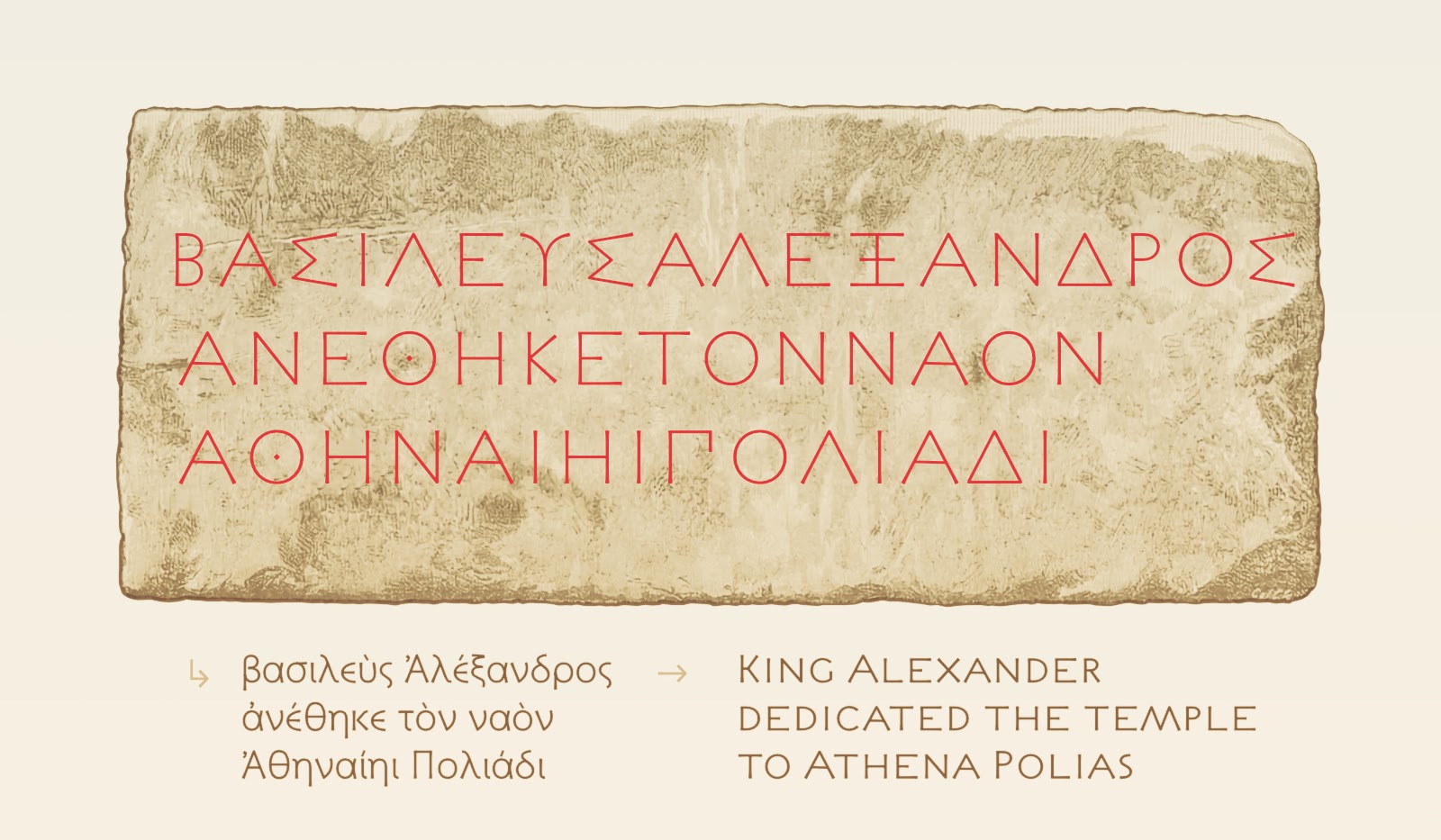
ΒΑΣΙΛΕΥΣ ΑΛΕΞΑΝΔΡΟΣ ΑΝΕΘΗΚΕ ΤΟΝ ΝΑΟΝ ΑΘΗΝΑΙ ΠΟΛΙΑΔΙ

Translation:

King Alexander dedicated the Temple to Athena Polias.


EDITED FROM https://esintype.com/research/priene-inscription/


Sunday, 5 November 2023

ALEXANDRIA ESCHATE ~ FERGANA VALLEY ~~ TADJIKISTAN


Alexandria Eschate (Attic Greek: Ἀλεξάνδρεια Ἐσχάτη, Doric Greek: Αλεχάνδρεια Ἐσχάτα, romanized: Alexandria Eschata, "Furthest Alexandria") was a city founded by Alexander the Great, at the south-western end of the Fergana Valley (modern Tajikistan) in August 329 BCE.It was the most northerly outpost of Alexander's Empire in Central Asia. Alexandria Eschate was established on the south bank of the river Jaxartes (Syr Darya), at or close to the site of modern Khujand (Хуҷанд; خجند). According to the Roman writer Curtius, Alexandria Ultima retained its Hellenistic culture as late as 30 BCE.

History

This region where Alexandria Eschate would be founded was ruled over by Persia starting with Xerxes I, and began to be populated by Greeks starting at that time. When Greeks  in other parts of the Persian empire rebelled or otherwise were troublesome, they would be exiled to the far northeast of the Persian empire, the most distant segment from their homelands. This was not uncommon, because the coastline of Asia Minor was populated by many Greek-culture and language cities, who had colonized the region in the previous centuries. By the time of the fall of Persia to Alexander the Great, many had been exiled to this region north of India, so Greek villages, language, and culture were therefore all common in that area. Cyrus the Great founded a city there as his northeastern-most outpost, known as Cyropolis, which may have later become the site of Alexandria Eschate, simply renamed.


Alexander the Great

Alexander, during his years of conquest, would regularly establish long-term outposts to support his advance, either renaming and permanently securing an existing city, or creating a long-term, albeit non-permanent, outpost built up like a town. According to Greek historian Plutarch, Alexander named seventy of these bases after himself.

Alexandria Eschate was located in the Ferghana Valley. 

In order to secure Sogdiana, the northeastern corner of the Persian empire, Alexander targeted Cyropolis and a half dozen other cities in 329 BCE.


Alexander first sent Craterus to Cyropolis, the largest of the towns holding Sogdiana against Alexander's forces. Craterus' instructions were to "take up a position close to the town, surround it with a ditch and stockade, and then assemble such siege engines as might suit his purpose...." The idea was to keep the inhabitants focused on their own defenses and to prevent them from sending assistance out to the other towns. Starting from Gazza, Alexander went on to conquer the other surrounding towns. Five of the seven towns were taken in two days. Many of the inhabitants were killed. Alexander then arrived at Cyropolis, which was the best fortified of the towns and had the largest population. It also had reputedly the best fighters of the region. Alexander battered Cyropolis' defenses with the siege engines. While the bombardment went on, Alexander ordered certain of his troops to sneak through a dried-up water course that went under the town's wall. Alexander also joined on this mission and once inside his troops opened the town's gate to admit his attacking force. Once the natives saw that the town was taken, they fell violently upon the attackers. Alexander received a violent blow from a stone that landed upon his head and neck. Craterus was wounded by an arrow. But the defenders were driven off. Arrian puts the defender's force at about 15,000 fighting men and claims that 8,000 of them were killed in the first phase of the operation. The rest apparently sought refuge inside the town's central fortress, but surrendered after one day for lack of water.


Accounts of how the battle went down differ among authors. Arrian cites Ptolemy as saying Cyropolis surrendered from the start, and Arrian also states that according to Aristobulus the place was stormed and everyone was massacred.


One, probably Cyropolis, came to be called Alexandria Eschate, his northeastern-most outpost. As with most other cities founded by Alexander, a group of retired and/or wounded veterans from his army was settled there, joining the large population of Greek exiles settled in the area by Persia in previous generations.

Because Alexandria Eschate was surrounded by Sogdian tribes, and was about 300 km (186 mi) north of the nearest Greek settlement, at Alexandria on the Oxus in Bactria, the Greeks built a 6.0 km (3.7 mi) wall around the city which, according to the ancient authors, was completed in about 20 days.It experienced numerous conflicts with the local population.


Alexandria Eschate was located 300 km north-west of the main Greek colonies in Central Asia, at Bactria.

From 250 BCE, the city likely had greater contact with Bactria, after the Greco-Bactrian king Euthydemus I extended his control into Sogdiana.


Alexandria Eschate was also located around 400 km (249 mi) west of the Tarim Basin (now Xinjiang, China), where other Indo-European peoples, like the Khotanese, Tocharians, Wusun and/or Yuezhi were established. There are indications that Greek expeditions travelled as far as Kashgar. The historian Strabo claims that the Greeks "extended their empire even as far as the Seres and the Phryni .


"Seres" meant either China proper – in which case the Greeks achieved the first direct contact between China and a European society, some time around 200 BCE – or the peoples of the Tarim. In any case, a city known to the Chinese as Dayuan, which was mentioned by scholars from the Han dynasty (1st century BCE to 2nd century CE), is speculated to refer to Alexandria Eschate. The prefix da meant "Great", while the suffix Yuan was the Chinese rendition of Ionians.


Chinese embassies were established in Dayuan, beginning with Zhang Qian opened around 130 BCE. Soon the city and the rest of Dayuan were conquered completely by the Han after winning the War of the Heavenly Horses. This contributed to the opening up the Silk Road from the 1st century BCE. Dayuan means "Great Ionians" in the Chinese language, Greeks generally being known in Asia by some variant of "Ionians". See Names of the Greeks: Ionians, Yunani, and Yavan for more information.


Archaeological remains

The remains of Alexander's town lie in the tell of the old citadel in Khojand. Although the oldest surface remains of the walls date only to the 10th century, Soviet and Tajik excavations of the site have revealed that below the modern surface are medieval, Hellenistic and Achaemenid layers. These layers have revealed fortifications dating to around the 4th century BCE.


Other remains include household utensils, armaments and building materials which are exhibited in the Museum of Regional Studies in Khojand. The site has also revealed numerous Hellenistic coins and pottery. 

In the Tabula Peutingeriana, below the city there is a rhetorical question in Latin: "Hic Alexander responsum accepit: usque quo Alexander?" (English: Here Alexander accepted the answer: "Until where, Alexander?") — referencing both his insatiable appetite for conquest and a legend from the Alexander Romance in which "celestial creatures" admonished Alexander to not pursue further explorations, which would ultimately lead to his untimely death.


Edited from WIKIPEDIA

Sunday, 1 October 2023

ALEXANDRIA ARACHOSIA ~ THE MODERN KANDAHAR OF AFGHANISTAN


Alexandria in Arachosia (Greek: Ἀλεξάνδρεια Ἀραχωσίας) also known as Alexandropolis (Ἀλεξανδρόπολις), was an ancient city that is now called Kandahar in Afghanistan. It was one of more than twenty cities founded  by Alexander the Great. It was founded around 330 BCE, on the foundations of an earlier Achaemenid fortress. Arachosia is the Greek name of an ancient province of the Achaemenid, Seleucid and Parthian empires. The province of Arachosia was centered around the Argandab valley in Kandahar. It did not reach the Hindu Kush, but it apparently extended east as far as the Indus River, although its exact extents are not yet clear.

After the conquests of Alexander the Great, Arachosia was ruled by the Satrap Sybirtius. In the 3rd century BCE, it is thought that the ambassador to the Indian court Megasthenes departed from the city to visit India:


Megasthenes lived with Sibyrtius, satrap of Arachosia, and often speaks of his visiting Sandracottus, the king of the Indians. Arrian, Anabasis Alexandri.


Isidorus of Charax in his 1st century CE "Parthian stations" itinerary described an "Alexandropolis, the metropolis of Arachosia", which he said was still Greek even at such a late time:


Beyond is Arachosia. And the Parthians call this White India; there are the city of Biyt and the city of Pharsana and the city of Chorochoad and the city of Demetrias; then Alexandropolis, the metropolis of Arachosia; it is Greek, and by it flows the river Arachotus. As far as this place the land is under the rule of the Parthians.

The remains of Alexandria in Arachosia are today found in the tell of Old Kandahar citadel in the western portion of the modern city. The citadel tell was excavated by the British Society for South Asian Studies through the 1970s and with the relative improvement in security from 2008 to 2009.


These excavations indicate that the Islamic walls were based on those from classical times, indicating what might be a square (tetragonis) shaped town, but one highly modified by the unusual topography. A triangular-shaped portion of the tell adjoining the Greek town is from the Buddhist era.


Alexander appears to have founded his town on the site of a 6th-century BCE Persian garrison point. The pass, river and junction of three long-distance trade routes made the location of strategic importance. To date, no Greek buildings have been found, but numerous coins, inscriptions and graves have been discovered. Further discoveries are anticipated as excavation reaches deeper strata of the tell.


The citadel walls have been shown to have contained circular towers similar to those at Farah, Balkh and Nadi Ali Sorkh Gdagh, although these could be Islamic in age.

 Edited from WIKIPEDIA

Thursday, 7 September 2023

THE CASTLE OF ALEXANDER THE GREAT ~ GARDEZ ~ PAKTIA ~ AFGHANISTAN


The old fortress in Gardez City. Originally built by the armies of Alexander the Great, and subsequently rebuilt by many of the invading armies to pass through Gardez, including the British and Soviets. The fortress, colloquially known as 'Castle Greyskull' by American troops which were  stationed in the area, was also home to an Afghan National Army detachment. U.S. Air Force photo by 1st Lt. John Severns

Source ~ Wikipedia

Friday, 18 August 2023

ALEXANDER THE GREAT ~ GREEK GOLD COIN OF KING LYSIMACHOS


One of the most beautiful known portraits of Alexander the Great, in gold.

This stunning gold stater minted under King Lysimachos depicts one of the earliest known portraits of Alexander the Great, in superb Hellenistic style, dating to 297 - 281 BCΕ.

The obverse shows the now deified King, Alexander the Great. He is shown facing right, his wild, unruly hair held down by a thin diadem, the horn of Ammon curling over his ear, clearly identifying him as Alexander.

The reverse with the Goddess Athena enthroned left, holding Nike in Her extended right hand, resting left elbow on shield with aegis. The legend reading:

  ΒΑΣΙΛΕΩΣ ΛΥΣΙΜΑΧΟΥ ~~ VASILEOS LYSIMACHOU

"Of King Lysimachos"


These coins, apart from their practical use at the time, were also meant to demonstrate  Lysimachos' connection to Alexander and thus, his legitimacy to rule. Today ,the surviving examples are admired and collected as beautiful artworks depicting one of history's greatest men.

This is an outstanding example of this hugely desirable type, arguably preserving the most artistically accomplished image of Alexander known from these coins, an apparently unrecorded reverse variety but from the same obverse die as the famous Nelson Bunker Hunt example.


Friday, 14 July 2023

FAILAKA ~ IKAROS ~ THE ISLAND OF KUWAIT WITH A GREEK NAME


The history of one island off the coast of Kuwait dates back more than 3,500 years. The island of Fylakio, Greek for outpost, was a coveted prize of the world’s most ancient and famous civilizations.

Failaka’s name is derived from the Greek word for outpost. But Alexander the Great, according to later classical authors such as Strabo and Arrian, gave Failaka the name Ikaros, since it resembled the Aegean island of that name in size and shape. French archaeologists working on the island in recent years have found several stone inscriptions dating to the 4th and 3rd centuries BCE mentioning the name Ikaros, as well as architecture and artifacts that reveal a bustling community with international ties during that period. The island’s accessible fresh water, easily defended coastline, and strategic location also attracted the attention of Alexander’s successors, who vied among themselves for control of regional trade routes. Antiochus I, who ruled the Seleucid Empire in the third century BCE, built a 60-foot-square fort around a well on Failaka. Inside the fortress compound, one small, elegant temple has Ionic columns and a plan that is quintessentially Greek, including an east-facing altar. This was no simple import, however, but a fascinating amalgamation of designs. The column bases, for example, are of the Persian Achaemenid style, similar to those in the capital, Persepolis, burned by Alexander’s troops in the 4th century BCE.


 According to Mathilde Gelin from the French Institute of the Near East in Damascus, who is currently working at the site, this unusual pairing reflects a rare fusion of Greek and Eastern cultures. The sturdy fort eventually grew into a bustling port town, with other temples, houses, and larger fortifications, until its eventual abandonment by the first century BCE. Gelin hopes the current excavations will reveal what role the fort and settlement played in both island life and that of the wider region during a time of remarkable cultural mixing.

The history of Failaka was mentioned as far back as Strabo’s Geography in 25 CE and Arrian’s Anabasis but the Greeks were not the first people to discover it. There is evidence – though contested – that Bahrain’s ancient civilization of Dilmun had a lot to do with Failaka before the Greeks. Also, when the Greeks reached the Island, there was already a native speaking Aramaic population.

During the Hellenistic era, there was a temple dedicated to Artemis on the island; the wild animals of the island were dedicated to the Goddess with a decree for their protection. Strabo wrote that there was a temple of Apollo and an oracle of Artemis  Tauropolus(μαντεῖον Ταυροπόλου). The island is also mentioned by Stephanus of Byzantium and Ptolemaeus.


Several expeditions visited to conduct archaeological work on Failaka. The first expedition was by the Danish in 1970, then the French in 1983. In 2010 an Italian team, led by Associate Professor of Classical Archaeology at University of Perugia, Gian Luca Grassigli, landed at Failaka as well. This team excavated several objects, including porcelain, glass, bronze objects, and pottery.


One of the goals of these expeditions was to finally figure out if Failaka was the same Ikaros mentioned in ancient sources. In 1970, this speculation was put to rest when an inscription of 44 lines was discovered by the Danish expedition. From then on, there has never been so much as a fleeting doubt that the Ikaros mentioned in ancient sources was and still is modern Failaka.


It should also be noted  that both Failaka in the Persian Gulf and Icarus in the Aegean Sea housed bull cults would have made the identification all the more tempting.


During the Hellenistic era, there was a temple dedicated to Artemis on the island; the wild animals of the island were dedicated to the Goddess with a decree for their protection. Strabo wrote that there was a temple of Apollo and an oracle of Artemis  Tauropolus(μαντεῖον Ταυροπόλου). The island is also mentioned by Stephanus of Byzantium and Ptolemaeus.

Edited from  archaeology.org, Wikipedia


Sunday, 11 June 2023

THE PLAN OF ALEXANDER THE GREAT TO CONQUER ARABIA


In 324 BCE, Alexander the Great sent naval expeditions to make a survey of Arabia in preparation for an invasion he was planning.  There were meetings with the admiral of his fleet, Nearchus, whose newly-restored fleet was ready for the next great campaign in Arabia. Alexander ordered dredging around Babylon to build a proper harbor, sufficient to supply 1,000 warships with maintenance facilities and docks. His days were filled with business, his nights in poring over maps and descriptions of unknown islands, far lands, navigational problems, the advice of subordinates, all in preparation for his conquest of Arabia.

Although his death in 323 B.C.E. stopped the invasion, the men whom Alexander sent succeeded in providing the Greeks with detailed information about Arabia.  Some of the expedition leaders produced surveys which have come down to us through the Greek historians and geographers. From Arrian’s,Anabasis, we know that Alexander built a large harbor at Babylon as part of his preparation for conquering Arabia. Arrian wrote:


“Near Babylon, he constructed a harbor by excavation l enough to afford anchorage for 1,000 ships of war; and adjoining the harbor he built dockyards. Miccalus the Clazomenian was dispatched to Phoenicia and Syria with 500 talents to enlist some men and purchase others who were experienced in nautical affairs… He made these preparations for the fleet to attack the main body of the Arab.”  


Arrian explained that Alexander planned to occupy Arabia:


“…under the pretext that they were the only barbarians of this region who had not sent an embassy to him or done anything else becoming their position and showing respect to him. But the truth was, as it seems to me, that Alexander was insatiably ambitious of acquiring fresh territory.”


Arrian cited other reasons that Alexander planned to occupy Arabia: its fertility and the growth of certain plants there. Arrian wrote:


“The fertility of the land was a secret inducement to him to invade it. He had heard that the people obtained cassia from the lakes and myrrh and frankincense from the trees, that cinnamon was cut from the shrubs, and that the meadows produced spikenard without any cultivation.” 


Alexander sent three naval expeditions from Babylon. The first was under Archias, who went as far as the island of Tylus (Bahrain). Aristobulus’ account of the expedition contains a description of the sacred island of Icaros (modern-day Falaika, 20 km off the coast of Kuwait) and also informs Arrian’s extensive description of the southern shores of the Persian Gulf. Archias was followed by Androsthenes of Thasos who reached the Straits of Hormuz in 423 BCE. Androsthenes wrote a book describing his voyage. The book is lost, but his work was a subject of study by the later Greek historians and geographers.


The third naval expedition Alexander sent was under Hieron of Soli. Arrian wrote:


“Hieron of Soli, the pilot, also received a triacontor [30-oared ship] from Alexander and advanced farthest of those whom he had despatched to this region; for he had received instructions to sail round the whole Arabian peninsula as far as the Arabian Gulf near Egypt over against Heroopolis. Though he had sailed round the greater part of Arabia, Hieron did not dare go further, but turned back to Babylon.”


Hieron’s sailing “round the greater part of Arabia” means that he sailed around western Arabia. But he turned back. We suppose the reason Hieron turned back before reaching the Egyptian Gulf opposite to Heroopolis was the arid tract of central western Arabia. We can understand this from another document in which Arrian wrote about a voyage of Nearchus, who was instructed “to find out what men inhabit it, to discover the harbors and rivers in it, to ascertain the customs of the people, and to see if any of the country was fertile and if any was sterile. This was why Alexander’s naval expedition returned in safety; for if it had sailed beyond the deserts of Arabia, it would not have returned in safety. This is said also to have been the reason that Hieron turned back.”


Arrian tells us that the Greek explorers were explicitly instructed to explore and learn about the inhabitants, their customs, the fertility of the lands, etc. They had to give a complete picture. Sailing around Arabia allowed them to gather in-depth information about the lands and the cities that existed in their day. The information they gathered became an important resource for the later Greek explorers of Arabia.

An important historical note: The circadian process was first described by one of Alexander’s sea captains, Androsthenes, who observed the diurnal leaf movements of a tamarind tree. The circadian rhythm is a roughly 24 hour cycle in the physiological processes of living beings. Circadian rhythms are important in determining the sleeping and feeding patterns of all animals, including human beings. There are clear patterns of brain wave activity, hormone production, cell regeneration and other biological activities linked to this daily cycle.

Edited from historyofmacedonia.wordpress


Tuesday, 17 January 2023

THE LOST GREEK CITIES OF CENTRAL ASIA

For centuries, Bactria - a region shared by modern Afghanistan, Uzbekistan, and Tajikistan - was part of the Hellenistic world. Conquered by Alexander the Great, Bactria became the heart of a powerful Greek kingdom. And even after the Greco-Bactrian kingdom was overrun by nomads, its cities continued to thrive. This video explores their fates. 

Credit to YouTube channel  toldinstone


Sunday, 1 January 2023

THE GOLD STATERS OF ALEXANDER’S SUCCESSORS


With no mass media, ancient coins functioned as powerful tools for propaganda due to their portability and potential to circulate widely. Rulers would carefully choose their types and each element of the designs of their coinage to convey a specific message to their subjects, allies, and enemies.

Alexander the Great understood this concept and carefully planned the specific details of his portraits on sculptures as well as coins. Alexander is represented most famously as Herakles on his tetradrachms. He aspired to be a hero himself and Herakles was the premier embodiment of strength, determination, and willpower in Greek Religion, traits central to Alexander’s mission of global dominance.

After Alexander died suddenly at the age of 32, the future of his vast empire was unknown. His generals scrambled to determine who should succeed him as Alexander had no heir.

On his deathbed, Alexander passed his signet ring to Perdiccas, the leader of his elite calvary, nominating him as his successor, but Perdiccas did not claim power immediately. Princess Roxana of Bactria was pregnant with Alexander’s child at the time of his death, and the gender of the baby was unknown.

Perdiccas argued that they should wait to see if the unborn child would be male and therefore have a legitimate claim to the throne. The infantry instead proposed that Philip III Arrhidaios, Alexander’s half-brother, should rule regardless of the gender of Roxana’s baby.

The factions reached a compromise, and when Alexander IV was born in August 323 BCE, he and Philip III were jointly made kings but acted only as figureheads, while Perdiccas would actually rule the Empire as regent.

This coin was minted within a year of Alexander’s death, and it retained the type started by Philip II of a portrait on the obverse and a charioteer driving galloping horses on the reverse. However, its style marked a significant deviation from any of the other gold staters of the era.

The type was struck in both Kolophon and Magnesia from a single obverse die which was transported and used in the two mints, indicating that it was clearly a critically important design that could not be easily replicated by a different artist due to its intricacy.

Most of the Macedonian staters depict the God Apollo, but this coin features Alexander himself, representing one of his earliest surviving portraits. It was engraved by an uncommonly talented artist, sculptural in nature, reflecting identical facial features to known depictions of Alexander in its magnificent, gem-like composition.


Alexander’s portrait was likely placed on the obverse in an attempt to legitimize the new haphazard regime, associating the image of the well-known ruler to denote his blessing. By replacing the God Apollo, the “Bringer of Light”, with the portrait of Alexander, the coin also conveys the message that Alexander carried the light and wisdom of Hellenistic society throughout the known world.

The coin’s beauty and historical importance have made it one of the most desirable and exciting of all gold staters minted in the name of Philip.

Despite the effort put into the development of this coin and the extensive negotiations, the new regime was met with confusion and discomfort, eventually resulting in the assassination of Perdiccas in 321 BCE and 40 years of war between the fragmented powerful generals, splitting Alexander’s Empire into the Ptolemaic Kingdom, the Seleucid Empire, the Kingdom of Pergamon, and Macedonia.

Edited from coinweek


Tuesday, 13 December 2022

GREEK CAMPAIGNS IN INDIA


In ancient times, trade between the Indian subcontinent and Greece flourished with silk, spices and gold being traded. The Greeks invaded South Asia several times, starting with the conquest of Alexander the Great and later with the Indo-Greek Kingdom.Yet,prior to mortal men,a Greek God had marched through India.

 The expedition of Greek God Dionysus in Ancient India


One of the beloved children of Zeus, God Dionysus,is the first who discovered the cultivation of the vine and the mode of extracting its precious juice;but Hera struck Him with madness, and drove Him forth a wanderer through various parts of the earth. In Phrygia the Goddess Cybele, better known to the Greeks as Rhea, cured Him and taught Him Her religious rites, and He set out on a progress through Asia teaching the people the cultivation of the vine. The most famous part of His wanderings is His expedition to the Indian subcontinent, which is said to have lasted several years. When Alexander the Great reached a city called Nysa near the Indus river, the locals said that their city was founded by Dionysus in the distant past and their city was dedicated to the God Himself. These travels took something of the form of military conquests; according to Diodorus Siculus,he conquered the whole world except for Britain and Ethiopia.Returning in triumph ( Dionysus is considered the founder of the triumphal procession) He undertook to introduce His worship into Greece, but was opposed by some princes who dreaded its introduction on account of the ecstasy, and the liberating madness it brought with it (e.g. Pentheus or Lycurgus).

Conquests of Alexander the Great (327–326 BCE)

In 327 BCE, Alexander the Great began his foray into Punjab. King Ambhi, ruler of Taxila, surrendered the city to Alexander. Many people had fled to a high fortress/rock called Aornos. Alexander took Aornos by storm after a successful siege. Alexander fought an epic battle against the ancient Indian monarch Porus in the Battle of Hydaspes (326).


East of Porus' kingdom, near the Ganges River, was the powerful kingdom of Magadha, under the Nanda Dynasty.


According to Plutarch, at the time of Alexander's Battle of the Hydaspes River, Magadha's army further east numbered 200,000 infantry, 80,000 cavalry, 8,000 chariots, and 6,000 war elephants, which was discouraging for Alexander's men and stayed their further progress into the Indian subcontinent:


As for the Macedonians, however, their struggle with Porus blunted their courage and stayed their further advance into India. For having had all they could do to repulse an enemy who mustered only twenty thousand infantry and two thousand horse, they violently opposed Alexander when he insisted on crossing the river Ganges also, the width of which, as they learned, was •thirty-two furlongs, its depth •a hundred fathoms, while its banks on the further side were covered with multitudes of men-at‑arms and horsemen and elephants. For they were told that the kings of the Ganderites and Praesii were awaiting them with eighty thousand horsemen, two hundred thousand footmen, eight thousand chariots, and six thousand fighting elephants. And there was no boasting in these reports. For Androcottus, who reigned there not long afterwards, made a present to Seleucus of five hundred elephants, and with an army of six hundred thousand men overran and subdued all India.

--Plutarch, Parallel Lives, "Life of Alexander"

Seleucid (305 BCE)

Alexander's army mutinied along the Hyphasis, as Alexander died before he could make a conquest in fighting the Nanda Empire, making the Beas River the eastern extant of the Macedonian Empire.

Following Alexander's death, Seleucus I Nicator, founder of the Seleucid dynasty and former Diadochi, gained control over Mesopotamia and the eastern satraps of the former Macedonian Empire. Seleucus unsuccessfully tried to campaign in India by invading what is now Punjab in northern India and Pakistan in 305 BCE.


Meanwhile, in India, Chandragupta Maurya, the founder of the Mauryan Empire with the help of Chanakya his guru and political advisor, rose to power by overthrowing the Nanda Empire in Pataliputra. His next course of action was to lead his armies into the Indus to battle with the Seleucid Empire and annex the satraps. The Seleucid-Mauryan War waged on for over two years, resulting in significant territorial and political change in the region. To resolve the conflict both parties finally settled upon a marriage alliance. Chandragupta annexed the Greek satraps, while also gaining Seleucid's daughter in marriage. In exchange, Basileus Seleucus received 500 prized war elephants from the Indian Emperor, an asset which was used to decisively win the Battle of Ipsus.


Seleucus also sent an ambassador named Megasthenes to Chandragupta's court, who repeatedly visited Chandragupta's capital of Pataliputra (modern Patna in Bihar state). Megasthenes wrote detailed descriptions of India and Chandragupta's reign.


Continued diplomatic exchanges and good relations between the Seleucids and the Mauryan emperors are then documented throughout the duration of the Mauryan empire.

Indo-Greek rule

In 180 BCE, the Indo-Greeks, invaded parts of northwest and northern India and ruled in the Punjab region. They are an extension of the Greco-Bactrian dynasty of Greek kings (the Euthydemids) located in neighbouring Bactria.

The invasion of northern India followed the destruction of the Mauryan dynasty by the general Pushyamitra Shunga, who then founded the new Indian Shunga dynasty (185 BCE-78 BCE). The Indo-Greek king Menander may have campaigned as far as the capital Pataliputra in eastern India (today Patna): "Those who came after Alexander went to the Ganges and Pataliputra" (Strabo, XV.698).


The Indo-Greeks ruled various parts of north-western South Asia until the end of the 1st century BCE, when the Scythians and Kushans started rising into power.


Legacy

Buddhism flourished under the Indo-Greeks, leading to the Greco-Buddhist cultural syncretism. The arts of the Indian sub-continent were also quite affected by Hellenistic art during and after these interactions.

Editet from Wikipedia


Monday, 15 February 2021

ALEXANDER THE GREAT CROSSES THE HINDU- KUSH


After his men suffered from frostbite and severe hunger while crossing a 3,700-meter-high pass in the Hindu Kush in April, when mountains were still covered in snow, Alexander got his hands on Bessus, who was turned over by his allies. Bessus was tied a post on the side of a road. After he was taunted and jeered, his ears and nose were cut off. After that he may have been dismembered but more likely he was crucified.


 Arrian wrote: “After the transaction of this business, he advanced against Bactra and Bessus, reducing the Drangians and Gadrosians to subjection on his march. He also reduced the Arachotians to subjection and appointed Menon viceroy over them. He then reached the Indians, who inhabit the land bordering on that of the Arachotians. All these nations he reached marching through deep snow and his soldiers experiencing scarcity of provisions and severe hardship. Learning that the Areians had again revolted, in consequence of Satibarzanes invading their land with , cavalry, which he had received from Bessus, he dispatched against them Artabazus the Persian with Erigyius and Caranus two of the Companions, also ordering Phrataphernes, viceroy of the Parthians, to assist them in attacking the Areians. An obstinately contested battle then took place between the troops of Erigyius and Caranus and those of Satibarzanes; nor did the barbarians give way until Satibarzanes, encountering Erigyius, was struck in the face with a spear and killed. Then the barbarians gave way and fled with headlong speed. 


 “In the meantime, Alexander was leading his army towards Mount Caucasus, where he founded a city and named it Alexandreia. Having offered sacrifice here to the Gods to whom it was his custom to sacrifice, he crossed Mount Caucasus, after appointing Proëxes, a Persian, viceroy over the land, and leaving Neiloxenus son of Satyrus, one of the Companions, with an army as superintendent. According to the account of Aristobulus, Mount Caucasus is as lofty as any in Asia, and most of it is bare, at any rate in that part where Alexander crossed it. This range of mountains stretches out so far that they say even that Mount Taurus, which forms the boundary of Cilicia and Pamphylia, springs from it, as do other great ranges which have been distinguished from the Caucasus by various names according to the position of each. Aristobulus says that in this part of the Caucasus nothing grew except terebinth trees and silphium; notwithstanding which, it was inhabited by many people, and many sheep and oxen graze there; because sheep are very fond of silphium. For if a sheep smells it even from a distance, it runs to it and feeds upon the flower. They also dig up the root, which is devoured by the sheep. For this reason in Cyrene, some drive their flocks as far as possible away from the places where their silphium is growing; others even enclose the place with a fence, so that even if the sheep should approach it they would not be able to get within the enclosure. For the silphium is very valuable to the Cyrenaeans.


 “Bessus, accompanied by the Persians who had taken part with him in the seizure of Darius, and by, of the Bactrians themselves and the Daans who dwelt on this side the Tanais, was laying waste the country at the foot of Mount Caucasus, in order to prevent Alexander from marching any further, both by the desolation of the land between the enemy and himself and by the lack of provisions. But none the less did Alexander keep up the march, though with difficulty, both on account of the deep snow and from the want of necessaries; but yet he persevered in his journey. When Bessus was informed that Alexander was now not far off, he crossed the river Oxus, and having burnt the boats upon which he had crossed, he withdrew to Nautaca in the land of Sogdiana. He was followed by Spitamenes and Oxyartes, with the cavalry from Sogdiana, as well as by the Daans from the Tanais. But the Bactrian cavalry, perceiving that Bessus had resolved to take to flight, all dispersed in various directions to their own abodes."