Showing posts with label IRAN. Show all posts

Monday, 18 November 2024

ZEUS ~ SERAPIS ~ OHRMAZD WITH KUSHAN WORSHIPPER ~ BACTRIA


This rare Central Asian votive panel depicts a deity (with nimbus) being approached by a male worshiper, probably nonroyal but portrayed as of equal stature to the god. Compositionally, they follow scenes of homage and investiture from the post-Hellenistic West and from Iran in which a king and a god appear side by side. A majestic figure with a full beard and long wavy hair, who has been identified as the supreme deity Zeus/Serapis/Ohrmazd, receives a suppliant in the characteristic Iranian short tunic and leggings, hands clasped in adoration. Here, the rich intercultural style that developed in the Kushan realm is clearly displayed: Indian divine iconography; the Iranian type of two-figured composition; and Greco-Roman naturalism in the drapery and pose, as well as in the use of light and shadow to suggest modeling. The panel has holes at the corners and was probably set up, together with three others acquired by the Museum (MMA 2000.42.1, .3, .4), on the interior walls of a sanctuary, perhaps a family shrine. 

Source MET  Museum

Friday, 15 January 2021

THE EXPEDITION OF ALEXANDER THE GREAT AGAINST THE MARDIANS AND THE ARIASPIANS


 Arrian wrote: “He [ Alexander the Great ] then marched forward against the Mardians [ Iranian tribe living along the mountainous region bordering the Caspian Sea] taking with him the shield-bearing guards, the archers, the Agrianians, the brigades of Coenus and Amyntas, half of the Companion cavalry, and the horse-lancers; for he had now a troop of horse-lancers. Traversing the greater part of the land of the Mardians, he killed many of them in their flight, some indeed having turned to defend themselves; and many were taken prisoners. No one for a long time had invaded their land in a hostile manner, not only on account of its ruggedness, but also because the people were poor, and besides being poor were warlike. [Source: Arrian the Nicomedian (CE 92-175), “Anabasis of Alexander”, translated, by E. J. Chinnock, London: Hodder and Stoughton, 1884, gutenberg.org]


 “Therefore they never feared that Alexander would attack them, especially as he had already advanced further than their country. For this reason they were caught more easily off their guard. Many of them, however, escaped into the mountains, which in their land are very lofty and craggy, thinking that Alexander would not penetrate to these at any rate. But when he was approaching them even here, they sent envoys to surrender both the people and their land to him. He pardoned them, and appointed Autophradates, whom he had also recently placed over the Tapurians, viceroy over them. Returning to the camp, from which he had started to invade the country of the Mardians, he found that the Greek mercenaries of Darius had arrived, accompanied by the envoys from the Lacedaemonians who were on an embassy to king Darius. The names of these men were, Callicratidas, Pausippus, Monimus, Onomas, and Dropides, a man from Athens.


 These were arrested and kept under guard; but he released the envoys from the Sinopeans, because these people had no share in the commonwealth of the Greeks; and as they were in subjection to the Persians, they did not seem to be doing anything unreasonable in going on an embassy to their own king. He also released the rest of the Greeks who were serving for pay with the Persians before the peace and alliance which had been made by the Greeks with the Macedonians. He likewise released Heraclides, the ambassador from the Chalcedonians to Darius. The rest he ordered to serve in his army for the same pay as they had received from the Persian king, putting them under the command of Andronicus, who had led them, and had evidently been taking prudent measures to save the lives of the men."


 “Alexander appointed two commanders over the Companion cavalry, Hephaestion, son of Amyntor, and Clitus, son of Dropidas, dividing the brigade of the Companions into two parts, because he did not wish any one of his friends to have the sole command of so many horsemen, especially as they were the best of all his cavalry, both in public estimation and in martial discipline. He now arrived in the land of the people formerly called Ariaspians, but afterwards named Euergetae, because they assisted Cyrus, son of Cambyses, in his invasion of Scythia. Alexander treated these people, whose ancestors had been serviceable to Cyrus, with honour; and when he ascertained that the men not only enjoyed a form of government unlike that of the other barbarians in that part of the world, but laid claim to justice equally with the best of the Greeks, he set them free, and gave them besides as much of the adjacent country as they asked for themselves; but they did not ask for much. Here he offered sacrifice to Apollo, and arrested Demetrius, one of his confidential body-guards, on suspicion of having been implicated with Philotas in the conspiracy. Ptolemy, son of Lagus, was appointed to the post vacated by Demetrius."

Edited from : Facts and Details

Saturday, 26 December 2020

THE EXPEDITION OF ALEXANDER THE GREAT TO HYRCANIA


Arrian wrote: “Alexander now took the soldiers who had been left behind in his pursuit and advanced into Hyrcania, which is the country lying on the left of the road leading to Bactra. On one side it is bounded by lofty mountains densely covered with wood, and on the other it is a plain stretching as far as the Great Sea in this part of the world. He led his army by this route, because he ascertained that the  mercenaries serving under Darius had succeeded in escaping by it into the mountains of Tapuria; at the same time he resolved to subdue the Tapurians themselves. [Source: Arrian the Nicomedian (A.D. 92-175), “Anabasis of Alexander”, translated, by E. J. Chinnock, London: Hodder and Stoughton, 1884, gutenberg.org]


 “Having divided his army into three parts, he himself led the way by the shortest and most difficult route, at the head of the most numerous and at the same time the lightest division of his forces. He despatched Craterus at the head of his own brigade and that of Amyntas, some of the archers, and a few of the cavalry against the Tapurians; and he ordered Erigyius to take the  the rest of the cavalry, and lead the way by the public thoroughfare, though it was longer, conducting the wagons, the baggage, and the crowd of camp-followers. After crossing the first mountains, and encamping there, he took the shield-bearing guards together with the lightest men in the Macedonian phalanx and some of the archers, and went along a road difficult and hard to travel upon, leaving guards for the roads wherever he thought there was any peril, so that the barbarians who held the mountains might not at those points fall upon the men who were following.


 Having passed through the defiles with his archers, he encamped in the plain near a small river; and while he was here, Nabarzanes, the commander of Darius's cavalry, Phrataphernes, the viceroy of Hyrcania and Parthia, and the other most distinguished of the Persians in attendance on Darius, arrived and surrendered themselves. After waiting four days in the camp, he took up those who had been left behind on the march, all of them advancing in safety except the Agrianians, who, while guarding the rear, were attacked by the barbarian mountaineers. But these soon drew off when they got the worst of it in the skirmish. Starting from this place, he advanced into Hyrcania as far as Zadracarta, the capital of the Hyrcanians. In this place he was rejoined by Craterus, who had not succeeded in falling in with the Greek mercenaries of Darius; but he had thoroughly traversed the whole country, gaining over part of it by force and the other part by the voluntary capitulation of the inhabitants. Erigyius also arrived here with the baggage and wagons; and soon after Artabazus came to Alexander with three of his sons, Cophen, Ariobarzanes, and Arsames, accompanied by Autophradates, viceroy of Tapuria, and envoys from the Greek mercenaries in the service of Darius.


 “To Autophradates he restored his viceregal office; but Artabazus and his sons he kept near himself in a position of honour, both on account of their fidelity to Darius and because they were among the first nobles of Persia. To the envoys from the Greeks, begging him to make a truce with them on behalf of the whole mercenary force, he replied that he would not make any agreement with them; because they were acting with great guilt in serving as soldiers on the side of the barbarians against Greece, in contravention of the resolution of the Greeks. He commanded them to come in a body and surrender, leaving it to him to treat them as he pleased, or to preserve themselves as best they could. The envoys said that they yielded both themselves and their comrades to Alexander, and urged him to send some one with them to act as their leader, so that they might be conducted to him with safety. They said they were , in number. Accordingly he sent Andronicus, son of Agerrhus, and Artabazus to them."

Edited from : factsanddetails.com

Thursday, 9 April 2020

LIST OF THE ANCIENT CITIES CALLED 'ALEXANDRIA '


In a span of just 13 years, from 336 BCE to 323 BCE, Alexander the Great pushed the boundaries of his Macedonian Kingdom as far south as Egypt and as far east as India. Along with conquering region after region, people after people, he founded a series of cities which he named for himself.  These cities would generally serve as places to settle the many thousands of veteran soldiers who had followed him across the Middle East and into South Asia.  Many of these Alexandrias persist today: some with different names; some retaining versions of their original name.  Other Alexandrias have long since passed, and still others have been lost to history.  According to the great biographer/philosopher Plutarch, Alexander founded at least 70 cities, although this number probably include pre-existing settlements renamed and/or repopulated by Alexander.   The actual number of cities directly founded by Alexander regardless is known to be at least twenty, and most of those took his name. Below, a summary of the various Alexandrias (and other such derivative toponyms) in chronological order.


Alexandroupolis

Founded in 340 BCE, while Alexander was still a crown prince under his father Philip II. Little else is known about this presumably short-lived settlement other than its location was likely near the modern Bulgarian city of Sandanski in the extreme southwest of the country.

Alexandria Troas
 Originally founded in 334 BCE, this city on the east Aegean coast did not receive the name 'Alexandria' until 301 BCE, after being renamed by Lysimachus, Alexander’s successor in the region.  The suffix ‘Troas’ refers to the Troad, the historical name of the Biga Peninsula in Turkey at the southwest end of the Sea of Marmara, not far from Troy. A prominent city in its time- its population reached possibly 100,000 people- Alexandria Troas was refounded as a major Roman administration centre in 12 BCE and was even a possible candidate for becoming the new capital of the Roman Empire under Constantine (he, of course, would choose Byzantium).  The city remains a titular see of the Catholic Church but fell into decline in the medieval era.  Much of the city’s ruins were plundered for building material.  Among the ruins still visible there today are an old bath/gymnasium complex and an ancient stadium discovered in the 1970s but not unearthed until 2009.


Alexandria by the Latmus: This is likely the ancient fortress city of Alinda, in the modern-day Aydın Province of Turkey, which dated back hundreds of years before Alexander. Apparently refounded as a military settlement in 333 BCE, the city was returned to its previous name sometime before 81 BCE.  Coins were still being minted here into the 3rd century CE. 


Alexandria ad Issum/Alexandretta

Now known by its Turkish endonym İskenderun -although the modern city may just preserve the name of the ancient city rather than being a direct continuation-the city was founded on the Mediterranean coast in 333 BCE at the north entrance to Syria.  Alexandretta prospered until the 3rd century CE, when it was surpassed by neighbouring Antioch (Antakya).


Alexandria, Egypt:

 Easily the most famous of all Alexandrias and one that remains a major metropolis today of well over 4 million people, Alexandria, Egypt was founded in 331 BCE by Alexander to be the new centre of Hellenism in Egypt.

 The new city was built on the site of the pre-existing city of Rhacotis; within a century, it was the largest city in the world.  Despite the various rulers that have come and gone throughout the millennia (the Ptolemies, the Romans, the Sassanids, the Ottomans, the British, and the current republic of Egypt), Alexandria has maintained its prominence as the second city of Egypt after Cairo.


Alexandria Ariana
The first of many Alexandrias in the far east of the Macedonian Empire, this Alexandria is better known today as Herat, the main city of western Afghanistan. Prior to Alexander’s conquering of the region in 330 BCΕ, this city was very likely Artacoana, the capital of Aria.

Conquered by the Parthians in 167 CE, the name Heratwas derived over time from Aria.


Alexandria Prophthasia: Modern-day Farah, Afghanistan.  

Prophthasia was the capital of the Drangiana satrap of the Achaemenid Empire.  The ‘Alexandria’ prefix was added to the city’s name when Alexander came through in October of 330 BCE.  The name Phra for the city was first recorded in the 1st century CE.


Alexandria Arachosia

This is Kandahar, the second-largest city in Afghanistan.   Prior to Alexander’s arrival at the end of 330 BCE, this was likely the Achaemenid city of Kapisakaniš. Arachosia was another satrap roughly equivalent to today’s Kandahar and Helmand provinces.  The name ‘Kandahar’ itself derives from ‘Alexandria’ (Iskandariya).  Despite its location near the edge of the empire, the city remained culturally Greek for some time after Alexander’s death.  Today, Kandahar is known primarily as one of the major battlegrounds of the War in Afghanistan.


Alexandria Caucasiana

Not to be confused with the Caucasus region on the Europe/Asia border, Caucasus Indicus was an ancient exonym for the Hindu Kush.  This Alexandria was a 329 BCE refounding of the Achaemenid city of Kapisa to serve as Alexander’s base in the Hindu Kush (the location is 65 km north of modern Kabul).  The city would eventually be traded to the Indian king Chandragupta Maurya in 303 BCE by Alexander’s successors in exchange for 500 elephants.


Alexandria Eschate
‘Eschate’ translates to ‘farthest’, signifying this city’s position on the Jaxartes (Syr Darya) river that marked the northern edge of Alexander’s empire (reached in 329 BCE) where his troops would do battle against the Scythian tribes to the north and the Sogdian peoples that surrounded them.  Formerly the site of Cyropolis, the northeasternmost city of the Persian Empire of Cyrus the Great, Alexandria Eschate lay at the western end of the Fergana Valley, making it a major location on the Silk Road trading route connecting Europe and Asia.  Today, the city is called Khujand, the second-largest city and northernmost major city of Tajikistan.


Alexandria Oxiana

Moving to the south across the region of Sogdiana, Alexander refounded a Persian city on the Oxus (Amu Darya) river in 329 BCE.  For two centuries the city served as an outpost of Greek culture until its sacking by nomadic tribes in 145 BCE lead to its abandonment.  Today, it is known under the Uzbek name Ai-Khanoum (‘lady moon’ or ‘face in the moon’) on the Afghan side of the Oxus across from Tajikistan.  Between 1964 and 1978, Ai-Khanoum was excavated by French archaeologists, uncovering large amounts of Greek and Indian artefacts, as well as the ruins of a 5,000-seat theatre, numerous temples, and colonnaded courts.  Sadly, three-plus decades of warfare have devastated the archaeological site.


The ruins of Alexandria on the Oxus.


Alexandria Margiana
This city on the Murghab River in the middle of the Karakum Desert is most famous as the major Silk Road port of Merv/Marv and is the site of where the current city of Mary was developed in 1884, as a Russian military post after Russia’s conquering of the Emirate of Bukhara.  Later it would become a major centre of Turkmenistan’s cotton and natural gas industries.  Human settlement on this site dates back to prehistoric times and is mentioned in ancient Persian texts as Mouru and Margu.

  Whether or not it was Alexander himself who refounded the city in 328/327 BCE or his general Craterus, the city was temporarily renamed for him regardless.  A major cultural and religious crossroads, Merv is reputed to have been the largest city in the world in the mid-12th century with a population of 200,000, about twice that of modern-day Mary.  The only time the site was not settled occurred in the 19th century after the Bukharans razed Merv in 1794, deported the population, and environmentally wasted the city via dam breakages.


Alexandria Bucephalus
Founded in 326 BCE on the Hydaspes (Jhelum River) and named for Alexander’s beloved horse Bucephalus.  This site was located somewhere in the Punjab, perhaps near the modern Pakistani city of Jhelum.  The large dockyards described indicate that it was intended as a centre of commerce.  The city was renowned enough to appear eight centuries later as one of the easternmost places listed on the Tabula Peutingeriana.

Alexandria Nicaea
Located across the river from Alexandria Bucephalus and founded at the same time, evidently serving the same function (this is believed to be the modern town of Mong, which would place the city 34 km/21 mi downstream from Jhelum).  Nicaea translates to ‘victory’, as the Hydaspes River was the scene of Alexander’s last great victory in India over the king Porus, in May 326 BCE.  Alexander was impressed enough by Porus’ skill and bravery to let Porus rule in his name upon his departure. 

Alexandria on the Hyphasis
The furthest eastern outpost of the Macedonian Empire, this is ultimately where Alexander would begin his long turn back west after his troops mutinied upon his attempt to invade the kingdom of Magadha, having been pushed too far from home for too long to tolerate any further.  The Hyphasis is today’s Beas River in India’s Punjab state.

Alexandria en Indo Potamo (Alexandria on the Indus): Now heading south along the Indus River, Alexander founded this settlement in 325 BCE at the confluence of the Indus and Chenab River with 10 000 veterans and natives. Under its modern name of Uch Sharif, it would become a major centre of Islamic study and architecture.  The ruins of Alexander’s city are believed to lie underneath Uch’s citadel, much of which was washed away by a change in the course of the Chenab.

Alexandria Rhambacia
 Modern-day Bela, Pakistan near the mouth of the Indus, founded in the autumn of 325 BCE.

Alexandria Carmania
Assuming this was founded by Alexander and not by the later Seleucids, it would have to have been founded at the beginning of 324 BCE in Carmania (analogous to Iran’s Kerman Province).  Equated possibly with the modern locale of Golashkerd near the border with Kerman in Hormozgān.

Alexandria Susiana: 
One of the last cities founded before Alexander’s 323 BCE death upstream in Babylon, Alexander founded this city on an artificial hill above the Tigris River estuary in the spring of 324 BCE atop the older Persian settlement of Durine.  This city would go on to be better known under the name Charax Spasinu or simply Charax, an Ancient Greek reference to its palisaded fort.  Originally a bustling port with its centre located less than 2 km from the mouth of the river, the location is now 150 km (93 mi) from the Persian Gulf thank to the continual deposition of material in the Tigris-Eurphates delta, not far from modern Basra, Iraq.  The site of the old city has been identified but no excavations have taken place.

By K. KuschSource: Brewminate 

Wednesday, 23 October 2019

GREEK LOANWORDS IN MEDIEVAL NEW PERSIAN


It's perfectly reasonable that the number of borrowed words from the Greek language into the Persian one should vary,depending on the kinds of texts and on the fields of learning.in contrast to Islamic religious scholarship (apart from the Koran’s Greek loanwords, which naturally passed into Persian) the secular or 'ancient sciences' seem to be the domain of Greek terminology; Aristotelian philosophy, medicine and all its related fields,as well as the occult sciences were filled with words of Greek origin. We should also keep in mind that during the Islamic period, Persian learned literature was largely modelled upon Arabic precursors; and that these, whether they were direct or indirect translations from Greek or Arabic originals, tried to minimize the vocabulary which was foreign and sounded unfamiliar. This was contrary to the position often accorded to Arabic in Persian, in which non-Arabic technical terminology was, as a rule, replaced by loan-adaptations or at least by words of common, even if non-technical, currency. A lot of non-Arabic words were not considered foreign, due to their complete assimilation into the language. Trade and administration were other paths through which Greek words entered Persian. In the end, the majority of Greek linguistic elements that remained in Persian were proper names- particularly those of ancient authors- as well as terms of merchandise and units of measure.To provide a balanced description, it should be noted that essentialy any Greek word seen in Arabic could be incorporated into Persian, whether it is considered as purely Arabic or correctly identified as being of Greek origin.

Along with their division into semantic fields, Greek lexical items in Persian can also be distinguished by their route and time period of borrowing;taking into account the historical 'pauses' which defined the periods of potential contact and the fact that, for most of their history, the two linguistic areas of Iranian and Greek were not contiguous. The Muslim conquest and, with it, the fall of the Sasanians,  the linguistic shift to Iranian, and the period of literary inactivity of what subsequently emerged as New Persian represented a historical moment in the introduction of Greek into Iranian. 
 There is a fundamental difference between the Greek words that entered Persian before the Muslim conquest and those borrowed after the conquest. The former passed either directly or via Aramaic from Greek into Pahlavi, while the latter inevitably had Arabic as their proximate origin before entering Persian. This is true for most of the Greek terms of Medicine and pharmacy used in Persian (e.g., ṯāfisā < Gk. thapsia, Thapsia granica L., and qarābāḏin, < Gk. graphidion “booklet”). 

There are, however, a number of notable exceptions that show traces of an intra-Iranian passage from the Sasanian period into New Persian and are not limited to the medical context; for example, yāra (Gk. hiera “holy”), teryāk (Gk. thēriakē “treacle”), stēr (Gk. statēr “stater,” New Per. sir, a unit of weight), and deram, derham “dram, dirham,” q.v. (Gk. drakhmē). On the other hand, Greek medical and medicinal terms, first borrowed during the Sasanian or early post-Sasanian periods, gradually stopped being used in Persia, at least before the final shift to neo-Persian. These terms, however, were taken by Arabic and were later re-introduced from Arabic into Persian; examples of this trend are  qawlanj (< Gk. kōlik “colic”) and the more common variant of the just-mentioned yāra, iyāraj.
 From the field of astronomy, we see cases of  late Middle Iranian Greek loanwords which first passed into Arabic before making their way back into Persian:  the names Baṭlamiyus (Gk. Ptolemaios, “Ptolemy”) and Majesṭi (Gk. Megísiē, “Almagest”).We can reasonably deduce that from the same late middle-Iranian period, such Persian medical loanwords in Arabic as bersām and sarsām were derived,loanwords from Greek pleuritis, inflammation of the side, “pleurisy” and phrenitis, inflammation of the brain, “frenzy,” respectively.

As mentioned before, proper names, mostly of authors, are a large group of Greek elements in Persian. The majority of these come from the fields where the Greeks excelled,such as medicine and mathematics; Esmāʿil Jorjāni’s Ḏaḵira-ye ḵᵛārazmšāhi   is an excellent medical source for Greek names in Persian.

Below there are some words of Greek origin, which are quite common in Persian:
Anthroponyms
 (A) Pre-Islamic period: Alaksandar “Alexander,” Baṭlamiyus (see above); (B) Islamic period: Arisṭuṭālis “Aristotle,” Eskandar “Alexander,” Aflāṭun “Plato,” Faluṭin “Plotinus,” Boqrāṭ “Hippocrates,” Ṯāvon “Theo,” Jālinus “Galen,”. There are a lot of names, which belonged to famous Greek writers from the fields of philosophy, science, and medicine, and they were introduced into Persian via Arabic.


Toponyms

Islamic period (through Arabic): Aṯiniya “Athens,” Eskandariya “Alexandria,” Ankuriya “Ankara,” QaysÂāriya “Caesarea,” Rumiya “Rome,” Aṭrābolos “Tripoli”; (through the Anatolian Turkish language): Senub “Sinope,” Sivās “Sivas.”


Astronomy
 Islamic period (through Arabic): Baršāvoš “Perseus,” Dalfin “Delphinus,” Qanṭuris “Centaurus,” Qiṭus “Cetus,” and Qifāvus “Cepheus.”


Biblionyms
Abiḏimiyā, < Epidēmía “the Epidemics of Hippocrates,” Urḡānun < Organon “the Organon of Aristotle,” Isāḡuji < Eisagōgē “the Isagoge of Porphyry,” Bāri Armāniās < Perì Hermēneías “Aristotle’s De interpretatione,” Ṯāwolujiyā “Theología, Pseudo-Aristotle’s Theology,” < Qaṭājānes < Kata genē Galen’s De compositione medicamentorum.”


Administrative terms 
Pre-Islamic period: daftar (register, account book) < diphthéra “parchment” 
 Islamic period: barid (the official postal and intelligence service of the Caliphate and early Islamic states) < berēdos “post-horse,” possibly borrowed directly from Greek into Arabic and then passed into Persian.


Units of currency and measure

Pre-Islamic period: deram, derahm < drakhmē; dinār < dēnárion (Lat. denarius); pul < obolos; stēr < statēr; Islamic period (through Arabic): derham (by “retrograde derivation from Ar. quasi-pl. darāhem, see Spitaler), qest < xéstēs, “pint,” qerāṭ < kerátion “carat.”


General terms

eqlim < klima, “clime,” sābun < sápōn, “rotten, putrid,” manjaniq < manganikón, “pulley,” buqalamun < hupokálamon, “moiré cloth, etc.,” qāmus < ōkeanós “ocean,” āb(a)nus < ebenos “ebony,” ṭumār < tomárion “document, tract,” qalam < kálamos “reed,” qerṭās < khártēs “sheet of papyrus,” qānun < kanōn “straight-edge, rule,” yāqut “ruby” (retrograde singular from Arab. quasi-pl. yawāqit) < hiákinthos “sapphire, zircon, etc.,” zabarjad < smáragdos “emerald.”


Medical terms

 The works of major Greek authorities in Medicine,such as Galen, had been translated in Arabic, along with Dioscorides' classic book known in Arabic as Fi hayula ʿelaj al-ṭebb and Ketab al adwia al-mofrada. These sources held an abundance of Greek medical terms. The book of Dioscorides was studied in its Arabic translation and it was translated into Persian .The few examples from these translated books on different subjects give us an idea of the amount of words coming from the Greek language.
 (a) Morbidity, etc.: fanṭāsiya < phantasía, “display; imagination,” ilāvus < eìleos, “intestinal disease,” farāniṭes, qarāniṭes (by misreading of fāʾ) < phrenitis, “frenzy,” māliḵuliā < melancholia; 
(b) Materia medica: anisu,anisun < anison, anēthon “dill, anise,” qulqās < kolokási- "Egyptian lotus,” qalqand(is) < khálkanthon, khalkánthes “copper sulfate solution”; 
(c) Pharmacy: eyāraj, qarābāḏin, teryāq.


Philosophical terms

 hayulā < hulē, “wood, timber; matter,” faylasuf (perh. by retrograde derivation from Ar. quasi-pl. falāsefa) < philósophos “philosopher.”


Alchemical terms
 eksir < xērion “desiccative powder for wounds,” ṭelasm < télesma “payment, outlay,” kimiā < khumeía “melting; alchemy.”

Religious terms
Eblis < diábolos “slanderer; the Devil,” Edris < Andre‚as, enjil < euangélion “reward for good news; gospel.”

Adapted from: Encyclopedia Iranica

Sunday, 29 September 2019

GREEK IDEAS AND SCIENCES IN SASSANIAN IRAN


The arrival of Greek ideas and sciences in Iran cannot be traced only through directly translated texts.  It must also be sought in the allusions and references that we can glean from Pahlavi literature, and, on occasion, in longer passages where the closely related medical and philosophical theories of the ancient East indicate their origins in Greek or Indian civilization.  As early as 1955, Robert Zaehner wrote: “That the Pahlavī books borrowed extensively from Greek philosophy seems now indisputable: the reverse has yet to be proved.”  While such borrowings are attested most of all in the Sasanian period, some go back at least as far as the Achaemenid period, when, as is shown by the frequent appearance of Greek doctors at the court, cultural relationships developed. Two prominent examples of this are Ctesias, who spent seventeen years at the Achaemenid court and was the personal physician of Artaxerxes II, or Apollonides of Cos at the court of Xerxes and Artaxerxes I. 

This disposition to Greek (and Indian) medicine appears again in Sassanian times, in Gondēšāpur, a city in Khuzestan.  Greek philosophers who had taken refuge in Iran after Justinian closed the School of Athens in 529 CE taught here. Moreover, the first hospital (bimārestān) was founded here, probably under Ḵosrow I Anušervān; it was called the Academia Hippocratica.  Greek- and Syrian-speaking Christian deportees who had populated the city took charge of medical activities there.  Evidence of this is the debate held under the aegis of Ḵosrow II Parviz in 610 CE, in which the chief physician (drustbed) Gabriel of Šiggār (Senjār) took part (see entry “Gondēšāpur”).  The management of the hospital of Gondēšāpur was in the hands of the Christian Boḵtišuʿ family.  Medieval Muslim bibliographies attest a continuous Hippocratic tradition of medical practice and teaching at Gondēšāpur from the time of the city’s foundation.

Harold W. Bailey identified several terms of Greek philosophy that were adopted by Iranian languages (often through Syriac) or translated into them word for word.  The Greek mikros kosmos is thus rendered in Middle Persian as gēhān ī kōdak, the microcosm, which is man as opposed to the kosmos or the macrocosm, as gēhān ī wuzurg in Middle Persian.  The theory of the microcosm and macrocosm, which establishes a correspondence between the various elements of the human body and those of the cosmos, associated with astrology’s seven planets and twelve signs of the zodiac, is of Greek and even Gnostic origin, and can be traced back to Plato’s Timaeus.  The Bundahišn thus indicates that “the skin is as the sky, the flesh as the earth, the bones as the mountains, and the veins as rivers, the blood in the body is as the water in the sea, the stomach is as the ocean, and the hair as the plants ...”.  The Dēnkard attests the same theory, albeit limiting the number of elements in comparison to seven: “The body of the world is fire, water, earth, metals, plants, beasts, and man, as the body of man is marrow, blood, veins, nerve, bone, flesh, and hair.”  The seven parts of the body are clearly related to the seven planets, borrowed from Greek astrology.  The same doctrines are present to a great extent in Manicheism, and one may wonder whether it might have accepted them before they passed into Mazdeism. 

 Non-Manichean Gnostic literature is replete with the same theories.  The Secret Book of John, translated from Greek into Coptic, can be considered “the direct source of the Manichean, Syriac, and Iranian accounts,” as stated by Michel Tardieu, who considers that the Mazdean lists of seven terms derive from Manichean lists.  The Hippocratic tradition (cf. Boethius, De Hebdomadibus, first cent. BCE) employed both the teaching of the Greek astrologers and that of Plato’s Timaeus, which is the original source for the theory of the microcosm.  The Iranians also adopted the Greek, namely the Hippocratic, concept of the composition of man, made up of the four cosmic elements (water, air, fire, and earth) and of the four liquids or humors (blood, phlegm, red bile, and black bile).  Zādspram was well acquainted with the properties of each of the humors and their relation to those of the cosmic elements, as described by Hippocrates and Galen. Water is cold and wet, air hot and dry, fire hot and wet, and the earth cold and dry.  The humors, likewise, each had two distinct properties: blood is hot and wet, like fire; phlegm is cold and wet, like water; red bile is hot and dry, like air; and black bile is cold and dry, like the earth .

To highlight the point, one may cite the following passage from Galen, which includes a noteworthy summary of this twofold concept, based on Hippocrates: “To this branch of science belongs [the book] On the Elements According to Hippocrates, in which it is demonstrated that hot, cold, wet, and dry constitute the common elements that issue from bodies subject to genesis and corruption.  And if these are named according to their substance, they are earth, fire, air, and water, while human bodies are formed from the elements of blood, phlegm, and the two biles” . The process of generation was also understood on the basis of Greek science, notably in the idea that the semen is located in the head and passes down the back.  All this science probably reached the Iranians through Syrian Christians .
Paul the Persian is said to have dedicated a book on Aristotle’s Logic to Ḵosrow I Anušervān.  Ptolemy’s Almagest is cited in Dēnkard in the form megistīk ī hrōmāy, derived from the Greek megistè (probably via Syrian).  A passage in Dēnkard IV clearly states that writings of the Greeks, as well as the Indians, were accepted, and therefore known and read, by the Mazdean theologians.  The text, variously translated by Bailey, Shaked, and Shaki, can be read as follows: “The King of Kings Shābūr, son of Ardašīr, collected the secular writings  ... concerning medicine, astronomy, motion, time, space, substance, genesis, decay, transformation, logic, and other crafts and skills, which were dispersed among the Indians and the Greeks and other lands ...” .  The present author agrees with Mansour Shaki in taking the expression az dēn bē to mean “secular,” and not “religious” (Shaked), a sense which does not fit the context.  This list covers all the branches of science developed by Aristotle, which were so adapted in Mazdeism to the conceptual framework of a strict dualism that a rigorous comparison would be a somewhat risky endeavor .  Bailey has set out the comparable terms: “The two topics of bawišn ‘becoming’ and vināsišn ‘destruction’ ... refer ... to the treatise Peri geneseōs kai phtorās ‘on becoming to be and passing away,’ which was rendered into Syriac by Ḥunain (b. Es῾āq).”  Middle Persian jadag-vihīrīh (transformation) corresponds exactly to Greek metaskèmatisis ‘change of form’” .  Similarly, the Middle Persian “gōhr ī dāmān may reasonably be taken ... in the conception of creation as referring to the (Aristotelian) protè hylè, the underlying matter” 

The association of medicine (biziškīh) and physics (cihr-šnāsīh) is also striking.  The theory of the transformation of the cosmic elements by the means of their reciprocal differences, which is to be found in Aristotle’s On Generation and Corruption, finds a striking echo in chapter 119 of Dēnkard III , although the Mazdean author does not state the agent of such transformation, namely, the four elementary properties combined in pairs.  As for the four humors and their seats, which are thoroughly described in Zādspram, the source is to be found in the treatise On the Nature of Man (Ar. Fi ṭabiʿat al-ensān) in the Hippocratic Corpus.  Zādspram’s explanation of sight is that fiery light comes to reside in the eyes during the formation of the embryo.  This corresponds to the explanation given by Plato and by Empedocles, which was rejected by Aristotle.  Touraj Daryaee has demonstrated the association between sight, the semen, and the brain, in which the semen forms an association that, as Richard Onians has shown, is of Greek origin. 
Shaki has dealt with Mazdean philosophical and theological ideas and has brought to light a Greek, or neo-Platonic, substratum (see entry “Falsafa”).  But Mazdean philosophy is still too complex and too little explored to yield to study by the comparative method.  As a first step, the overarching ideas would have to be defined in terms of their technical nature and their interrelations.  Among these ideas, that of the “good measure” (Mid. Pers. paymān) is of particular significance.  The Dēnkard declares that the Iranians have always praised moderation and faulted excess and shortcoming.  The concept was not, of course, of their invention; it clearly came from Aristotle and was adopted by Hippocrates.  In the Nicomachean Ethics , the writer defines virtue as a medium between two opposites: “It is a mean between two kinds of vice, one of excess and the other of deficiency.”  But the Mazdean theologians, in adapting the concept to their system of strict dualism, somewhat distorted the significance of the medium as a just mean.  They compared only two terms: “good is, in summary, the measure ...; evil is, in summary, excess and deficiency” (Dēnkard III).  Aristotle also linked these two words when he wrote that “injustice consists in excess and deficiency in the sense that it is productive of these ...”.  The Dēnkard appears to reproduce precisely that assertion: “Violence (must), which is itself excess and deficiency, is the principle of injustice”.  These few comparisons should suffice to show the extent to which Ādurfarnbag ī Farroxzādān, the first author of Dēnkard, was acquainted with Aristotle’s moral and philosophical writings, no doubt through Syrian versions. 

The theory of universal sympathy, which goes back at least as far as the Stoics (4th-3rd cent. BCE), finds its counterpart in Iran not only in the theory of the microcosm and macrocosm, but also in some more obscure passages of the Dēnkard, where it is stated that physical medicine cannot keep the body in good health unless the soul is also taken care of, thus emphasizing the necessary harmony between body and soul. 

  Astronomy and astrology spread from Iran to India thanks to borrowings from Greece and Mesopotamia, in a confluence of the Semitic, Greek, and Indo-Iranian world.  It appears that the first two Sassanian kings commissioned translations of Greek and Sanskrit works on astronomy and astrology, notably the treatises of Dorotheus of Sidon and Vettius Valens and Ptolemy’s Syntaxis Mathematike , but these Middle Persian translations have been lost .  In 556, Ḵosrow I Anušervān reportedly summoned an assembly of astronomers to draw up the tables.  While deeply influenced by the Indian approach, the tables also had as a practical model the Greek tradition, notably Ptolemy’s Manual Tables. 

History was never a science in pre-Islamic Iran; it was intermingled with myth, and, furthermore, primary importance was given to oral transmission.  Historical geography has received more attention in recent research.  The world was envisaged as being divided into seven regions (kišwar, see CLIME), and the four cardinal points and a center, represented by Iran, which served as the point of reference.  This latter theory was known across the ancient eastern Mediterranean.  

SOURCE: Encyclopedia Iranica

Sunday, 4 August 2019

LAODICEA ~ SEEKING A GREEK TEMPLE IN NAVAHAND OF IRAN


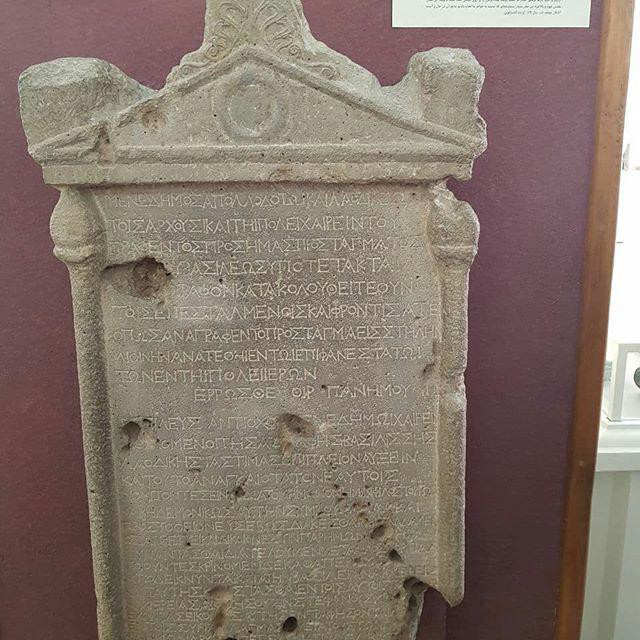
The Greek inscription found in Navahand


The chance discovery of an inscription in Nahavand in 1943 suggested the existence of a Greek temple. Based on the translation of the Greek inscription, the temple was built during the reign of Antiochus III (223-187 BCE), in the place then referred to as Laodicea. In 1949, five small bronze figures were discovered by accident in the same area. 

A little later, whilst visiting the area, Ghirshman happened to identify a Seleucid stone altar and in 1978, during a survey and sounding, Gh. Masumi discovered a stone column base in the same location.


In 2005,during surface survey, an Ionic column base and capital were discovered in the yard of a house belonging to the Seleucid era , as well as a plain stone shaft, bearing no decoration, which probably dates to the Sasanian period. Local people reported several engraved stones, a column drum, and columns bases which had been recycled in the foundations of walls or as steps. Although excavations were limited in this built-up area, 11 test trenches were cut, bringing to light potsherds, architectural fragments, graves, parts of columns and other stone objects. The finds were all obtained from disturbed contexts. In some sondages the excavations continued to a depth of 450cm from the surface, but all layers were damaged and disturbed because of recent activities. 


The pottery included examples from the Seleucid (Figure 4), Parthian (Figure 5), Sasanian and Islamic periods.
The most important find was an Ionic stone capital, now in Nahavand Museum. It is 73.5cm in diameter and 26.5cm in height and decorated by two volutes on two sides. A similar capital, found in Iran, came from a Parthian site in Khorhe and another, found on the present border of Iran, came from the Oxus Temple in modern-day Tajikistan.

Another important item was a column base, which had been used as a mortar for many years and then was abandoned in the corner of a house yard. It is a circular base, 60cm in diameter and 33cm in height. It is decorated by two rather large bold bands. It is very similar to the Ionic column base from Bisotun.


Conclusion

All the Seleucid finds from Nahavand, such as the Greek inscription, the stone altar, bronze figures of the Greek Gods, column bases, capital and potsherds were discovered in the same location at Do-Khaharan, indicating the most likely site of the Greek temple at Iranian Laodicea.

SOURCE: tavoosonline.com

Thursday, 4 July 2019

ELYMAIS ~ THE HELLENISTIC KINGDOM IN IRAN


Elymais or Ελυμαΐς (Greek form of the older name, Elam) was a semi-independent state of the 2nd century BCE to the early 3rd century CE, frequently a vassal under Parthian control, and located at the head of the Persian Gulf in the present-day region of Khuzestan, Iran (Susiana). It is reported that these people were great archers and natives of Susa, which lay to the east of Elymais territory. Most of the Elymais were probably descendants of the ancient Elamites, who once had control of that area in the past. The provinces of Elymais were Massabatice (later Masabadhan), Corbiane and Gabiane. 
The coins of Elymais were based on Greek standards of debased Drachms and Tetradrachms. The royal picture is generally based on Parthian coinage, usually with an anchor with a star in crescent figure. The reverse has a figure or bust of Artemis with text around it, an eagle, or often only elongated dots.


Coin of Kamnaskires II Nikephoros 

Kamnaskires II, surnamed Nikephoros ("the Bringer of Victory") was a king of the Elymais only known from his coins. He reigned from about 147 to 139 BCE. Around 150 BCE, the Seleucid empire disintegrated and at several places local governors became independent and assumed the title of "king" (basileus). The first king in the Elymais was Kamnaskires Soter ("the Saviour"), who ruled 147 BCE. Kamnaskires II Nikephoros ruled slightly later and it is possible that he was identical with Kamnaskires Soter, just changing his name. The coins of Kamnaskires II Nikephoros are fully Hellenistic in style. They show the portrait of a young man. The reverse shows most often a young god. Less common are an anchor, a cornucopia, an eagle, a bow with quiver or a Nike.


EDITED FROM: Wikipedia 

Monday, 1 July 2019

THE STATUE OF HERACLES AND ITS GREEK INSCRIPTION ON MOUNT BEHISTUN IN IRAN


The statue of Hercules is located in Mount Behistun in Iran. It was sculpted for a governor of the Seleucid Empire or the Parthian Empire.
 Hercules is lying on a 2-metre long platform and holds a bowl in his left hand. He has put his right hand on his leg. The statue is 1.47 m long and is attached to the mountain ,with a dedicatory inscription behind Heracles .
The inscription on this statue, is one of the few Greek inscriptions that have survived in Iran. 
Inscription (Original Greek Text) 

ἔτους δξρ᾽, μηνὸς
Πανήμου, Ἡρακλῆν
Καλλίνικον
Ὑάκινθος Πανταύχου
ὑπὲ[ρ] τῆς Κλεομένου
τοῦ ἐπὶ τῶν ἄνω
σ[ατρ]απειῶν σωτηρίας
τῶν σατραπῶν


Translation

In the year 164 (of the Seleucid era)
in the month of Panemos (June)
[set this statue of] Herakles 
Kallinikos ("Hercules glorious in victory")
did Hyakinthos, son of Pantauchos,
for the safety of Kleomenes,
Commander of the Upper Satrapies,
of the satraps.


Friday, 28 June 2019

HERACLES ~ THE GREEK HERO WHO CROSSED BORDERS AND SHAPED NATIONS


Heracles ( Greek: Ηρακλής )  is the most well -known divine Hero in Greek Religion. Son of Zeus and Alcmene, he travelled to many different countries of the ancient world.


Birth
A major factor in the well-known stories about Heracles is the hatred that the Goddess Hera, wife of Zeus, had for him. A full account of Heracles must render it clear why Heracles was so tormented by Hera, when there were many illegitimate offspring sired by Zeus.  Zeus made love to the mortal Alcmene after disguising himself as her husband, Amphitryon, home early from war -Amphitryon did return later the same night, and Alcmene became pregnant with his son at the same time. Heracles'twin mortal brother was Iphicles.


When Heracles was born,Fear of Hera's revenge led Alcmene to expose the infant. However, he was taken up and brought to Hera by his half-sister Athena, who played an important role as protectress of heroes. Hera did not recognize Heracles and nursed him out of pity. Heracles suckled so strongly that he caused Hera pain, and She pushed him away. Her milk sprayed across the heavens and there formed the Milky Way. But with divine milk, Heracles had acquired supernatural powers. Athena brought the infant back to his mother, and he was raised by his parents.


Heracles as a boy strangling a snake (marble, Roman artwork, 2nd century CE). Capitoline Museums in Rome, Italy.

The child was originally given the name Alcides by his parents; it was only later that he became known as Heracles, being renamed Heracles in an unsuccessful attempt to appease Hera. He and his twin were just eight months old when Hera sent two giant snakes into the children's chamber. Iphicles cried from fear, but his brother grabbed a snake in each hand and strangled them. He was found by his nurse playing with them on his cot as if they were toys. Astonished, Amphitryon sent for the seer Tiresias, who prophesied an unusual future for the boy, saying he would vanquish numerous monsters.

After killing his music tutor Linus with a lyre, Heracles was sent to tend cattle on a mountain by his foster father Amphitryon. Here, according to an allegorical parable, "The Choice of Heracles", he was visited by two allegorical figures—Vice and Virtue—who offered him a choice between a pleasant and easy life or a severe but glorious life: he chose the latter.


Later in Thebes, Heracles married King Creon's daughter, Megara. In a fit of madness, induced by Hera, Heracles killed his children and Megara. After his madness had been cured by Antikyreus, he realized what he had done and fled to the Oracle of Delphi. He didn't know that the Oracle was guided by Hera. He was directed to serve King Eurystheus for ten years and do any task Eurystheus required of him. Eurystheus decided to give Heracles ten labours, but after completing them, Heracles was cheated by Eurystheus when he added two more, resulting in the Twelve Labours of Heracles.
1. The Slaying of the Nemean Lion
Heracles defeated a lion that was attacking the city of Nemea with his bare hands. After he succeeded, he wore the skin as a cloak to demonstrate his power over the opponent he had defeated.
2. The Slaying of the 9-headed Lernaean Hydra
The Hydra was a fire-breathing monster with a lion's head and a body of many snakes which lay in a swamp near Lerna. Hera had sent it in hope it would destroy Heracles' home city because she thought it was invincible. With help from his nephew Iolaus, he killed the Hydra and dipped his arrows in its poisoned blood, making them more lethal.
3. The Capturing of the Golden Hind of Artemis
Hercules was ordered not to kill, but to catch, this monster- different, but still difficult, task. It cost time but, having chased it for a year, Heracles wore out the Hind and presented it alive to Eurystheus.
4. The Capturing of the Erymanthian Boar
This was a fearsome marauding boar on the loose. Eurystheus set Heracles the Labour of catching it, and bringing it to Mycenae. Again, a time-consuming task, but the tireless hero found the beast, captured it, and brought it to its final spot. Patience is the heroic quality in the third and fourth Labours.
5. The Cleaning of the Augean Stables in a single day
The Augean stables were the home of 3,000 cattle with poisoned faeces which Augeas had been given by his father Helios. Heracles was given the near impossible task of cleaning the stables of the diseased faeces in only one day. He accomplished it by digging ditches on both sides of the stables, moving them into the ditches, and then diverting the rivers Alpheios and Peneios to wash the ditches clean.
6. The Slaying of the Stymphalian Birds
These aggressive man-eating birds were terrorizing a forest near Lake Stymphalia in northern Arcadia. Heracles scared them with a rattle given to him by Athena, to frighten them into flight away from the forest, allowing him to shoot many of them with his bow and arrow and bring back this proof of his success to Eurystheus.
7. The Capturing of the Cretan Bull
This harmful bull was destroying the lands round Knossos on Crete. Heracles captured it, and carried it on his shoulders to Eurystheus in Tiryns. Eurystheus released it, and it wandered to Marathon which it then terrorized, until killed by Theseus.


Heracles capturing the Cretan Bull. Statue in Germany. 

8. The Theft of the Mares of Diomedes
His next challenge was to steal the horses from Diomedes' stables- horses that had been trained by their owner to feed on human flesh. Heracles' task was to capture them and hand them over to Eurystheus. He accomplished this labour by feeding King Diomedes to the animals before binding their mouths shut.
9.  The  Belt of Hippolyta, Queen of the Amazons
Hippolyta was an Amazon queen and she had a girdle given to her by her father. Heracles had to retrieve the girdle and return it to Eurystheus. He and his band of companions received a rough welcome because, ordered by Hera, the Amazons were supposed to attack them; however, against all odds, Heracles completed the task and secured the girdle for Eurystheus.
10. The Theft of the Cattle of the Monster Geryon
The next labour was to capture the herd guarded by a two-headed dog called Orthrus, the herdsman Erytion and the owner, Geryon; a giant with three heads and six arms. He killed the first two with his club and the third with a poisoned arrow. Heracles then herded the cattle and, with difficulty, took them to Eurytheus.
11.  The Theft of the Golden Apples of the Hesperides

Hercules and Atlas statue, by Michel Anguier, 1668. Louvre Museum 

These sacred fruits were protected by Hera who had set Ladon, a fearsome hundred-headed dragon as their guardian. Heracles had to first find where the garden was; he asked Nereus for help. He came across Prometheus on his journey. Heracles shot the eagle eating at his liver, and in return he helped Heracles with knowledge that his brother would know where the garden was. His brother Atlas offered him help with the apples if he would hold up the heavens while he was gone. Atlas tricked him and did not return. Heracles returned the trickery and managed to get Atlas taking the burden of the heavens once again, and returned the apples to Mycenae.
12. The Capturing of Cerberus
Heracles capturing Cerberus by Antonin Wagner. Hofburg, Vienna 

His last labour and undoubtedly the riskiest. Eurystheus was so frustrated that Heracles was completing all the tasks, that he had 
given him a challenge, which he thought was impossible: Heracles had to go down into the Underworld of Hades and capture the ferocious three-headed dog Cerberus who guarded the gates. Heracles used the souls to help convince Hades to hand over the dog. Hades agreed to give Heracles the dog if he used no weapons to obtain him, and on the condition that Cerberus would later be returned safe to his master. Heracles succeeded and took the creature to Mycenae, causing Eurystheus to be fearful of the power and strength of this hero.


Mortal Death and Rise to Olympus

Heracles killing Nessus the Centaur.1599, Florence

 Having wrestled and defeated Achelous, god of the Acheloos river, Heracles takes Deianira as his wife. Travelling to Tiryns, a centaur, Nessus, offers to help Deianira across a fast flowing river while Heracles swims it. However, Nessus tries to steal Deianira away while Heracles is still in the water. Angry, Heracles shoots him with his arrows dipped in the poisonous blood of the Lernaean Hydra. Thinking of revenge, Nessus gives Deianira his blood-soaked tunic before he dies, telling her it will "excite the love of her husband".

Several years later, rumor tells Deianira that she has a rival for the love of Heracles. Deianira, remembering Nessus' words, gives Heracles the bloodstained shirt. Lichas, the herald, delivers the shirt to Heracles. However, it is still covered in the Hydra's blood from Heracles' arrows, and this poisons him, tearing his skin and exposing his bones. Before he dies, Heracles throws Lichas into the sea, thinking he was the one who poisoned him .Heracles then uproots several trees and builds a funeral pyre on Mount Oeta, which Poeas, father of Philoctetes, lights. As his body burns, only his immortal side is left. Through Zeus' apotheosis, Heracles rises to Olympus as he dies.
No one but Heracles' friend Philoctetes would light his funeral pyre. For this action, Philoctetes or Poeas received Heracles' bow and arrows, which were later needed by the Greeks to defeat Troy in the Trojan War.
According to Herodotus, Heracles lived 900 years before Herodotus' own time (c. 1300 BCE).
Character 

Extraordinary strength, courage, ingenuity, and sexual prowess with both males and females are among the characteristics commonly attributed to him. Heracles used his wits on several occasions when his strength did not suffice. Together with Hermes, he is the patron and protector of gymnasia and palaestrae. His iconographic attributes are the lion skin and the club. These qualities did not prevent him from being regarded as a playful figure who used games to relax from his Labours and played a great deal with children. By conquering dangerous archaic forces he is said to have "made the world safe for mankind" and to be its benefactor.
Heracles and his child Telephus. (Marble, Roman copy of the 1st or 2nd century CE)

 Heracles was an extremely passionate and emotional individual, capable of doing both great deeds for his friends - such as wrestling with Thanatos ( Death ) on behalf of Prince Admetus, who had regaled Heracles with his hospitality, or restoring his friend Tyndareus to the throne of Sparta after he was overthrown- and being a terrible enemy who would wreak horrible vengeance on those who crossed him. 
Presence of Heracles around the world


Iconographical evolution from the Greek Heracles to Shukongōshin. From left to right:
1) Heracles (Louvre Museum).
2) Heracles on coin of Greco-Bactrian king Demetrius I.
3 Vajrapani, the protector of the Buddha, depicted as Heracles in the Greco-Buddhist art of Gandhara.
4) Shukongōshin of Buddhist temples in Japan.(Sensō-ji)


 As Buddhism expanded in Central Asia and fused with Hellenistic influences into Greco-Buddhism, the Greek hero Heracles became Vajrapāni. In that era, he was typically depicted as a hairy, muscular athlete, wielding a short "diamond" club. Via the Greco-Buddhist culture, Heraclean symbolism was transmitted to the Far East. An example remains to this day in the Nio guardian deities in front of Japanese Buddhist temples.

Heracles as protector of Buddha, Vajrapani, 1st-century C.E.. Gandhara.

The protector Vajrapani of the Buddha is another incarnation of Heracles ( Gandhara Art )

Iran 
Strabo reports, probably on authority of Nearchus reports in his Geographika  that the Karmanians worshipped a divinity of victory. That this was Bahram/Verethragna is unlikely if, as per Strabo, he was their "only god." However, the account does reveal that divinities of war were known to the people who were not of the Iranian plateau, evidence for which also comes from Herodotus.

Under the Seleucids (330–150 BCE) and Arsacids (250 BCE–226 CE),  the Empires influenced by Hellenic culture, Verethragna was both identified as Ares and associated with Heracles, and given the Greek name Artagnes. This syncretism is well attested in statuary and iconography, most notably in that of the inscription of Antiochus I Theos of Commagene, in which all three names occur together.


Hellenistic-era depiction of the Zoroastrian divinity Bahram as Hercules carved in 153 BCE at Kermanshah, Iran.

That Bahram was considered the patron divinity of travelers is perhaps reflected by the life-size rock sculpture of the divinity on the main highway at Behistun. There Bahram reclines with a goblet in his hand, a club at his feet and a lion-skin beneath him.
In the early Sassanid period Bahram is still represented as the Greek Heracles. In the relief of Ardeshir I at Naqs-e Rajab III, Bahram appears as one of the two smaller figures between Ahura Mazda and the king. There, he has a lion's skin in his left hand and brandishes a club in his right. The other small figure - who appears to be paying homage to Bahram - is the future king Bahram I.

India
Megasthenes' Herakles is the conventional name of reference of an ancient Indian deity. Herakles was originally a classical Greek divinity. However, in the aftermath of Alexander the Great's conflicts in North-Western India, an Indian version of this classical Greek deity was identified by Megasthenes, who travelled to India as the ambassador of the Seleucids during the reign of Chandragupta Maurya. Upon visiting Mathurai of the Early Pandyan Kingdom, he described the kingdom as being named after Pandaea, Herakles' only daughter.


The Mathura Herakles, strangling the Nemean lion (Kolkata Indian Museum).

Many scholars have suggested that the deity identified as Herakles was Krishna. Edwin Francis Bryant adds the following in this regard:
“ According to Arrian, Diodorus, and Strabo, Megasthenes described an Indian tribe called Sourasenoi, who especially worshipped Herakles in their land, and this land had two cities, Methora and Kleisobora, and a navigable river, the Jobares. As was common in the ancient period, the Greeks sometimes described foreign gods in terms of their own divinities, and there is a little doubt that the Sourasenoi refers to the Shurasenas, a branch of the Yadu dynasty to which Krishna belonged; Herakles to Krishna, or Hari-Krishna: Mehtora to Mathura, where Krishna was born; Kleisobora to Krishnapura, meaning "the city of Krishna"; and the Jobares to the Yamuna, the famous river in the Krishna story. Quintus Curtius also mentions that when Alexander the Great confronted Porus, Porus's soldiers were carrying an image of Herakles in their vanguard. ”

— Krishna: a sourcebook, Edwin Francis Bryant, Oxford University Press US, 2007

James Tod associated Herakles primarily with Baladeva, Krishna's older sibling, but also indicated that Herakles could be associated with both:
“ How invaluable such remnants of ancient race of Harikula! How refreshing to the mind yet to discover, amidst the ruins on the Yamuna, Hercules (Baldeva, god of strength) retaining his club and lion's hide, standing on his pedestal at Baldeo, and yet worshipped by Suraseni! This was name given to a large tract of country round Mathura, or rather round Surpura, the ancient capital founded by Surasena, the grandfather of the Indian brother-deities, Krishna and Baldeva, Apollo and Hercules. The title would apply to either ; though Baldeva has the attributes of 'god of strength'. Both are es (lords) of the race (kula) of Hari (Hari-kul-es), of which the Greeks might have made the compound Hercules. ”

— James Tod, Annals and Antiquities of Rajasthan 

Megasthenes' Herakles as Shiva
According to Quintus Curtius, the Sibae, whom he calls Sobii, occupied the country between the Hydaspes and the Akesines. They may have derived their name from the god Siva.
“ Again when Alexander had captured at the first assault the rock called Aornos, the base of which is washed by the Indus near its source, his followers, magnifying the affairs, affirmed that Herakles had thrice assaulted the same rock and had been thrice repulsed. They said also that the Sibae were descended from those who accompanied Herakles on his expedition, and that they preserved badges of their descent, for they wore skins like Herakles and carried clubs, and branded the mark of a cudgel on their oxen and mules. ”
— Ancient India as described by Megasthenes and Arrian - Dr. Schwanbeck and J.W. McCrindle (1877), pp. 128–129 


According to Dr. Schwanbeck and J. W. McCrindle, Megasthenes meant Siva when he mentioned Herakles in his book Indika
“ Such, then are the traditions regarding Dionysus and his descendants current among the Indians who inhabit the hill-country. They further assert that Herakles also was born among them. They assign to him like Greeks, the clubs and the lion's skin. He far surpassed other men in personal strength and prowess, and cleared sea and land of evil beasts. Marrying many wives he begot many sons, but one daughter only. The sons having reached man's estate, he divided all India into equal portions for his children, whom he made kings in different parts of his dominion. He provided similarly for his daughter, whom he reared up and made a queen. He was the founder, also, of no small number of cities, the most renowned and greatest of which he called Palibothra (Pataliputra). He built therein many sumptuous palaces, and settled within its walls a numerous population. The city he fortified with trenches of notable dimensions, which were filled with water introduced from the river. Herakles, accordingly, after his removal from among the men, obtained immortal honor; and his descendants, having reigned for many generations and signalized themselves by great achievements, neither made any expedition beyond the confines of India, nor sent out any colony abroad. At last however, after many years had gone, most of the cities adopted the democratic form of government, though some retained the kingly until the invasion of the country by Alexander. ”

— Ancient India as described by Megasthenes and Arrian - Dr. Schwanbeck and J.W. McCrindle (1877), pp. 57–58 

Father of the Scythians


 When Heracles carried away the oxen of Geryon, he also visited the country of the Scythians. Once there, while asleep, his horses suddenly disappeared. When he woke and wandered about in search of them, he came into the country of Hylaea. He then found the dracaena of Scythia in a cave. When he asked whether she knew anything about his horses, she answered, that they were in her own possession, but that she would not give them up, unless he would consent to stay with her for a time. Heracles accepted the request, and became by her the father of Agathyrsus, Gelonus, and Scythes. The last of them became king of the Scythians, according to his father's arrangement, because he was the only one among the three brothers that was able to manage the bow which Heracles had left behind and to use his father's girdle.

Heracles in Africa 
On his way to the Garden of Hesperides as his 11th Labour,  Heracles had to fight against Antaeus, who was the half-giant son of Poseidon and Gaia.Antaeus killed people and built a temple to his father using their skulls. Ancient sources place him in Libya.
Plutarch recounts what he says to be a local myth, according to which Heracles, after the death of Antaeus, consorted with his wife, Tinge. They had a son called Sophax, who named a city in North Africa Tingis after his mother. Sophax in his turn was father of Diodorus who conquered many Libyan peoples with his army of Olbians and Mycenaeans brought to Libya by Heracles.

Egypt
Herodotus connected Heracles to the Egyptian god Shu. Also he was associated with Khonsu, another Egyptian god who was in some ways similar to Shu. As Khonsu, Heracles was worshipped at the now sunken city of Heracleion, where a large temple was constructed.

Most often the Egyptians identified Heracles with Heryshaf, transcribed in Greek as Arsaphes or Harsaphes (Ἁρσαφής). He was an ancient ram-god whose cult was centered in Herakleopolis Magna.

 Spain
When Heracles was assigned to take the cattle of Geryon, he travelled to the Iberian Peninsula- that is, modern day Spain. 
This marked the westward extent of his travels. A lost passage of Pindar quoted by Strabo was the earliest traceable reference in this context: "the pillars which Pindar calls the 'gates of Gades' when he asserts that they are the farthermost limits reached by Heracles." Since there has been a one-to-one association between Heracles and Melqart since Herodotus, the "Pillars of Melqart" in the temple near Gades/Gádeira (modern Cádiz) have sometimes been considered to be the true Pillars of Hercules.


According to some sources,while on his way to the garden of the Hesperides on the island of Erytheia, Hercules had to cross the mountain that was once Atlas. Instead of climbing the great mountain, Hercules used his superhuman strength to smash through it. By doing so, he connected the Atlantic Ocean to the Mediterranean Sea and formed the Strait of Gibraltar. One part of the split mountain is Gibraltar and the other is either Monte Hacho or Jebel Musa. These two mountains taken together have since then been known as the Pillars of Hercules, though other natural features have been associated with the name. Diodorus Siculus, however, held that instead of smashing through an isthmus to create the Straits of Gibraltar, Hercules narrowed an already existing strait to prevent monsters from the Atlantic Ocean from entering the Mediterranean Sea. In some versions, Heracles instead built the two to hold the sky away from the earth, liberating Atlas from his damnation.
Having killed Geryon, he freed the locals from his tyranny and founded cities. For example, the founding of Gadeira ( Cadiz ) by Heracles is still commemorated on the city's coat of arms. Another city, Helike ( modern-day Elche ) is said to have been founded by Heracles. 
Sallust mentions in his work on the Jugurthine War that the Africans believe Heracles to have died in Spain where, his multicultural army being left without a leader, the Medes, Persians, and Armenians who were once under his command split off and populated the Mediterranean coast of Africa.

 Gaul 


Heracles sculpture, Louvre Museum

Temples dedicated to Heracles abounded all along the Mediterranean coastal countries. For example, the temple of Heracles Monoikos (i.e. the lone dweller), built far from any nearby town upon a promontory in what is now the Côte d'Azur, gave its name to the area's more recent name, Monaco.
The Gauls had particular reason for their attachment to this hero. They associated Heracles with numerous local stories, since he was said to have passed through Gaul during one of his Twelve Labours (the rustling of Geryon’s cattle). So it was that the cities of Autun, Alesia and Nîmes declared themselves to have been founded by Heracles and that the Lepontians boasted of their descent from his companions.During his stay, Heracles had affairs with many local princesses, whose children were (depending on the version of the story) Celtos, Galatos and/or Iberus, the eponymous ancestors of the Celts, Galatians and Iberians.Heracles’ passage across Gaul thus linked these provinces to the Græco-Roman world starting from the earliest days of antiquity. Furthermore, the Gauls had to admire Hercules as the incarnation of that strength and spontaneous ardour so dear to the Celtic heart, if one can believe the ancient stereotype.


Inscriptions in Hercules’ honour are not particularly abundant in Gaul. Nonetheless, his image is frequently to be encountered, especially on the monumental Jupiter columns typical of the Rhenish region.


In the Rhenish and Danubian regions, dedications are most often made to Hercules Saxanus.This is a Latin adjective—saxanus, belonging to stones, having to do with stones. As it happens, the myth that links Hercules to stones also anchors him in the soil of Gaul.  The epithet 'saxanus' refers to an ambush suffered by Hercules while bringing back the cattle of Geryon. Returning from Spain by way of present-day Provence, Hercules found himself surrounded by enemy Ligurians. The hero prayed to his father Zeus to come to his aid, and the latter caused rocks to rain down on the enemy. In this way, the rocky landscape of the Crau was formed. In memory of this moment of piety and extraordinary aid, people might invoke Heracles Saxanus at times when, surrounded by enemies, they feared for their lives and only divine intervention might save them. Having become a God, Heracles is inclined to recall his own distress and aid in turn those who are suddenly in need of him.

 Inscriptions in honour of Hercules Saxsanus stretched from Germania Inferior and Gallia Belgica as far as Noricum and Venetia, with a special concentration in Germania Superior.


SOURCE : Wikipedia