Tuesday, 24 September 2019

KUSHAN COINS


The Kushans established their rule over a vast area of northern India and central Asia during the 1st century C.E. Many significant rulers of early India belonged to this dynasty including Kujula Kadphises, Kanishka, etc. The Kushans originally belonged to the Yu-Chih tribe. They took the advantage of political instability in the region of northern India during the 1st century C.E. and established their dominance. The empire of the Kushans experienced much prosperity, due to the trading activities of the merchants. They carried out their trade mainly in silk with the Roman Empire. Their commercial activities generated a huge amount of wealth, part of which find its way into the Kushana treasury. The prosperity of the Kushan Empire is well reflected in their coins.

The  Kushan  kings, Kujula and Vima issued gold coins. Archaeologists and numismatists have also found their copper coins. The Kushan coins are excellent examples of artistic excellence and sophistication. The coins were die-struck and produced in large numbers to facilitate growing trade and commerce. They exhibited a great similarity to the earlier Indo-Greek coins, as these coins also depicted the portrait of the issuing monarch in a great detail. The Kushans also closely followed the Indo-Greek weight standard in minting their coins. Some of the coins of Vima Kadphises were minted following the Roman aureus. The early gold coins of the Kushans weigh around 8 gm. We have also some specimens of silver coins issued by Vima. The silver coins were mainly circulated in the area of lower Indus region.

Another main characteristic of the Kushan coins are the depiction of various deities on the reverse of the coins. Various Greek, Iranian, Bactrian and Indian deities were featured in the Kushana coins. We found the Indo-Iranian deities like Mazda, Mao, Athsho, etc. inscribed on the coins of the Kushans. This is significant because it showed the syncretism nurtured by the Kushan rulers.

Another significant example of the syncretism of the Kushans is evident from their issue of bilingual coins. The obverse of the coins carries Greek inscriptions and the reverse Kharosthi inscriptions using the Prakrit language, which was the lingua franca of northern India during the early centuries of Christian era.

The greatest of the Kushan rulers is Kanishka I. He expanded the Kushan rule to many far flung areas of central and eastern India. He also reformed the currency system and issued new variety of coins. The martial character of the king is well depicted in the coins. He can be seen carrying a spear in his left hand in many of the coins.

The Greek and Indian gods and goddesses continued to feature in the Kushan coins. The prominence of the Indian god Shiva in the coins of Kanishka and later Kushans is regarded by numismatists as a proof of their conversion to Saivism in later days. Buddhism also had a profound effect on the Kushans. It is well documented in the archaeological remains. Buddha is also represented in various forms in their coins. Buddha is regarded as Boddo and Sakamano Boddo in these coins. These corroborate the literary texts which described the great patronage provided by Kanishka to Buddhism. Kanishka is still much revered as one of the greatest patrons of Buddhism. However, the policies of issuing bilingual coins were discontinued in favor of Greek or Bactrian legends.

The later Kushan rulers such as Vasudeva, Huvishka, etc. continued to issue highly sophisticated gold coins. The portrait of Huvishka in the coins is highly appreciated for its artistic excellence and exact depiction of the.

Due to the abundance of the gold coins of the Kushans, they are considered as the worthy predecessors of the Guptas by some scholars.

More for the Kushan Empire here: https://greekasia.blogspot.com/2019/05/the-hellenistic-kushan-empire-and.html

EDITED FROM: coin-competition.eu

Monday, 23 September 2019

COINAGE OF INDO- GREEKS


Striving for realism in sculptural modelling, movement and expression became the major force motivating Hellenistic art.  Perhaps there was a desire to impress subjects of the realm with the true appearance of their lawful monarch which led to engrave the portraits on the coins of Bactrian Greeks and Seleucids.  Alexander was the first emperor to put his portrait on his coins and the practice was inherited by his successors in India.  Extraordinary realism of their portraiture and the Praxitelean character of the full length images of deities on the reverse were the prime attributes of their coins. It is not clear whether Alexander himself has issued any coins in his name during his sojourn in India.  But it is a fact that his coins are a great rarity in India and it seems that his coins have come from Bactria.

The gold and silver coins with fabulous portraits, which circulated in Bactria were never current in India as they fall under Greek coinage category.  The coins with the portrait head and bilingual fall under Indian coinage.  The Seleucid king Antiochus I (293-280 BCE) is shown on his coins with all the paths of humanity, the divine power is clearly reflected in Seleucus' coins.  Demetrios  I was the first ruler to strike square copper coins in bilingual format, Kharoshti on the reverse and Greek on the obverse. Silver coins underwent radical change upon the movement of government to south of Hindu Kush, and the coins were called Didrachm and Hemidrachms.  Generally, coins are circular, exceptions are the few square ones of Appollodotos and Philoxenos.


The portraits of early Indo Greek rulers such as Euthydemos-I, Demetrios-I (wearing an elephant's scalp) and Antimachus (wearing Kausia - a flat shaped cap and with a smiling face) are so realistic in appearance, that the coin portrait seems to represent the ruler faithfully.  The coins of Demetrious-II, Euthydemos-II, Pantaleon, Agathocles, Menander and Strato-I are also assigned to the same class as they express powerful features and very intricate personal details. The portrait of Eucradites-I and the bust of members of the house of Eucradites-I is so realistic that their coins indicate rigid majesty, tendency for idealization and the taste for symbolic ornamentation when compared to the coins of house of Euthedemos. Some of the coins of this house carried the image of the king on horseback.  Notably, the Dioskouri, the Greek heroes featured in Eukratides's coins exhibit the horsemanship and prowess in battle through the raised spears.  The coins of Appollophanes, Philoxenos and Theophilos are extremely rare and hence leads to suspect that they were the pretenders.  Perhaps all the Indo- Greek coins may have been the products of a single school of engravers; the realism makes us believe that they were familiar with the Hellenestic school of Pergamon.


Indo-Greeks were excellent coin smiths and the fabric far exceeded than the true Greek coins.  Indo-Greeks did not like abstract shapes and  they modified Greek Gods to look like Indians.  Upon the arrival of the Greeks, the sculptural techniques were heavily influenced by them.  Indo-Greeks kept very close to their Greek roots,something which can be seen in the bilingual legends they carried on their coins. During that time, India saw a revolution in art and culture.  The Gods  for whom the Indo-Greek artists laboured had hardly changed for many generations : Apollo, the intellectual God of Arts and Music, Zeus, the King of the Gods and Hera, His consort, Artemis, the Virgin Huntress, muscular Heracles, the God of Strength, Athena the Goddess of Wisdom, Aphrodite, the Goddess of Love,  Dionysos, the God of Ecstasy, and winged deities Nike and Eros. Helios, Poseidon, Demeter, the Dioskouri  and Tyche are the other Greek divinities which could be seen in their coinage.  Many of these images iconographically influenced the Indian pantheon at a later stage.


The vitality of  the Hellenistic Art school is reflected in the coins the Indo- Greek engravers made.  Bold reliefs were employed on large flans to impart three dimensional effect of images and legends; The marginal borders and the legends along with the borders set the boundary.  Clearly formed cheeks, broad smooth forehead, deep furrows which divide hair and beard, muscular bare body with every minute anatomical detail are reflected in their coinage.  Though drapery is so thick, the movement is exhibited by the position of the limbs or partial torsion of the body.  The figures are created in such a magnificent style, that the light and shadow highlight the liveliness of image.


On the reverse of Eukratides's copper, we see the figure of seated Zeus along with the legend in Kharoshti 'The city deity of Kapisa'.  The later kings Strato-I and Hermaios struck coins with debased silver and even in lead.  One of the copper coins of Hermaios, the legend Kujula Kadphises appears on the reverse. Probably this could be assumed that the dynasty was succeed by the Kushans.


SOURCE: forumancientcoins.com

NEMESIS ~ THE GREEK GODDESS OF REVENGE AND DIVINE RETRIBUTION


Nemesis is the Greek Goddess of Revenge and Divine Retribution. She plays an important role in the history of the Ancient World.Nemesis is the personification of Divine retribution against those who commit  Hubris (arrogance before the Gods). Her name means "She Who Distributes What is Due." Nemesis directs human affairs in such a way as to maintain balance.She is also known as Rhamnusia,and another name for her is Adrasteia, meaning “the Inescapable.”She represents the ideas of righteous anger, due enactment, or divine vengeance.

 Nemesis has been described as a daughter of Zeus,but according to Hyginus, She is a child of Erebus and Nyx. Hesiod mentions that She is the daughter of Nyx, being born without a father.In the Theogony, Nemesis is the sister of the Moirai (the Fates), the Keres (Black Fates), the Oneiroi (Dreams), Eris (Discord) and Apate (Deception).

In the classic Greek tragedies, Nemesis appears chiefly as the avenger of crime and the punisher of hubris and as such is akin to Ate, the Greek goddess of mischief, delusion, ruin, and folly and the Erinyes.

There is also a tradition that Nemesis produced the egg from which hatched two sets of twins: Helen of Troy and Clytemnestra and the Dioscouri, Castor and Polydeukes. According to this story,Nemesis tries  to avoid Zeus' amorous advances and turns into a goose; but He is also transformed into a swan and sleeps with Her. Nemesis, then,lays an egg that is discovered in the marshes by a shepherd, who passes it to Leda. It is in this way that Leda comes to be the mother of Helen of Troy, as she kept the egg in a chest until it hatched.


The Symbols of Nemesis
Nemesis is depicted as a beautiful, thoughtful woman, often wearing a crown and holding a rudder, balance, and cubit and seated in a chariot drawn by griffins.The wheel is also one of her main symbols, as it illustrates the speed with which Nemesis executes justice and the swift change of conditions. She often holds a whip or a sword, symbols of power and punishment .Another interesting fact about Nemesis is that She has wings.

Sunday, 22 September 2019

HORAE ~ THE GREEK GODDESSES OF SEASONS AND DIVINE ORDER


The Horae or Hours are the Goddesses of the seasons in Greek Religion. They are also Goddesses of order and justice, as well as the wardens at the gates of Mount Olympus. They are the daughters of either Zeus and Aphrodite , or Zeus and Themis. Two groups of Horae are mentioned.
The first group is associated with Aprodite and Zeus, and is linked to the classical three seasons of the year; Thallo (the bringer of blossoms) is the Goddess of spring and blooming, protecting young people; Auxo (the increaser of plants); and Carpo (the bringer of food) aare linked to autumn, ripening and harvesting. The latter is also the main Guardian of the path that leads to Mount Olympus and the One who conceals it behind the clouds.
The second group, linked to Themis and Zeus, is closely associated with law and order. The three Horae in this case are Dike, Goddess of moral justice; Eunomia, Goddess of order and governing according to good laws; and Eirene, Goddess of peace and wealth, who is depicted carrying a cornucopia, scepter and a torch.
The Orphic Hymn below refers to the 2nd group of Horae- translation in English and a Youtube video with reciting in Greek : 


Daughters of Zeus and Themis, seasons bright,
Justice [Dike], and blessed Peace [Eirene], and lawful Right [Eunomia],
Vernal and grassy, vivid, holy pow'rs, whose balmy breath exhales in lovely flow'rs
All-colour'd seasons, rich increase your care, circling, for ever flourishing and fair:
Invested with a veil of shining dew, a flow'ry veil delightful to the view:
Attending Persephone, when back from night,
the Fates [Moirai] and Graces [Kharites] Lead her up to light;
When in a band-harmonious they advance, and joyful round her, form the solemn dance:
With Ceres [Meter] triumphing, and Jove [Zeus] divine; propitious come, and on our incense shine;
Give earth a blameless store of fruits to bear, and make a novel mystic's life your care.

Saturday, 21 September 2019

ORPHIC HYMN TO PHANES PROTOGONOS


According to the Orphic Theogony, Phanes is one of the names of the creative principle of the Universe,personification of the Creator Eros. Phanes is a primal Deity- that's why in Greek He is called Protogonos. He came out of the Cosmic Egg, which Nyx ( Night) had given birth to. In the 'Orphic Rhapsodies', it is mentioned that Chronos ( Time ) is the cause of all things and the Creator of Phanes' Cosmic Egg.

The following is the Oprhic Hymn to Phanes, translated inEnglish:

Mist clears, day dawns, the First day dawns,
breaking dim and Universal Light. Orpheus sings and singing brings us light.Across the Sky the great and golden Egg hangs like an oblong Sun about to burst, cracking amidst the horizons of those Immortal Beings, of Living Gods the First, the Archetypes, as yet unseen, unknown, that are to come. The high-pitched shuddering song through nothingness resounds, Primeval Word, Creation at the beginning of all worlds.

First-born of time and space Protogonos,  only Begetter Begotten on Himself; double-sexed, a living X, a cross whose meeting point is undivided, wealth of proposition and increase. Phanes-Ericapeus, All-Powerful, Ineffable, Occult, Winged Glory , through the world You fly. Increase of joy and wonder, pierce the very vault of of darkest Heaven with flashing pinions formed of glittering sapphire and of gold interleaved with spangles of the Stars and whirling circles of universal fire.Priapus, dark-eyed splendour , Thee I sing , Bountiful, Unwearying Potent King.
Invincible, Prime Unity, The One; Good in Himself; Spawning nothing but good; the very Spirit and Image of the Great God. Sole breeding Ruler of eternity, Lord, Quintessence of infinity; of Ether and of Chaos father-mother according to Pythagoras himself. How could that One unfold, make two, divide? become corruptible, and multiply, break down? First of the Secret Genera of the Divine, says Syrianus. Called by Orpheus, on the authority of Proclus, Tender Love.

The Second King is Night; the Third is Heaven; Saturnus is the Fourth and Fifth Lord Zeus, Ruler of His Father; Dionysos Sixth in due progression of the royal line, emanations from the Original Divine. All these Kings, these intellectual Gods, are born into the world when it is made upon the breaking of the Golden Egg, when Great Lord Phanes, Beautiful, comes forth giving birth to everything that lives.


On Earth is Heaven found; and in the Sky another Earth , the wise Egyptian taught. Each in each is bound; and by and by returns to its beginning at the end ,when universal destructions rend the plurality of whirling matter. Phanes lives forever, can never die, we men are made Immortal by His Love, men and women glorified, here below as there above, just as before the cracking of the Egg. 

ORPHIC HYMN TO GODDESS ATHENA


The following video presents the Orphic Hymn to Goddess Athena. The hymn is recited in the original ancient Greek text.


The English translation is as follows , by Thomas Taylor :

Only- begotten, noble race of Jove,
Blessed and fierce, who joyest in caves to rove; Oh, warlike Pallas, whose illustrious kind, ineffable and effable we find: Magnanimous and famed, the rocky height, and groves, and shady mountains Thee delight ; In arms rejoicing, who with Furies dire and wild, the souls of mortals dost inspire. Gymnastic Virgin of terrific mind,Dire Gorgon's bane, unmarried, blessed, kind, Mother of Arts, impetuous; understood, Rage to the wicked, Wisdom to the good :
Female and male, the Arts of War are Thine, Fanatic, much-formed Dragoness, Divine :Over the Phlegrean giants, roused to ire, Thy coursers driving , with destruction dire. Sprung from the head of Jove, of splendid mien, Purger of evils, all-victorious Queen. Hear me, Oh Goddess, when to Thee I pray, with supplicating voice both night and day , and in my latest hour, give peace and health, propitious times, and necessary wealth, and, ever-present, be thy votaries aid, Oh, much implored, Art's Parent, blue-eyed Maid. 

ORPHIC HYMN TO GODDESS ARTEMIS


In the above video, you can listen to the Orphic hymn dedicated to Goddess Artemis,sung in ancient Greek. This wonderful piece of Hellenic Religion includes the many epithets to describe the Maiden Goddess. Below, there is an English translation of the lyrics.
Performance/ Music : Dimitris Erateinos

Hear me, oh, Queen, many- named daughter of Zeus, Titanis, Bacchic, renowned, Archeress, exalted, shining on all, torch-bearer, Goddess Diktynna, Protectress of childbirth, You aid in a woman's travail while never having Yourself the pain of childbirth, freeing women from maidenhood, inspiring zeal, Huntress, driving cares away, youthful Runner, Shooter of arrows, Huntress, You roam through the night, Keeper of the chapel, gracious One, Liberator, manly One, You wail in your revels, bestowing quick childbirth, You foster the fledgling mortals, fond of the chase, Earthy, Slayer of wild beasts, Blessed, You dwell in the mountains and forests, Hunter of deer, revered, Mistress, Queen of all, Beautiful scion forever to be, haunting the forests, Protectress of dogs, Kydohnian, many-shaped,come, Goddess Deliverer, Beloved One, to all your mystics. Be accessible, bring us the splendid fruits of the earth, lovely peace, beautiful locks of hair and health; Drive away disease and pain to the mountains. 

Friday, 20 September 2019

GRECO-BACTRIAN AND INDO-GREEK KINGDOMS THROUGH GREEK AUTHORS


The rarity of the appearance of Greco-Bactrian and Indo-Greek Kingdoms in ancient literature is one of the reasons why those states are so little-known today. Indo-Greek literature did exist, but none has been found that speaks about the Greco-Bactrian and Indo-Greek states. Classical authors tell us very little about Indo-Greek kingdoms, as they were far away from the Mediterranean world, cut-off from other Greeks by the mighty Parthian state. Indian classical literature almost never interested itself in events, except from a religious point of view, and thus does not help to solve the dilemma. Chinese accounts exist, but only supply us with limited information.

Almost all of what remains today of ancient litterature about those kingdoms can be summarized on one page, which is what this article is going to accomplish.

NB: These are only quotes about the Greco-Bactrian and Indo-Greek kingdoms, and not about Bactria,as an area.

Some Greek Sources
When the news came that Euthydemus with his army was before Tapuria, and that 10,000 cavalry were in his front guarding the ford of the river Arius, Antiochus decided to abandon the siege and deal with the situation. The river being at a distance of three days' march, he marched at a moderate pace for two days, but on the third day, he ordered the rest of his army to break up their camp at daylight while he himself with his cavalry, his light-armed infantry, and 10,000 peltasts advanced during the night, marching quickly. For he had heard that the enemy's horse kept guard during the day on the river bank, but retired at night to a town as much as 20 stades away. Having completed the remainder of the distance during the night, as the plain is easy to ride over, he succeeded in getting the greater part of his forces across the river by daylight. The Bactrian cavalry, when their scouts had reported this, came up to attack and engaged the enemy while still on the march. The King, seeing that it was necessary to stand the first charge of the enemy, called on 1,000 of his cavalry who were accustomed to fight round him and ordered the rest to form up on the spot in squadrons and troops and all place themselves in their usual order, while he himself with the force I spoke of, met and engaged the Bactrians who were the first to charge. In this affair it seems that Antiochus himself fought more brilliantly than any of those with him. There were severe losses on both sides, but the King's cavalry repulsed the first Bactrian regiment. When, however, the second and third came up, they were in difficulties and had the worst of it. It was now that Panaetolus ordered his men to advance, and joining the King and those who were fighting round him, compelled those Bactrians who were pursuing in disorder to turn rein and take to headlong flight. The Bactrians, now hard pressed by Panaetlus, never stopped until they joined Euthydemus, after losing most of their men. The royal cavalry, after killing many of the enemy and making many prisoners, withdrew, and at first encamped on the spot near the river. In this battle, Antiochus's horse was transfixed and killed, and he himself received a wound in the mouth and lost several of his teeth, having in general gained a greater reputation for courage on this occasion than on any other. After the battle Euthydemus was terror-stricken and retired with his army to a city in Bactria called Zariaspa.

(Polybius, Histories, X, 49, between 167-157 BCE. Translation: H. J. Edwards 1922)


For Euthydemus himself was a native of Magnesia, and he now, in defending himself to Teleas, said that Antiochus was not justified in attempting to deprive him of his Kingdom, as he himself had never revolted against the King, but after others had revolted he had possessed himself of the throne of Bactria by destroying their descendants. After speaking at some length in the same sense, he begged Teleas to mediate between them in a friendly manner and bring about a reconciliation, entreating Antiochus not to grudge him the name and state of King, as if he did not yield to this request, neither of them would be safe; for considerable hordes of Nomads were approaching, and this was not only a grave danger to both of them, but if they consented to admit them, the country would certainly relapse into barbarism. After speaking thus, he dispatched Teleas to Antiochus. The King, who had long been on the look-out for a solution of the question when he received Teleas' report, gladly consented to an accommodation owing to the reasons above stated. Teleas went backwards and forwards more than once to both Kings, and finally Euthydemus sent off his son Demetrius to ratify the agreement. Antiochus, on receiving the young man and judging him from his appearance, conversation, and dignity of bearing to be worthy of royal rank, in the first place promised to give him one of his daughters in marriage and next gave permission to his father to style himself King. After making a written treaty concerning other points and entering into a sworn alliance, Antiochus took his departure, serving out generous rations of corn to his troops and adding to his own the elephants belonging to Euthydemus.

(Polybius, Histories, XI, 34.1-10, between 167-157 BCE. Translation: H. J. Edwards 1922)


The Greeks who caused Bactria to revolt grew so powerful on account of the fertility of the country that they became masters, not only of Ariana, but also of India, as Apollodorus of Artemita says: and more tribes were subdued by them than by Alexander—by Menander in particular (at least if he actually crossed the Hypanis towards the east and advanced as far as the Imaüs), for some were subdued by him personally and others by Demetrius, the son of Euthydemus the King of the Bactrians; and they took possession, not only of Patalena, but also, on the rest of the coast, of what is called the kingdom of Saraostus and Sigerdis. In short, Apollodorus says that Bactriana is the ornament of Ariana as a whole; and, more than that, they extended their empire even as far as the Seres and the Phryni. Their cities were Bactra (also called Zariaspa, through which flows a river bearing the same name and emptying into the Oxus), and Darapsa, and several others. Among these was Eucratidia, which was named after its ruler. The Greeks took possession of it and divided it into satrapies, of which the satrapy Turiva and that of Aspionus were taken away from Eucratides by the Parthians. And they also held Sogdiana, situated above Bactriana towards the east between the Oxus River, which forms the boundary between the Bactrians and the Sogdians, and the Iaxartes River. And the Iaxartes forms also the boundary between the Sogdians and the nomads.

(Strabo, Geography, XI. 11.1-2, between15/10 BCE and 24 CE. Translation: Horace Leonard Jones 1917)

At any rate, Apollodorus, who wrote The Parthica, when he mentions the Greeks who caused Bactriana to revolt from the Syrian kings who succeeded Seleucus Nicator, says that when those kings had grown in power they also attacked India, but he reveals nothing further than what was already known, and even contradicts what was known, saying that those kings subdued more of India than the Macedonians; that Eucratidas, at any rate, held a thousand cities as his subjects.

(Strabo, Geography, XV.3,between15/10 BCE and 24 CE. Translation: Horace Leonard Jones 1917)

EDITED FROM: Ancient History Encyclopedia

Tuesday, 17 September 2019

MARBLE COLUMN FROM THE TEMPLE OF ARTEMIS IN SARDIS


The section of a fluted Ionic column in the center of this room stood over fifty-eight feet high in its original location at the Temple of Artemis. The delicate foliate carving on the capital is unique among extant capitals from the temple, and the torus (foliated base), with its vegetal scale-like pattern, is also exceptionally elaborate. This capital is slightly smaller than others found at the site, indicating that it does not belong to the outer colonnade. Two similar pairs of columns stood in the east and west porches. The column, displayed here with most of the shaft omitted, was probably originally from one or more of those pairs. Alternatively, it may be from the cella (inner room) or from the inner back porch. Parts of the fluted shaft are restored, and the profiled base below the torus is a copy of the original.


SOURCE: THE MET MUSEUM

Sunday, 15 September 2019

GRECO-BUDDHISM : THE GREEK INFLUENCE IN ASIA


Greco-Buddhism is the term used for  the cultural syncretism between Hellenistic culture and Buddhism, which developed between the 4th century BCE and the 5th century CE in Bactria and the Indian subcontinent, namely the territories of modern-day Afghanistan, India, and Pakistan. It was a cultural consequence of a long chain of interactions initiated by Greek forays into India from the time of Alexander the Great, carried further by the establishment of the Indo-Greek Kingdom and extended during the flourishing of the Kushan Empire. Buddhism was then adopted in Central and Northeastern Asia from the 1st century CE, ultimately spreading to China, Korea, Japan, Philippines, Siberia, and Vietnam. In 326 BCE, Alexander conquered the Northern region of India. King Ambhi of Taxila, known as Taxiles, surrendered his city, a notable Buddhist center, to Alexander. Alexander fought the famous Battle of Hydaspes against King Porus of Pauravas in the Punjab, in 326 BCE. Several Greek philosophers, such as Pyrrho, Anaxarchus and Onesicritus, are said to have been selected by Alexander to accompany him in his eastern campaigns. During the 18 months they were in India, they came in contact with Indian ascetics, who are known as Gymnosophists.

Pyrrho (360-270 BCE) returned to Greece and became the first Skeptic and the founder of the Pyrrhonism school. The Greek biographer Diogenes Laërtius explained that Pyrrho's equanimity and detachment from the world were acquired during his stay in India. Few of his quotes are directly known, but they are clearly reminiscent of śramanic, possibly Buddhist, thought: "Nothing really exists, but human life is governed by convention. ... Nothing is in itself more this than that". Strabo informs us that Onesicritus, a Cynic, is said by Strabo to have learnt in India the following precepts: "That nothing that happens to a man is bad or good, opinions being merely dreams. ... That the best philosophy [is] that which liberates the mind from [both] pleasure and grief". The Indian emperor Chandragupta Maurya, founder of the Maurya Empire, took back the northwest Indian territory which Alexander had taken over in 322 BCE.  Emperor Seleucus I Nicator came to a marital agreement as part of a peace treaty, and several Greeks, such as the historian Megasthenes, resided at the Mauryan court. Chandragupta's grandson Ashoka embraced the Buddhist faith and became a great proselytizer in the line of the traditional Pali canon of Theravada Buddhism, insisting on non-violence to humans and animals (ahimsa), and general precepts regulating the life of common people. According to the Edicts of Ashoka, set in stone, some of them written in Greek and some in the Achemenid script, he sent Buddhist emissaries to the Greek lands in Asia and as far as the Mediterranean. Alexander had established several cities in Bactria,such as Ai-Khanoum and Bagram; the administration which was formed under his rule and under the Seleucids and the Bactrian Kingdom, lasted firmly for more than 200 years. During all this time, the contacts with the Indian territories were constant and direct. 

The Greeks sent ambassadors to the court of the Maurya Empire, such as the historian Megasthenes under Chandragupta Maurya, and later Deimachus under his son Bindusara, who reported extensively on the civilization of the Indians. The Greco-Bactrians maintained a strong Hellenistic culture at the door of India during the rule of the Maurya Empire in India, as exemplified by the archaeological site of Ai-Khanoum. When the Maurya Empire was toppled by the Shunga Empire around 180 BCE, the Greco-Bactrians expanded into India, where they established the Indo-Greek Kingdom, under which Buddhism was able to flourish.The Greco-Bactrians conquered parts of North India from 180 BCE, whence they are known as the Indo-Greeks.

They controlled various areas of the northern Indian territory until  10 CE. Buddhism prospered under the Indo-Greek kings, and it has been suggested that their invasion of India was intended to protect the Buddhist faith from the religious persecutions of the Shungas (185–73 BCE), who had overthrown the Mauryans. According to Ptolemy, Greek cities were founded by the Greco-Bactrians in northern India. Menander established his capital in Sagala (Sialkot, Punjab, Pakistan) one of the centers of the blossoming Buddhist culture. A large Greek city built by Demetrius and rebuilt by Menander has been excavated at the archaeological site of Sirkap near Taxila, where Buddhist stupas were standing side-by-side with Hindu and Greek temples, indicating religious tolerance and syncretism. The Kushan Empire, one of the five tribes of the Yuezhi, settled in Bactria around 125 BCE, displacing the Greco-Bactrians and invading the northern parts of Pakistan and India from around 1 CE. By that time they had already been in contact with Greek culture and the Indo-Greek kingdoms for more than a century. They used the Greek script to write their language, as exemplified by their coins and their adoption of the Greek alphabet.

The absorption of Greek historical and religious culture is suggested by Kushan sculptures representing Dionysian scenes or even the story of the Trojan Horse and it is more than probable that Greek communities remained under Kushan rule. The Kushan king Kanishka, who honored Zoroastrian, Greek and Brahmanic deities as well as the Buddha and was famous for his religious syncretism, convened the Fourth Buddhist council around 100 CE in Kashmir in order to redact the Sarvastivadin canon. Some of Kanishka's coins bear the earliest representations of the Buddha on a coin (around 120 CE), in Hellenistic style and with the word "Boddo" in Greek script. The Kanishka casket, dated to the first year of Kanishka's reign in 127 CE, was signed by a Greek artist named Agesilas, who oversaw work at Kanishka's stupas (cetiya), confirming the direct involvement of Greeks with Buddhist realizations at such a late date. Numerous works of Greco-Buddhist art display the intermixing of Greek and Buddhist influences, around such creation centers as Gandhara. The subject matter of Gandharan art was definitely Buddhist, while most motifs were of Western Asiatic or Hellenistic origin.

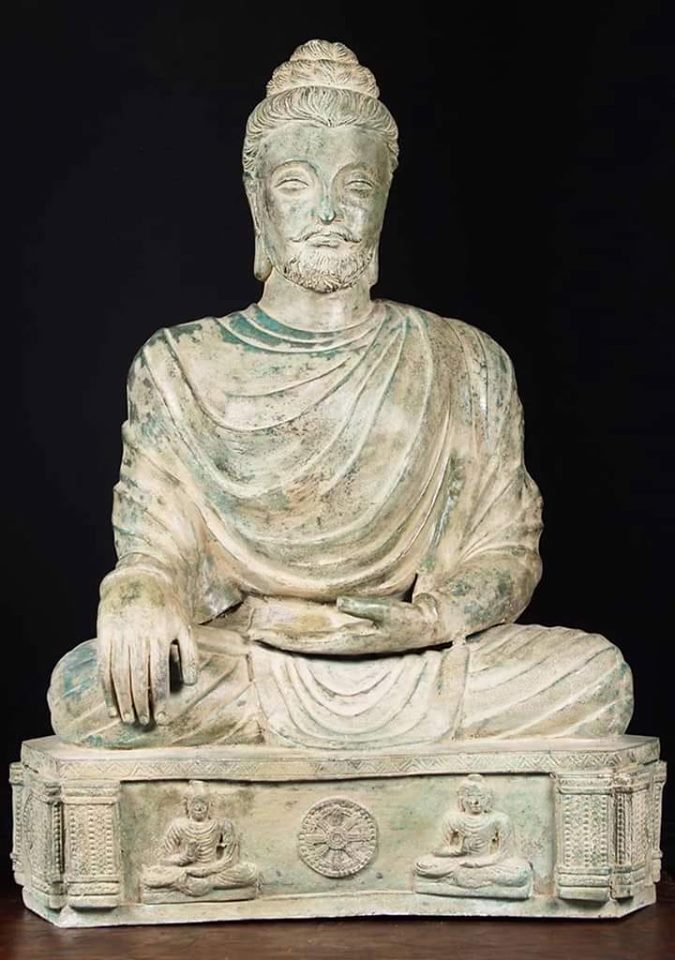
The first anthropomorphic representations of the Buddha himself are often considered a result of the Greco-Buddhist interaction. Before this innovation, Buddhist art was "aniconic": the Buddha was only represented through his symbols. Many of the stylistic elements in the representations of the Buddha point to Greek influence: himation, the contrapposto stance of the upright figures ( 1st–2nd century Gandhara standing Buddhas ), the stylized curly hair and ushnisha apparently derived from the style of the Apollo Belvedere(330 BCE) and the measured quality of the faces, all rendered with strong artistic realism. A large quantity of sculptures combining Buddhist and purely Hellenistic styles and iconography were excavated at the modern site of Hadda, Afghanistan. The curly hair of Buddha is described in the famous list of the physical characteristics of the Buddha in the Buddhist sutras. The hair with curls turning to the right is first described in the Pāli canon. Greek artists were most probably the authors of these early representations of the Buddha, in particular the standing statues, which display "a realistic treatment of the folds and on some even a hint of modelled volume that characterizes the best Greek work. This is Classical or Hellenistic Greek, not archaizing Greek transmitted by Persia or Bactria, nor distinctively Roman." The Greek stylistic influence on the representation of the Buddha, through its idealistic realism, also permitted a very accessible, understandable and attractive visualization of the ultimate state of enlightenment described by Buddhism.


EDITED FROM: Wikipedia