Sunday, 22 March 2020

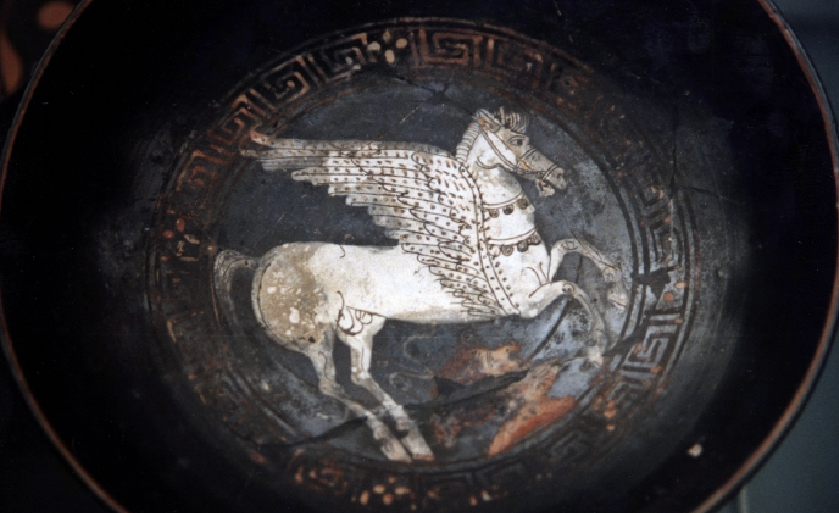
PEGASUS ~ THE GREEK WINGED HORSE


Pegasus (or Pegasos) is a winged-horse from Greek Tradition which was fathered by Poseidon and was born from the severed neck of the gorgon Medusa, slain by Perseus. Poseidon gave Pegasus to his son Bellerophon who put Pegasus to good use in his famous battle with the Chimaera.

The story of Bellerophon begins with the hero visiting Tiryns and enjoying the hospitality of the city’s king Proitos. However, trouble started when Stheneboia, the king’s wife, fell in love with the hero and made inappropriate advances. Bellerophon, being a good guest, politely rejected these advances but predictably, Stheneboia saw red and went before the king and accused the visitor of attempting to seduce her. In punishment, Bellerophon was sent by Proitos to serve his father-in-law Iobates, King of Lykia. On arrival, Bellerophon was set a series of dangerous and impossibly difficult tasks, chief amongst them being to destroy the fearsome and rather bizarre monster, Chimaera. This fire-breathing creature was a terrible mix of a lion’s body with a snake for a tail and the head of a goat sprouting from its back. 


 Bellerophon was fortunate to have Pegasus at his disposal- and his winged companion helped him immensely. In some accounts he found the horse at the fountain of Pirene near Corinth, and Hesiod suggests this fact explains the name Pegasus, derived from ‘water’- pēgē.  Taming the horse with the help of Athena, Bellerophon rode (and flew) Pegasus and managed to kill the monstrous Chimaera with his spear.
Bellerophon and Pegasus went on to enjoy further success with other challenges, Iobates assigned to the hero, including a battle with the Amazons. However, becoming rather boastful and thinking he could fly high enough on his winged steed to take his place amongst the Immortal Gods, Bellerophon was thrown by Pegasus and fell unceremoniously back to earth. Meanwhile, Pegasus kept on going and on reaching Mt. Olympus, he was given to Eos who was responsible for bringing Dawn across the sky each day. According to Hesiod in his Theogony, Pegasus also brought Zeus His thunder and lightning whenever needed.


Pegasus is also credited with creating a number of springs with a stamp of his hoof. Most famous of these were the Hippocrene spring on Mt. Helicon, close to the grove sacred to the Muses, and the spring at Troezen.

Pegasus appeared on Greek pottery, the earliest being Corinthian wares from the 7th century BCE. Pegasus was also a popular design on coins, in particular from Corinth from the 6th century BCE. A famous representation in sculpture is from the pediment of the Temple of Artemis on Corcyra (c. 580 BCE). The Bellerophon and Pegasus myth was also a popular subject in Roman art - especially engraved semi-precious stone cameos and floor mosaics - where the horse became symbolic of immortality.

Source:  https://www.ancient.eu/


Saturday, 21 March 2020

1821 ~THE GREEK WAR OF INDEPENDENCE ~ VIDEO


The Greek War of Independence ( 1821– 1831), also known as the Greek Revolution ( Greek: Ελληνική Επανάσταση / Elliniki Epanastasi), was a successful war waged by the Greeks to win independence for Greece from the Ottoman Empire. Independence was finally granted by the Treaty of Constantinople in July 1832 when Greece (Hellas) was recognized as a free country. The Greeks were the first of the subject peoples of the Ottoman Empire to secure recognition as a sovereign power. Greeks celebrate their independence day every year, on March 25.

Friday, 20 March 2020

PELLA ~ A HELLENISTIC CITY IN SYRIA


Pella (Ancient Greek: Πέλλα, Hebrew: פחל) is found in northwestern Jordan, at the modern town of Tabaqat Fahl, طبقة فحل) 27.4 km south of the Sea of Galilee. Pella represents one of about ten  cities of Decapolis, which were founded during the Hellenistic period and became powerful under Roman jurisdiction. With a history extending back into the Bronze Age, Pella expanded to its largest state during the Roman period. It is located in the Jordan Valley, 130 km north of Amman. Today, the city's ancient sites are excavated by archaeologists, and attract thousands of tourists annually.
Established as an urban centre under the early Seleucids, its ancient name must still have been known, for its new, Greek name was a close synonym, Pella - the birthplace of Alexander the Great in the area of Macedonia in Greece.

Several of these houses suffered what appears to be the same fiery destruction in the Late Hellenistic period. This has been attributed to a massive destruction by the Hasmonean king, Alexander Jannaeus, about 83 or 82 BCE (Josephus, The Jewish War 14.4.8; Antiquities 14.4.4). From Josephus, it is clear that Pella had been damaged and therefore needed some restoration by Pompey decades afterwards; but his specific reference to the destruction of Pella by Jannaeus because its inhabitants refusing to follow Jewish customs, seems to refer to a different place (Antiquities, XIII.395-397): it is listed as if amongst southern Levantine cities and out of its more normal sequence between Gadara, Gerasa and Scythopolis.

In 63 BCE, the Roman General Pompey integrated the region into the Eastern portion of the Roman Empire, converting the old Seleucid empire into the province of Coele-Syria and incorporating Judaea as a client kingdom.  A group of cities claiming Greek Hellenistic foundations asked Pompey for freedom from the threat of incorporation within Rome's new client-state of Hasmonaean Judaea. Pompey agreed, and these cities were called the Decapolis - literally, the ten cities - although the lists which have survived vary in composition and number. Pella, however, is consistently a "Decapolis" city, and the city in the northernmost bounds of the region known as Perea. If these cities had previously dated their years from their foundation under Alexander the Great or Seleucis I Nicator, they now honoured Pompey by counting 63 BCΕ as a new "Year One". Like most cities within the empire, Pella would have had its own town council. It also minted coins in the Roman period.

Source: Wikipedia

Thursday, 19 March 2020

THE GREEK REVOLUTION IN BEIRUT

On March 18th 1826, a small group of brave Greek Revolutionaries, led by Vasos Mavrovouniotis attempted to liberate the Ottoman-occupied city of Beirut, and thus spread the Hellenic Revolution to Coele-Syria.

According to then-British Consul John Barker, stationed in Aleppo, the Revolutionaries were thwarted by a local Mufti and a hastily arranged defense force. Although initially repelled, the Greek heroes did manage to hold on to a small portion of the city near the seashore in an area inhabited by local Greeks.

During that time, they appealed to the locals“to rise up and join them”, and even sent an invitation to the chief of the local Druzes to also join the Revolution. Although unsuccessful, their heroic attempt to incite the Greeks of the Levant lives on as a testament that the Greeks of Europe and those of the Levant were and still are one people.

Source: The Greco~Syrian Nation Facebook Page 

Wednesday, 18 March 2020

DIONISIOS SOTER ~ KING OF PUNJAB


Dionysios Soter (Greek: Διονύσιος ὁ Σωτήρ; epithet means "the Saviour") was an Indo-Greek king in the area of eastern Punjab.

According to Osmund Bopearachchi, he reigned c. 65–55 BCE and inherited the eastern parts of the Kingdom of the important late ruler Apollodotus II. The kings share the same epithet and use the common reverse of fighting Pallas Athena, and it seems plausible that they were closely related; however, relationships between the last Indo-Greek kings remain uncertain, since the only sources of information are their remaining coins. R. C. Senior dates him approximately ten years later.

Earlier scholars like Professor Ahmad Hasan Dani have dated Dionysius much earlier, between the years 115 and 100 BCE, making him the ruler of the Swat and Dir Valleys and the weak successor of Polyxenos.


Dionysios was probably pressured by the invasions of the Indo-Scythians, and also had to deal with Hippostratos, a more important king who had inherited the western part of the Kingdom of Apollodotus II.

Dionysios' name echoes the Greek God of wine and ecstasy, Dionysos, who, according to Greek Religion, had conquered India during a significant campaign. 

Dionysios was the first in the line of late kings who issued only silver drachms, but no tetradrachms, which was likely due to his limited resources. On their obverse, there is a diademed portrait of the king, with Athena Alkidemos on the reverse.


He also issued bronzes with Apollo on the reverse and a tripod on the obverse. Both these types were inherited from Apollodotus II. The quality of the portraits is inferior to most earlier kings. According to Bopearachchi, Dionysios inherited only the inferior celators of Apollodotus II, which he associates with mints in eastern Punjab.

One single coin of Dionysios Soter is known to have used the "boxy" mint-mark characteristic of the last Indo-Greek kings, down to Apollophanes, Strato II and Strato III, who used it exclusively of any other.He is also the first king known to have used this mint-mark, which therefore came to be during his reign.

Sources : Wikipedia, coinindia

Monday, 16 March 2020

THEODORUS OF CYRENE


Known as much for his pupils as for his other work, Theodorus of Cyrene worked on questions involving the square roots of 3 and 5. This led him to discoveries concerning irrational numbers, or numbers that continue indefinitely without any repeating pattern.

Theodorus was born in Cyrene, now part of Libya, which at that time was a Greek colony. Though he was in Cyrene when he died 67 years later, he must have spent part of his life in Athens, where he studied under Protagoras (c. 485-c. 410 BCE) and interacted with Socrates (c. 470-390 BCE). He later taught both Theaetetus of Athens (c. 417-c. 369 BCE) and Plato (427-347 BCE), the principal source of information regarding his work.

Plato later wrote that Theodorus showed his students that "the side of a square of three square units and of five square units" was "not commensurable in length with the unit length"—in other words, the square roots of 3 and 5 are irrational numbers.

As for Theodorus, little else is known about him aside from Plato's brief reference to his teachings regarding the irrational roots of 3 and 5. It is possible to infer from the Plato passage, located in his Theaetetus, that the irrational nature of √2 had already been established. Some claim that Pythagoras (c. 580-c. 500 BCE) showed that √2 was irrational, and certainly Theodorus must have used the Pythagorean theorem to construct lines of length √3 or √5 .

Most interesting, perhaps, is the role Theodorus played in the generalization of the idea of irrational numbers. This is indicated by this sentence in Plato: "The idea occurred to the two of us [Theaetetus and Socrates], seeing that these square roots appeared to be unlimited in multitude, to try to arrive at one collective term by which we could designate all these roots...." Using a method of reduction known at the time, he apparently proved that the roots of non-square numbers from 3 to 17 were irrational, and from this probably arrived at a general theorem that the square roots of all nonsquare numbers are irrational.

Source: http://www.bookrags.com/#gsc.tab=0

Saturday, 14 March 2020

THE TEMPLE OF ZEUS IN THE GREEK CITY OF CYRENE IN LIBYA


The city of Cyrene was founded c.631 BCE as a colony of the Greek island of Thera. It became the most important Greek city in the region and got its name from the Greek princess, or Nymph, Kyrene. The God Apollo fell in love with her and took her to Libya, where they had a child together. This ancient Greek city ,which was known as the Athens of Africa, was the location of the Temple of Zeus. Dating to the 6th century BCE, this temple is larger than the Parthenon in Athens; a reflection of the wealth and importance of the region of Cyrene in the ancient Greek world.

The Temple was built in the Doric style, with two rows of 17 X 8 Doric columns, 70 X 32 meters. Though initially a Greek temple, later stonework on the temple shows evidence of Egyptian style workmanship.

 The temple was destroyed during a Jewish rebellion in 115 CE, which took place in various Roman districts as far as Cyprus and then was restored in 120 CE. During its restoration, it was given a new marble frontage and a high podium, in the traditional Roman style which was popular within the Empire.


In the great earthquake of 365 CE, the Temple suffered severe damage and was left abandoned for many centuries.In 1957,Italian archaeologists restored the building to its present state temple of Zeus to its present state. All work for restoration in Libya ceased in 1974. The temple is now an UNESCO World Heritage site. 


Archaeological evidence suggest that animal sacrifices were carried out within the temple. Also, numerous coins have been found in the area which depict Zeus- Ammon, a syncretic image of Zeus.This worship could have appeared during Hellenistic Times. Under Roman rule, the Temple was devoted to Zeus as Jupiter.


Thursday, 12 March 2020

YAVANA JATAKA ~ THE TRANSMISSION OF GREEK KNOWLEDGE ON INDIAN ASTRONOMY


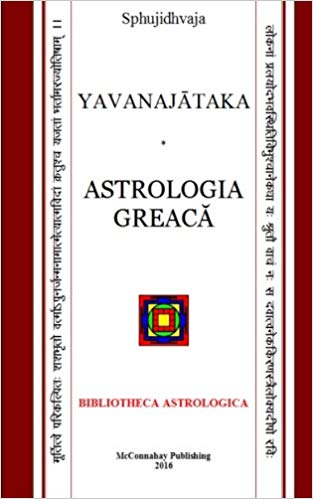
The Yavanajātaka (Sanskrit: yavana 'Greek' + jātaka 'nativity' = 'nativity according to the Greeks') of Sphujidhvaja is an ancient text in Indian astrology.

According to David Pingree, it is a later versification of an earlier translation into Sanskrit of a Greek text on horoscopy, thought to have been written around 120 CE in Alexandria. Based on Pingree's interpretation and emendations, the original translation, made in 149–150 CE by "Yavanesvara" ("Lord of the Greeks") under the rule of the Western Kshatrapa king Rudrakarman I, is lost; only a substantial portion of the versification 120 years later by Sphujidhvaja under Rudrasena II has survived. However, according to the recent research by Mak based on a newly discovered manuscript and other documents, Pingree's date interpretation as well as a number of crucial readings such as zero and other bhūtasaṃkhyā were based on his own emendation, not supported by what was written on the manuscripts. Furthermore, traditionally Yavanesvara and Sphujidhvaja were understood as referring to the same person, the former being an epithet to the latter, according to authors such as Bhaskara and Utpala. The date of the Yavanajātaka according to Mak is now revised to between 4th and 6th century CE.

Yavanajataka is one the earliest known Sanskrit works referencing western horoscopy. It was followed by other works of Western origin which greatly influenced Indian astrology: the Paulisa Siddhanta ("Doctrine of Paul"), and the Romaka Siddhanta ("Doctrine of the Romans"-meaning the byzantine empire).  However, the earliest known Sanskrit work on horoscopy is Vedanga Jyotisha.

It was translated by David Pingree into English, which was published as volume 48 of the Harvard Oriental Series in 1978.
The last verses of the text describe the role of Yavanasvera in the creation of the text, and the role of Sphujidhvaja in its subsequent versification:

"Previously Yavanesvara (the lord of the Greeks), whose vision of the truth came by favor of the Sun and whose language is flawless, translated this ocean of words, this jewel-mine of horoscopy, which was guarded by its being written in his tongue (i.e., Greek), but the truth of which was seen by the foremost of kings (in the year) 71; (he translated) this science of genethlialogy for the instruction of the world by means of excellent words." (Chapter 79/60-61 The Yavanajataka of Sphujidhvaja)
"There was a wise king named Sphujidhvaja who versified this entire (text), which was seen by him in the year 191, in 4,000 indravajra verses." (Chapter 79/62 The Yavanajataka of Sphujidhvaja)
The dates employed in the Yavanajataka are based on the Kushan and Greek era (see Chapter 79/14 "When 66 years of the Sakas have elapsed..."), meaning that the translation of the text into Sanskrit was made by Yavanasvera in 149 CE (year 71 of the Kushan and Greek era, which starts in 78 CE). Accordingly, the versification by Sphujidhvaja was made in 269 CE.

The Yavanajataka contains instructions on calculating astrological charts (horoscopes) from the time and place of one's birth. Astrology flourished in the Hellenistic world (particularly Alexandria) and the Yavanajataka reflects astrological techniques developed in the Greek-speaking world. Astronomical mathematical methods, such as the calculate of the 'horoskopos' (zodiac sign on the eastern horizon) was used in the service of astrology.
References to Greek astrology
There are various direct references to Greek astrological knowledge in the text, and the nomenclature is clearly taken from the Greek language:

"The seventh place from the ascendent, the descendent, is called jamitra (diametros) in the language of the Greeks; the tenth from the ascendent, the mid-heaven, they say, is the mesurana (mesouranma)." (Chapter 1/49 The Yavanajataka of Sphujidhvaja)
"This is said to be the method of determining the strength or weakness of the signs and planets according to the teaching of the Greeks; they say that, of the complete set of influences in horoscopy, there is an enormous number..." (Chapter 1/92 The Yavanajataka of Sphujidhvaja)
"Thirty-six are the thirds of the zodiacal signs which are called Drekanas (dekanos) by the Greeks. They have various clothes, forms, and colors; I will describe them with all their qualities beginning with their characteristic signs." (Chapter 3/1 The Yavanajataka of Sphujidhvaja)
"The rule concerning the actions of people which was described by the foremost (astrologers) of the Greeks with respect to the planetary week-days is to be established in a similar rule with respect to the hours (hora) which pass through the days" (Chapter 77/9 The Yavanajataka of Sphujidhvaja)
"If the ascendant is an upacaya of his birth-ascendant and is occupied by a benefit planet, but not conjoined with a malefic, and if the Moon is in a good and favourable sign, the Greeks say that he always succeeds in his undertakings." (Chapter 78/3 The Yavanajataka of Sphujidhvaja)
"The wise say that the observed course of the planets is the supreme eye of the entire body of the rules of horoscopy. I shall explain it concisely according to the instruction of the Greeks." (Chapter 79/1 The Yavanajataka of Sphujidhvaja)
"Some who are students of the laws (of astronomy) find that it is good to follow the opinion of the sage Vasistha; (but according to) the best of the Greeks (the yuga) should consist of 165 years." (Chapter 79/3 The Yavanajataka of Sphujidhvaja)

Source: Wikipedia

Tuesday, 10 March 2020

PEGASUS ON GREEK COINS


Pegasus (Greek: Πήγασος, Pḗgasos; Latin: Pegasus, Pegasos) is a winged divine horse, and one of the most recognized creatures in Greek Religion. Usually depicted as pure white, Pegasus is the offspring of the Olympian God Poseidon. He was foaled by the Gorgon Medusa upon her death, when the hero Perseus decapitated her. 

Pegasus was caught by the Greek hero Bellerophon, near the fountain Peirene, with the help of Athena and Poseidon. Pegasus allowed Bellerophon to ride him in order to defeat the monstrous Chimera, an achievement which led to many other exploits. Bellerophon later fell from the winged horse's back while trying to reach Mount Olympus. Afterwards, Zeus transformed Pegasus into the eponymous constellation.


Bellerophon was king of Corinth- therefore, Pegasus appears on numerous coins of Corinth and its colonies. Generally, this famous winged creature is featured on other ancient Greek coins as well. 
It was also used on modern Greek drachmas in the 20th century.


Sunday, 8 March 2020

ARCHEBIOS NIKEPHOROS ~ GREEK KING IN INDIA


Archebius Dikaios Nikephoros (Greek: Ἀρχέβιος ὁ Δίκαιος, ὁ Νικηφόρος; epithets mean respectively, "the Just", "the Victorious"; was an Indo-Greek king who ruled in the area of Taxila. Osmund Bopearachchi dates him to c. 90–80 BCE, and R. C. Senior to about the same period. 

He was probably one of the last Indo-Greek kings before the Saka king Maues conquered Taxila, and a contemporary of Hermaeus in the west. He may have been a relative of Heliokles II, who used a similar reverse and also the title Dikaios.
Archebius issued silver with diademed or helmeted king, sometimes in spear-throwing pose. On the reverse is Zeus standing facing, holding a thunderbolt or on some issues an aegis.


Archebius also struck a rare series of Attic tetradrachms, found in Bactria.
He issued bronzes with an owl / Nike.

Sources:  Wikipedia , Coinindia

Friday, 6 March 2020

ERATOSTHENES OF CYRENE


Eratosthenes of Cyrene (c. 276 BCE–192 or 194 BCE) was an ancient Greek mathematician, poet, and astronomer who is known as the father of geography. Eratosthenes was the first person to use the word "Geography" and other geographical terms that are still in use today, and his efforts to calculate the circumference of the Earth and the distance from the Earth to the Sun paved the way for our modern understanding of the cosmos. Among his other many accomplishments were the creation of the first map of the world and the invention of an algorithm known as the sieve of Eratosthenes, which is used to identify prime numbers.
Eratosthenes was born around 276 BCE in a Greek colony in Cyrene, a territory located in present-day Libya. He was educated at the academies of Athens and in 245 BCE, after earning attention for his skills, he was invited by Pharaoh Ptolemy III to run the Great Library at Alexandria in Egypt. This was a major opportunity, and Eratosthenes was excited to accept the position.

In addition to being a mathematician and geographer, Eratosthenes was also a very gifted philosopher, poet, astronomer, and music theorist. He made several significant contributions to science, including the discovery that a year is slightly longer than 365 days, requiring an extra day—or leap day—be added to the calendar every four years to keep it consistent.

Geography
While serving as the Head Librarian and scholar at the Library of Alexandria, Eratosthenes wrote a comprehensive treatise about the world, which he called "Geography." This was the first use of the word, which in Greek means "writing about the world." Eratosthenes' work introduced the concepts of torrid, temperate, and frigid climate zones. His map of the world, though highly inaccurate, was the first of its kind, featuring a grid of parallels and meridians used to estimate distances between different locations. Though Eratosthenes' original "Geography" did not survive, modern scholars know what it contained thanks to reports by Greek and Roman historians.

The first book of "Geography" contained a summary of existing geographical work and Eratosthenes' speculations about the nature of the planet Earth. He believed it was a fixed globe whose changes only took place on the surface. The second book of "Geography" described the mathematical calculations he had used to determine the circumference of the Earth. The third contained a map of the world in which the land was divided into different countries; it is one of the earliest examples of political geography.


Calculating the Circumference of the Earth
Eratosthenes' most famous contribution to science was his calculation of the circumference of the Earth, which he completed while working on the second volume of his "Geography."

After hearing about a deep well at Syene (near the Tropic of Cancer and modern-day Aswan) where sunlight only struck the bottom of the well on the summer solstice, Eratosthenes worked out a method by which he could calculate the circumference of the Earth using basic geometry. Knowing that the Earth was a sphere, he needed only two critical measurements to calculate the circumference. Eratosthenes already knew the approximate distance between Syene and Alexandria, as measured by camel-powered trade caravans. He then measured the angle of the shadow in Alexandria on the solstice. By taking the angle of the shadow (7.2 degrees) and dividing it into the 360 degrees of a circle (360 divided by 7.2 yields 50), Eratosthenes could then multiply the distance between Alexandria and Syene by the result to determine the circumference of the Earth.

Remarkably, Eratosthenes determined the circumference to be 25,000 miles, just 99 miles over the actual circumference at the equator (24,901 miles). Although Eratosthenes made a few mathematical errors in his calculations, they canceled each other out and yielded an amazingly accurate answer that still causes scientists to marvel.

A few decades later, the Greek geographer Posidonius insisted that Eratosthenes' circumference was too large. He calculated the circumference on his own and obtained a figure of 18,000 miles—about 7,000 miles too short. During the Middle Ages, most scholars accepted Eratosthenes' circumference, though Christopher Columbus used Posidonius' measurement to convince his supporters that he could quickly reach Asia by sailing west from Europe. As we now know, this was a critical error on Columbus' part. Had he used Eratosthenes' figure instead, Columbus would have known he was not yet in Asia when he landed in the New World.

Prime Numbers
A noted polymath, Eratosthenes also made notable contributions to the field of mathematics, including the invention of an algorithm used to identify prime numbers. His method involved taking a table of whole numbers (1, 2, 3, etc.) and striking off the multiples of each prime, beginning with multiples of the number two, then multiples of the number three, etc. until only the prime numbers remained. This method became known as the sieve of Eratosthenes, as it works by filtering out the non-prime numbers in the same way that a sieve filters solids out of liquids.


Death
In his old age, Eratosthenes became blind and he died of self-induced starvation in either 192 or 196 BCE in Alexandria, Egypt. He lived to be about 80 to 84 years old.


Legacy
Eratosthenes was one of the greatest Greek polymaths, and his work influenced later innovators in fields ranging from mathematics to geography. Admirers of the Greek thinker called him Pentathlos, after the Greek athletes known for their prowess in a number of different events. A crater on the Moon was named in his honor.


https://www.thoughtco.com/

Wednesday, 4 March 2020

THE IMPACT OF HELLENISM ON INDIAN CULTURE


The modern country called Greece in the continent of Europe is generally referred to as ‘ Hellas’.
This reference is found in all ancient literatures and inscriptions. So Greek culture is otherwise known as Hellenic culture to the rest of the world.


Background
Though India had maintained its trade and commercial contacts with other parts of the world, a new dimension was added by the invasion of the great Greek hero Alexander in the last quarter of 4th century BCE.

Alexander did not prefer to remain confined within the state of Greece. He dreamt of ruling over a large empire. So he came in direct conflict with the Persian emperor. In 330 BCE, Alexander brought an end to the powerful Persian rule in the battle at Arbela. After the Persian defeat, the traffic between India and the West slowed down.

After Persia, Alexander’s next move was to march towards India, and he marched to its north-western frontiers. He fought the Battle of Hydaspes with the Indian King Porus in 326 BCE. Alexander did not march into the interior of Indian sub-continent due to the exhaustion of his army. But even after his short stay in India, he left behind a rich legacy of Greek culture. This legacy not only influenced India but also brought new manifestations in different spheres.

During the time of Alexander, Greece had reached the pinnacle of glory in the realms of art, literature, philosophy and science.

The Hellenic influence was considerably felt first in the realm of political life. When Alexander returned from India, he left the charge of the conquered Indian territories among his generals, who ultimately paved the way for the rise of Maurya dynasty in Indian history. The young and ambitious Indian hero Chandragupta Maurya liberated the north-western frontier of India from  the Greek rule and founded the Maurya dynasty.

The first three Maurya kings Chandragupta, Bindusara and Ashoka maintained close relationships with the Greeks. Indeed, Chandragupta had married the Greek Princess Helena, daughter of Seleucus Nikator, a Greek king of Syria and a former General of Alexander’s army. This friendship was cemented by the arrival of Meghasthenes and Daimachus as ambassadors of Seleucus. Meghasthenes’s account of India in his book Indica refers to a great extent the cultural interactions between the two countries.

This relationship was strengthened further during the reign of Chandragupta Maurya’s son Bindusara who had asked the Greek King Antiochus to send Greek wine and raisins that were in great demand in India. The diplomatic relationship between India and the West are recorded in the Rock Edict XIII of Ashoka where Ashoka had referred to the names of five Greek rulers in whose kingdoms Buddhist missionary activities were undertaken.

Due to the increase of commercial as well as political intercourse, the number of visitors between India and the West also increased. Such contacts are recorded in great detail in works like Strabo’s Geography, Arrian’s Indica, Pliny’s Natural History, The Periplus of Erythrean Sea and Ptolemy’s Geography. Moreover, the Greeks were quite positive towards other religions such as Buddhism.The conversion of the Greek King Menander to Buddhism is a glaring example. Some Greeks also offered donations in the Buddhist caves at Karle.
The Garuda Pillar at Vidisha in Madhya Pradesh was the work of Heliodorous, son of Dion, a Greek envoy. Thus, India had come to occupy an important position in the Greek world. The other side of the story is equally fascinating. The Greeks also asserted tremendous influence on the cultural life of India in the fields of art and architecture, coinage, drama and science.


Art and Architecture

The Hellenic impact on Indian artistic tradition was tremendous. It manifested itself in the form of an entirely new movement known as Gandhara School of Art. As the name suggests, this school of art developed from the particular region of Gandhara in the north-west, now in Afghanistan. Later it spread over to Taxila, Mathura and Sarnath. This style of art chiefly concentrated on images and relics of Buddha. They were made of either stone or stucco. Most of the ruins of this form of art found at Bimaran, Dehri, Sakra and Hastanagar are now preserved in the museum of Peshawar in Pakistan.


It is otherwise called as Greco- Buddhist School of Art. Gandhara art is generally considered as an eastern expansion of Hellenic civilisation mixed with Indian elements or a western expansion of Indian culture. Prof. R.C. Majumdar has rightly remarked, “The Gandhara artists had the hands of a Greek and the hearts of an Indian.” This form of art actually originated in Bactria and Parthia under the Greek rulers. In course of time, the local artists began to construct Buddhist images applying Greek techniques but with Indian spirit and style.


2. The images had more resemblance with the Greek God Apollo with heavy ornamentation, drapery and headdress which were alien to Indian concept.

3. Refinement and polish of the images were of high order.

4. The images were seated in the typical Indian Yogic posture. It was an actual observation of Indian ascetics rather than on any western prototype.

Thus, with Hellenic influence, Gandhara school of art established itself firmly on Indian soil. At the same time to counterbalance and supplement the trends of this school, an indigenous school of art also developed known as the Mathura School of Art.


Coinage
The Greeks introduced o the art of coin making in India.The idea of striking both the obverse and reverse sides of the coins was learnt from the Greeks. One side contained the picture and symbol of the ruler while the other side had a picture of some other devices. Further, the technique of die cutting with refined polish was also learnt from the Greeks.

By introducing such new Hellenic techniques to the previously crude Indian coinage system, the Indians were able to produce coins of finer variety. Over time, the Sakas and the Parthians adopted this Greek technique which got further impetus under the Imperial Guptas.

Science
Indian science came under tremendous influence of Hellenism, especially in the field of astronomy. The Greeks were the inheritors of a glorious cultural heritage. Their advanced way of thinking with high pedigree influenced the Indians to a large extent.


Though the Greeks were treated as Yavanas or outsiders by the Hindus, their outstanding astronomical knowledge compelled the Indians to follow their methods. Gargi Samhita openly appreciates their intellectual superiority in astronomy. The signs of the zodiac, the 7-day week and the hour concepts were brought by the Greeks. 

The existence of planets, change of lunar appearances in relation to the stars was made known to the Indians through this Hellenic channel.

http://www.historydiscussion.net/