Friday, 7 February 2020

NICOMACHUS ~ THE PYTHAGOREAN MATHEMATICIAN OF GERASA ( JERASH )


Nicomachus of Gerasa (Greek: Νικόμαχος ) (60 CE – 120 CE)  was an important ancient mathematician, best known for his works Introduction to Arithmetic and Manual of Harmonics in Greek. He was born in Gerasa, in the Roman province of Syria (now Jerash, Jordan), and was strongly influenced by Aristotle.
Little is known about the life of Nicomachus, except that he was a Pythagorean who came from Gerasa. Historians consider him a Neopythagorean based on his tendency to view the numbers having mystical properties. The age in which he lived is only known because he mentions Thrasyllus in his Manual of Harmonics, and because his Introduction to Arithmetic was apparently translated into Latin in the mid-2nd century by Apuleius.His Manual of Harmonics was addressed to a lady of noble birth, at whose request Nicomachus wrote the book; this suggests that he was a respected scholar of some status.He mentions his intention to write a more advanced work, and how his frequent travelling leaves him short of time.
 As a Neo-Pythagorean, Nicomachus was often more interested in the mystical properties of numbers rather than their mathematical properties. One of his works that have been saved is his Introduction to Arithmetic (Ἀριθμητικὴ εἰσαγωγή, Arithmetike eisagoge). According to Henrietta O. Midonick (1965), he distinguishes between the wholly conceptual immaterial number, which he regards as the 'divine number', and the numbers which measure material things, the 'scientific' number. He writes extensively on numbers, especially on the significance of prime numbers and perfect numbers and argues that arithmetic is ontologically prior to the other mathematical sciences (music, geometry, and astronomy), and is also the root of these sciences. Boethius' De institutione arithmetica is, to a large part, a Latin translation of this work. However, Introduction to Arithmetic does contain quite elementary errors, which show that Nicomachus chose not to give proof of his results because he did not have such proof in general. Many of the results were known by Nicomachus to be true since they appeared with proof in Euclid, although in a geometrical formulation. Sometimes Nicomachus states a result which is simply false and then illustrates it with an example that happens to have the properties described in the result. We can deduce from this that some of the results are merely guesses based on the evidence of the numerical examples.
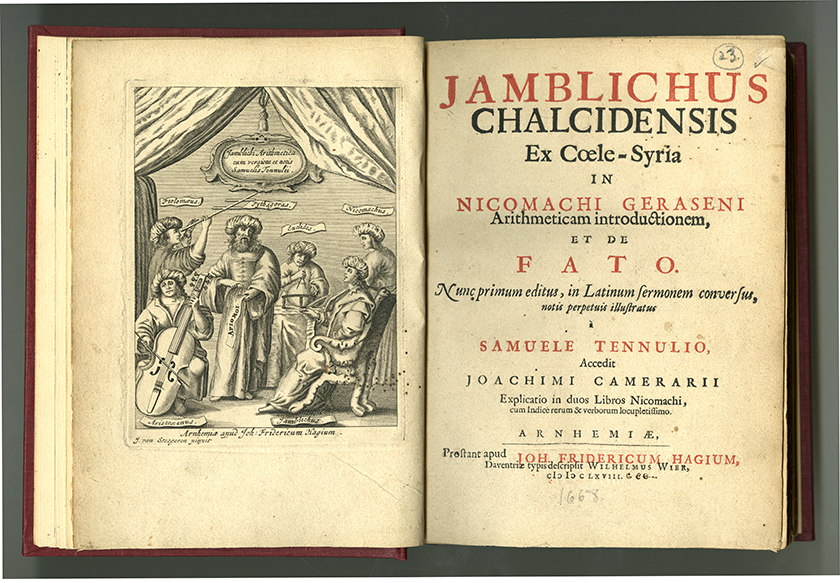
Although he was preceded by the Babylonians and the Chinese,Nicomachus provided one of the earliest Greco-Roman multiplication tables, whereas the oldest extant Greek multiplication table is found on a wax tablet dated to the 1st century CE (now found in the British Museum).

Manuale Harmonicum (Ἐγχειρίδιον ἁρμονικῆς, Encheiridion Harmonikes) is the first important music theory treatise since the time of Aristoxenus and Euclid. It provides the earliest surviving record of the legend of Pythagoras's epiphany, which took place outside a smithy, that pitch is determined by numeric ratios. Nicomachus also gives the first in-depth account of the relationship between music and the ordering of the universe via the "music of the spheres." Nicomachus's discussion of the governance of the ear and voice in understanding music unites Aristoxenian and Pythagorean concerns, normally regarded as antitheses.Amidst the theoretical discussions, Nicomachus also describes the instruments of his time, also providing a valuable resource. In addition to the Manual, ten extracts survive from what appear to have originally been a more substantial work on music.

The works of Nicomachus which have been lost are the following:

Art of Arithmetic (Greek: Τέχνη ἀριθμητική), his larger work on arithmetic, mentioned by Photius.
A larger work on music, promised by Nicomachus himself, and apparently referred to by Eutocius in his comment on the sphere and cylinder of Archimedes.
An Introduction to Geometry, referred to by Nicomachus, although it is unclear whether this was his own work. 
Theology of Arithmetic (Greek: Θεολογούμενα ἀριθμητικῆς), on the Pythagorean mystical properties of numbers. This work was divided into two books, mentioned by Photius. There is an extant work sometimes attributed to Iamblichus under this title, written two centuries later, which contains a great deal of material thought to have been copied or paraphrased from Nicomachus' work.
A Life of Pythagoras (per Iamblichus), one of the main sources used by Porphyry and Iamblichus, for their (extant) Lives of Pythagoras.
A collection of Pythagorean dogmata, referred to by Iamblichus.
On Egyptian festivals (Greek: Περὶ ἑορτῶν Αἰγυπτίων), is mentioned by Athenaeus, whether this was indeed written by Nicomachus is still uncertain.

Source :Wikipedia

Wednesday, 5 February 2020

CONSTANTINOS DOXIADIS ~ THE GREEK ARCHITECT OF ISLAMABAD


Islamabad was designed by a Greek architect, Constantinos Apostolou Doxiadis, and his firm. The city design was based on a grid plan. At that time, C. A. Doxiadis was implementing large projects in housing, urban and regional development in more than 40 countries.

Read more details about the Islamabad project by the firm, here:- https://www.doxiadis.org/Downloads/Islamabad_project_publ.pdf?fbclid=IwAR0tRDBAUZpglyuvsGfQfoK0UYhYdwwNmcVQVDv5FBkUTaYNav9vicnCD3s

Image: Dr. C. A. Doxiadis presenting his first ideas on the Master Plan of Islamabad, in February 1960
Source : Chief Commissioner Islamabad  Facebook Page

Monday, 3 February 2020

THEOPHILOS ~ INDO- GREEK KING

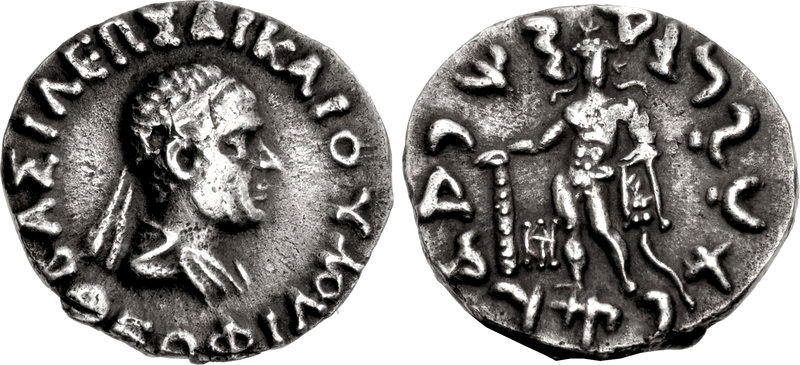
 Theophilos (Greek: Θεόφιλος) was a minor Indo-Greek king who ruled for a short time in the Paropamisadae. He was possibly a relative of Zoilos I and is only known from coins. It is possible that some of Theophilos' coins in fact belong to another ruler, in Greek Bactria, during approximately the same period.
While Bopearachchi suggests c. 90 BCE, R. C. Senior believes that Theophilos ruled in the 130s BCE. Both numismatics do however suggest that the reigns of Theophilos and Nicias were adjacent.
Just like Zoilos I, Theophilos struck Indian silver coins with Herakles, a common symbol of the house of Euthydemus I, and the epithet Dikaios/Dhramikasa "The Just/Follower of the Dharma". The monograms are mostly the same as those of Nicias. The bronzes have similar inscriptions.


However, there is a wholly different, and very rare, Attic coinage of a king Theophilos. Found in Bactria, these coins feature a reverse with a seated Athena with Nike, a different title Autokrator "Autocrat King" (Greek: ΒΑΣΙΛΕΩΣ ΑΥΤΟΚΡΑΤΟΡΟΣ), and also a separate monogram. Although this is not a very common occurrence on Indo-Greek coins, the coins of Theophilos have generally been accepted as belonging to one unique king.


Edited from : Wikipedia , Coinindia

Sunday, 2 February 2020

LIBYA ~ A COUNTRY NAMED AFTER A GRANDDAUGHTER OF ZEUS


Like all of the Mediterranean and beyond, Libya is another case of a territory with profound influence from Greek culture and ancient tradition. The name Libya is noted in Ancient Greek Religion, but also forms part of the Ancient Greek world. The Religion of the Greeks, which carries traces of history potentially dates back many thousand years BCE provides an explanation on how the area got its name.

 Libya is the daughter of Epafos (son of Zeus and Io) and Memphida (Memphis) and was the queen of the territory that took her name. Lybia had children with Poseidon; these were the twins Aginoras and Vilos and Lamia and Lelegas. Vilos has a son named Egyptos (Egypt, bordering Libya).

The most important point to note here is not so much the story, but the power of the ancient Greek Tradition and language that has allowed for the name to be maintained and to be assimilated in so many languages. This is one other piece of evidence of the profound influence of Greek culture in  North Africa. Although so many cultures invaded the Libyan territory, the Greek name of this territory has been maintained and adopted by the vast majority of languages.

One of the most famous Greek cities founded in Libya is Cyrene (pronounced Kirini in Greek) which, according to traditional historians, was founded in 630 BCE. Also, in ancient times the term “Libya” was used to describe all of northern Africa or the whole continent (e.g. Ptolemy).

Saturday, 1 February 2020

ALEXANDER THE GREAT DEPICTED WITH BUDDHA ~ HADDA, AFGHANISTAN


When sculptors of Hadda in Afghanistan wanted to represent Vajrapani, the protector of the Buddha, they opted for a syncretic picture of Alexander the Great under the features of Hercules.Thus the impact caused by the conquest of Alexander the Great in India at the end of the 4th century BCE continued throughout the centuries, leaving reminiscences of the past in the spirit and the behaviour of the various populations of the region, both Greek and Asian.

 The statues in the above photo were in Tapa-i-Shotor.

More about the other sculptures of Hadda here: https://greekasia.blogspot.com/2019/07/hadda-city-of-23000-greco-buddhist.html

Source: Osmund Bopearachchi ( academia.edu ), Mysterious Questions in the World

Thursday, 30 January 2020

THE GOLD ALEXANDER MEDALLIONS IN ABUKIR OF EGYPT


In 1902, rumors started to circulate in Egypt about a hoard of Roman gold that had been uncovered by peasants. Later that year some Syrian antiquities dealers arrived in Paris, accompanied by an "Oriental woman" not named in any source I can find. They offered an impressive collection for sale: more than 600 Roman aurei (gold coins), 18 gold bars and 20 gold medallions, which they said came from the Delta town of Abu Qir ( Abukir ). 


Based on the dates of the coins, the hoard was buried in the second half of the third century CE. Because of the dubious character of the sellers and the unusual nature of the finds, Parisian dealers decided the medallions were fake, and would not buy them. 

However, a German scholar, Heinrich Dressel, recognized them as genuine and bought four for the museum of Berlin, where they remain. The rest went back to Egypt and were then dispersed through various deals. Eleven are in Portugal,in the Calouste Gulbenkian Museum, and three ended up at the Walters Museum in Baltimore.

The medallion images are all on the theme of Alexander the Great, and one bears an inscription relating it to the Olympic Games. Museum guides say that these medals were given to Olympic victors, but classical scholars disagree for technical reasons.
So the medallions represent a mystery. Made by the best craftsmen, probably for the imperial household, they no doubt represent an attempt to associate the imperial family with Alexander.
http://benedante.blogspot.com/

DIOMEDES SOTER ~ INDOGREEK KING


Diomedes Soter (Greek: Διομήδης ὁ Σωτήρ; epithet means "the Saviour") was an Indo-Greek king. The places where his coins have been found seem to indicate that his rule was based in the area of the Paropamisadae, possibly with temporary dominions further east. Judging from their similar portraits and many overlapping monograms, the young Diomedes seems to have been the heir (and probably a relative) of Philoxenus, the last king to rule before the kingdom of Menander I finally fragmented.
Diomedes depicted the Dioscuri on his coins, either on horseback or standing; both types were previously used by Eucratides I. It is however uncertain how the two were related, since Eucratides I died long before Diomedes.

Diomedes minted both Attic-type coins (Greco-Bactrian style, with Greek legend only), and bilingual coins (with Greek and Kharoshthi), indicating that he was ruling in the western part of the Indo-Greek territory.

One overstrike is known, of a coin of Strato and Agathokleia over a coin of Diomedes.This overstrike could indicate that Diomedes fought over the central areas of the Indo-Greek territories with Strato and Agathokleia.
Bopearachchi dates Diomedes to c. 95–90 BCE and R. C. Senior dates him to c. 115–105 BCE.

Source :Wikipedia

Tuesday, 28 January 2020

DEMETRIUS III ANIKETOS ~ INDO-GREEK KING


Demetrius III Aniketos (Greek: Δημήτριος Γ΄ ο Ανίκητος; epithet means "the Invincible") is an Indo-Greek Κing who reigned in the area of Gandhara and Punjab.
Τhe coins of Demetrius III are few and rather crude. He copies some of his imagery from the renowned Bactrian king Demetrius I (c. 200–180 BCE). The two namesakes share the war-like epithet "The Invincible" and wear elephant-crowns, the symbol that Alexander the Great used to celebrate his conquest of the Indus Valley.

The historical sources of the Indo-Greek kingdom are very few, and the separation of kings with the same name is not an easy process. Numismatician Osmund Bopearachchi identifies three kings named Demetrius, placing the third around 100 BCE due to mintmarks and style of the coins (see discussion under Demetrius II). R. C. Senior agrees with this reconstruction, even though their dates are somewhat different: according to Bopearachchi he ruled around 100 BCE, whereas R. C. Senior places him circa 70 BCE, in both cases as successor of Heliokles II.

However, Demetrius III is the only Demetrius to strike bilingual Greek/Indian (Kharoshti) coins, and is therefore a likely candidate to be identified with the "Demetrius, king of the Indians" mentioned by Roman historian Justin. This Demetrius is said to have fought with the Bactrian king Eucratides (170–145 BCE) during the latter part of Eucratides' rule. Bopearachchi nevertheless identifies Justin's Demetrius with the king Demetrius II even though he only struck Greek coins and reigned c. 175–170 BCE, even before Eucratides. In addition, Bopearachchi's early dating of Demetrius II has been challenged.

Yet other authors have identified Justin's Demetrius with Demetrius I of Bactria, ignoring both Bopearachchi's chronology as well as modifying Justin's text.

Earlier authors such as Tarn and Narain thought that the Demetrius who struck the coins now identified with Demetrius III was the king who fought Eucratides, and saw him as a son of Demetrius I.

The absence of absolute proof of dating Demetrius III -such as counter-marked coins- and the remaining problems of all current reconstructions, means that the issue is not definitely solved, and the alternative chronology would be to place Demetrius III around 150 BCE in compliance with Tarn's and Narain's ideas about his identity as a Euthydemid prince who fought against Eucratides.
If Demetrius III ruled around 100 or 70 BCE, he seems to have been a relative of Heliokles II, though his title and use of the elephant-crown of Demetrius I also associates him with the king Lysias.

The actual coins of Demetrius III are very few and struck with a single, unique monogram. This suggests a short and insignificant reign. On his silver, Demetrius III appears in the kausia hat (on the unique known tetradrachm) or diademed, with a reverse of Zeus holding thunderbolt. His bronzes feature a king in elephant's crown, either Demetrius III or Demetrius I, with a thunderbolt on the reverse.

Edited from : Wikipedia

Sunday, 26 January 2020

CLEOPATRA MAKING OFFERINGS TO ISIS ~ GREEK-INSCRIBED STELE


This limestone stele was dedicated to Cleopatra VII Philopator on 2 July 51 BCE by Onnophris, the Greek "president of the association of Isis Snonais." This association of temples was placed under the protection of a form of the goddess Isis worshiped in Faiyum (Al-Fayyum). 

The stele follows the usual conventions: a winged disk surmounts a ritual scene in the upper section, in which the sovereign faces the goddess across an offering table; a dedication is inscribed in the lower section. Cleopatra is represented as a traditional male pharaoh, wearing the double crown of Upper and Lower Egypt, and a triangular loincloth. Two vases are offered to the goddess Isis, who nurses her baby, Horus. The Egyptians had continued to depict their Greek Kings and Queens according to the prescribed Pharaonic models. The relief's composition and iconography are purely Egyptian, but the text is written in Greek, the language of the conquerors.


On close observation, it appears that the stele has been re-engraved. The thin, straight lines around the edge, drawn to facilitate the correct alignment of the signs, do not coincide with those in the recessed areas containing the inscription. In addition, partially erased signs are still visible on the right edge.

The stele is dated year 1, the first day of the month "epiphi," which Greek scholars translate as 2 July 51 BCE. It was initially erected in honor of one of the Ptolemies, in all likelihood Cleopatra's father, and was re-worked following her accession.
The Greek text is as follows :
ὑπὲρ βασιλίσσης
Κλεοπάτρας θε-
ᾶς Φιλοπάτωρ τό-
πος Σνοναιτια-
κῆς συνόδου
ὧν συναγογὸς
Ὀννῶφρις λεσώνης
(ἔτους) αʹ, Ἐπὶφ αʹ.


Saturday, 25 January 2020

ENCELADUS ~ THE GREEK GIANT WHO CAUSES EARTHQUAKES


In Greek Religion, Enceladus ( Greek: Εγκέλαδος ) is one of the Giants, the children of Gaia (Earth), and Uranus (Sky). Enceladus is the most well-known opponent of Goddess Athena during the Gigantomachy, and ended up being buried under Mount Etna in Sicily.( for more on the Gigantomachy, click here.  Goddess Athena hurled the massive rock which was to become Sicily on Enceladus,as he was fleeing away from Her. Forever trapped underneath, Enceladus still demonstrates his powers everytime he tries to shake off the burden of the rock on top of him. Thus, he is the cause of earthquakes in the entire Mediterranean area.

In literature, references to this Giant occur as early as the plays of the fifth century BCE Greek tragedian Euripides. Although traditionally opposed by Athena, Virgil and others have Enceladus being struck down by Zeus. 


 The second century CE geographer Pausanias reports that a Tegean statue of Athena was called "Horse Goddess" because according to a local account Athena "drove the chariot and horses against Enceladus".

The battle between Athena and Enceladus was a popular theme in Greek vase paintings, with examples from as early as the middle of the sixth century BCE. We know, from the description given in Euripides' Ion, that the battle was depicted on the late sixth century BCE Temple of Apollo at Delphi.

The east pediment of the Old Temple of Athena on the Acropolis of Athens, dating from the late sixth century, prominently displayed Athena standing over a fallen giant, possibly Enceladus. The battle was probably also depicted on the new peplos (robe) presented to Athena on the Acropolis of Athens as part of the Panathenaic festival.

Edited from : Wikipedia 

Friday, 24 January 2020

OCEANUS ~THE TITAN GOD OF THE OCEANS


Oceanus is  one of the Titans, eldest son of Ouranos and Gaia. He is married to His sister, Tethys. From their union came the ocean Nymphs, known as the 3,000 Oceanids. The river Gods are His children as well.This is the God of the backward-flowing river Ocean, which bounds the earth and from which all rivers flow and every sea, and all the springs and wells. 

When the Titans overthrew their father Ouranos, and Cronos castrated Him , Oceanus did not participate in the rebellion. He also kept His distance from His siblings during the Titanomachy. In fact, His wife Tethys nursed and protected Hera in Their palace, during the Titanomachy. In the Iliad, Hera mentions that She is going to visit Her foster parents:

 'For I am faring to visit the limits of the all-nurturing earth,
and Oceanus, from whom the gods are sprung, and mother Tethys,
even them that lovingly nursed and cherished me in their halls,
when they had taken me from Rhea...' 


We also see Oceanus showing his compassion for Prometheus, and went to see him when he was chained in Caucasus. He generally seems to keep a distance from the affairs of the Gods as He as he does not—and unlike all the other river Gods, His sons—take part in the convention of Gods on Mount Olympus.


At first, Oceanus ruled over the Mediterranean and the Indian Ocean. Later, when the Greeks learned of the Atlantic Ocean and other bodies of salt water his role expanded. When the Olympians took over, Poseidon became the ruler of the Mediterranean Sea.


In Hellenistic and Roman mosaics, this Titan was often depicted as having the upper body of a muscular man with a long beard and horns (often represented as the claws of a crab) and the lower body of a serpent. On a fragmentary archaic vessel of circa 580 BCE, among the Gods arriving at the wedding of Peleus and the sea-nymph Thetis, we see a fish-tailed Oceanus, with a fish in one hand and a serpent in the other; gifts of bounty and prophecy.


According to Homer, Oceanus is the ocean-stream at the margin of the habitable world, the father of everything, limiting it from the underworld and flowing around the Elysium.
Oceanus is also mentioned in the Odyssey, as Circe instructs Odysseus on how to reach the Underworld. 
"… when in your ship you have now crossed the stream of Oceanus, where is a level shore and the groves of Persephone…beach your boat there by Ocean's swirling streams and march on into Hades' dark house." 


Thursday, 23 January 2020

ALEXANDER THE GREAT AND PLATO IN MUGHAL MANUSCRIPT


The Mughal Empire, or Mogul Empire, was an early-modern empire in South Asia .For about two centuries, the empire stretched from the outer fringes of the Indus basin in the West, Northern Afghanistan in the Northwest, and Kashmir in the North, to the highlands of present-day Assam and Bangladesh in the East, and the uplands of the Deccan Plateau in South India. The legacy of this Empire has greatly influenced the history of India and the monuments of these kings are among the most famous sights of the subcontinent.

The Khamsa of the Indian poet Amir Khusrau includes a section on the Greek King Alexander the Great, who in Khusrau’s telling of his life led expeditions to China, Russia, and the Western Isles, and also undertook quests of a spiritual dimension. Here, Alexander depicted as a turbaned king is seated on the right, listening to the sage Plato, who offers advice on rulership but also warns of Alexander’s impending death.
This image is essentially symbolic, since Plato lived before Alexander and the two of them never met in real life. However, Plato's Cave is a theme mentioned in the Koran; and so is Alexander the Great. These two major personalities of Ancient Greece, who had a tremendous impact in world History, appear together in this picture of a scholarly work created by Amir Khusrau, one of the most iconic Indian Sufi artists and scholars.


Sources: Wikipedia, The MET Museum , Oumar Sankhare: Le Coran et la Culture Grecque

Wednesday, 22 January 2020

CHARON ~ THE FERRYMAN OF HADES


In Greek Religion, Charon (Greek : Χάρων) is the ferryman of Hades. He receives the souls of the dead from God Hermes, who gathers them from the upper world and guides them to the shores of River Acheron. This river is the dividing line between the world of the living and the Underworld; and Charon provides passage with his boat.


Charon is the son of Erebus and Nyx. Some of his siblings incude Hypnos ( the God of Sleep ) and Thanatos (Death).Charon is depicted frequently in the art of ancient Greece. Attic funerary vases of the 5th and 4th centuries BCE are often decorated with scenes of the dead boarding Charon's boat.

 On the earlier such vases, he looks like a rough, unkempt Athenian seaman dressed in reddish-brown, holding his ferryman's pole in his right hand and using his left hand to receive the deceased.On later artistic depictions vases, Charon is given a more "kindly and refined" demeanor. Sometimes he is seen holding a double-headed hammer. Even though he looks elderly, Charon is extremely strong. Heracles wrestled with him when he descended into the Underworld and managed to subdue the Ferryman and make him  transport Him to the other side.


Paying a fee to the Ferryman
 A coin to pay Charon for passage, usually an obolus or danake, was placed in or on the mouth of a dead person. These coins had little value; yet, they were an indication that the deceased had been given proper burial and could make the trip. Those who could not pay the fee, or those whose bodies were left unburied, had to wander the shores of the Underworld for one hundred years as ghosts. If a soul tried to board the boat without paying, Charon used his pole to fight it away. The idea of roaming the shores of Acheron as a ghost was not desirable, of course- and Ancient Greeks buried their dead with the fee. This custom still exists in many parts of modern Greece.


Living people who want to visit Hades must also pay the ferryman.
Given the fact that they need two trips, Charon charges significantly more. Gods and Heroes such as Dionysos, Orpheus and Odysseus, travelled to the Underworld and returned, conveyed by the boat of Charon. 

Sources : Wikipedia , Ancient Greece Reloaded