Sunday, 29 December 2024

TYLOS ~THE GREEK ERA OF BAHRAIN

Modern- day Bahrain has a very rich history. It was home to Dilmun, an important Bronze Age trade centre linking Mesopotamia and the Indus Valley. Bahrain was later ruled by the Assyrians and Babylonians.

From the 6th to 3rd century BCE, Bahrain was part of the Achaemenid Empire. By about 250 BCE, Parthia brought the Persian Gulf under its control and extended its influence as far as Oman. The Parthians established garrisons along the southern coast of the Persian Gulf to control trade routes.

During the classical era, Bahrain was referred to by the ancient Greeks as Tylos, the centre of pearl trading, when the Greek admiral Nearchus serving under Alexander the Great landed on Bahrain.

 Nearchus is believed to have been the first of Alexander's commanders to visit the island, and he found a verdant land that was part of a wide trading network; he recorded: "That on the island of Tylos, situated in the Persian Gulf, are large plantations of cotton trees, from which are manufactured clothes called sindones, of strongly differing degrees of value, some being costly, others less expensive. The use of these is not confined to India, but extends to Arabia." The Greek historian Theophrastus states that much of Bahrain was covered by these cotton trees and that it was famous for exporting walking canes engraved with emblems that were customarily carried in Babylon. Alexander had planned to settle Greek colonists in Bahrain, and although it is not clear that this happened on the scale he envisaged, Bahrain became very much part of the Hellenised world: the language of the upper classes was Greek (although Aramaic was in everyday use). Local coinage shows a seated Zeus, who may have been worshipped there as a syncretised form of the Arabian sun-god Shams. Tylos was also the site of Greek athletic contests.


The Greek historian Strabo believed the Phoenicians originated from Bahrain  and Herodotus also held the same belief. This theory was accepted by the 19th-century German classicist Arnold Heeren who said that: "In the Greek geographers, for instance, we read of two islands, named Tyrus or Tylos, and Aradus, which boasted that they were the mother country of the Phoenicians, and exhibited relics of Phoenician temples." The people of Tyre, in particular, have long maintained Persian Gulf origins, and the similarity in the words "Tylos" and "Tyre" has been commented upon. However, there is little evidence of any human settlement at all on Bahrain during the time when such migration had supposedly taken place.

The name Tylos is thought to be a Hellenisation of the Semitic Tilmun (from Dilmun). The term Tylos was commonly used for the islands until Ptolemy's Geographia when the inhabitants are referred to as Thilouanoi. Some place names in Bahrain go back to the Tylos era; for instance the name of Arad, a residential suburb of Muharraq, is believed to originate from "Arados", the ancient Greek name for Muharraq.

In the 3rd century, Ardashir I, the first ruler of the Sassanid dynasty, marched on Oman and Bahrain, where he defeated Sanatruq, the ruler of Bahrain.

Bahrain was also the site of worship of an ox deity called Awal (Arabic: اوال) Worshipers built a large statue to Awal in Muharraq, which has now been lost. For many centuries after Tylos, Bahrain was known as Awal. By the 5th century, Bahrain became a centre for Nestorian Christianity. In 410, according to the Oriental Syriac Church synodal records, a bishop named Batai was excommunicated from the church in Bahrain. As a sect, the Nestorians were often persecuted as heretics by the Byzantine Empire, but Bahrain was outside the Empire's control, offering some safety. The names of several Muharraq villages today reflect Bahrain's Christian legacy, with Al Dair meaning "the monastery".

Edited  from HAL open  science 

Friday, 27 December 2024

THE GREEK PAST OF BAHRAIN


 A Pottery jar which  contains 310 imitation silver tetradrachms was excavated in 1970 close to the North rampart of the fort, in the Qal'at Al-Bahrain Site Museum, near Manama in Bahrain. The hoard dates from the Tylos Period of the region. The coins were minted in the 2nd century BCE and are imitations of the official coinage of Alexander the Great used in the Seleucid Empire, with Alexander as Heracles on one side and, unusually, Shamash, an Eastern Arabian divinity, on the other. The Qal'at Al-Bahrain Site Museum  was opened in 2008, displaying artefacts of the history and archaeology of the Qal'at al-Bahrain, or Bahrain Fort or Portuguese Fort, built 6th century CE, once the capital of the Dilmun Civilisation. Qal'at al-Bahrain is listed as a UNESCO World Heritage Site. 


Wednesday, 25 December 2024

MANETHO ~ AEGYPTIAKA ~ FREE PDF


Manetho  ~ Greek: Μανέθων is believed to have been an Egyptian priest from Sebennytos (Coptic: Ϫⲉⲙⲛⲟⲩϯ) who lived in the Ptolemaic Kingdom in the early third century BCE, during the Hellenistic period.
He authored the Aegyptiaca (History of Egypt) in Greek, a major chronological source for the reigns of the kings of ancient Egypt. It is unclear whether he wrote his history and king list during the reign of Ptolemy I Soter or Ptolemy II Philadelphos, but it was completed no later than that of Ptolemy III Euergetes.

A very interesting book about the history of Egypt in free PDF.

https://ia800408.us.archive.org/14/items/Manetho/Manetho.pdf


Monday, 23 December 2024

ALEXANDER THE GREAT COMMEMORATIVE COLUMN ~ HUND MUSEUM ~ PAKISTAN


 Hund is the oldest city in the Swabi district, located on the right bank of the Indus River. It has a rich history and has experienced different eras such as the Gandhara civilization, the Hindu Shahi dynasty, and the Muslim period. Alexander the Great passed by this place in 327 BCE and spent a night in the village before entering the Indian plains. 

Arrian, the second century CE military historian, records in Anabasis that Alexander and his conquering army of 50,000 men and all their animals crossed the Indus at Hund on a bridge of boats specially built for them by Alexander's commander, Hephaestion, in 326 BCE. When he arrived at the river, Alexander made animal sacrifices and held athletic games and a horse show. The omens proved favourable, so the army crossed. More sacrifices of thanksgiving were made on the other side, where King Ambhi of Taxila was waiting to surrender to Alexander. And so Alexander entered India. A Corinthian column, an example of Greek architecture, was recently added to the Hund museum to symbolize the presence of Alexander the Great.

Today Hund is a humble, run-down village, beautifully situated on the bank of the Indus and the passage of Alexander the Great has never been forgotten there.


Sunday, 15 December 2024

THE HELLENISTIC GULF ~ GREEK NAVAL PRESENCE IN MESOPOTAMIA AND THE GULF ~ FREE BOOK PDF


A book on the history of  Greeks  in the Gulf

For those who wish to read it, it's available here in pdf form for free.

 Click on this link  https://www.academia.edu/28384661/The_Hellenistic_Gulf

Friday, 13 December 2024

THE GOLD ZEUS OF CHINA ~VIDEO


History of the contacts between the Greco-Bactrians and the Chinese

by Lucas Christopoulos


Thursday, 12 December 2024

ASIA A CONTINENT NAMED AFTER A GREEK DEITY


The word Asia originated from the Ancient Greek word Ἀσία, first attributed to Herodotus (about 440 BCE) in reference to Anatolia or to the Persian Empire, in contrast to Greece and Egypt.


It originally was just a name for the east bank of the Aegean Sea, an area known to the Hittites as Assuwa. In early Classical times, the Greeks started using the term "Asia" to refer to the whole region known today as Anatolia (the peninsula which forms the Asian portion of present-day turkey). The Roman Empire referred to the entire Lydian region of what is now northwestern turkey as the province of Asia. Eventually, however, the name had been stretched progressively further east, until it came to encompass the much larger land area with which we associate it today, while the Anatolian Peninsula started being called "Asia Minor" or "The Lesser Asia" instead.


The deeper root of the etymology can only be guessed at. The following two possibilities have been suggested:


It could have originated from the Aegean root "Asis" which means "muddy and silty" as a description of the eastern shores of the Aegean Sea.

It could derive from the borrowed Semitic root "Asu", which means varyingly "rising" or "light", of course a directional referring to the sunrise, Asia thus meaning 'Eastern Land'.

However, since the Greek name Asia is in all likelihood related to Hittite Assuwa, the etymology of one has to account for the other as well.

In Greek Tradition, Asia is a name that belongs to  these deities:


1. Asia, one of the 3,000 Oceanides, daughter of the Titans Oceanus and Tethys. Asia is an Oceanid-nymph of Lydia in Anatolia (West Asia) and the wife of the Titan Prometheus. What is interesting is that,as we mentioned above, the term 'Asia' was first applied by the ancient Greeks to the region of Anatolia (modern Turkey) and it  was used to describe the ancient empire of the Lydians and its royal family (the Asiad clan)--a region often associated with the Titan Prometheus .Asia was frequently confounded with Klymene-Asia, wife of Iapetos and mother of Prometheus, and was probably the same as Pronoia, an Okeanis also named as the wife of Prometheus.

2. Asia, one of the 50 Nereids, the sea-Nymph daughters of the 'Old Man of the Sea' Nereus and the Oceanid Doris. She was counted in the train of Cyrene and may be the same to the above Asia.

3. Asia, a surname of Athena in Colchis. Her worship was believed to have been brought from thence by Castor and Polydeuces to Laconia, where a temple was built to Her at Las.


We do have references in literature about the possible divine origin of the name.

Hesiod, Theogony 346 ff (trans. Evelyn-White) (Greek epic C8th or 7th BCE):

"Tethys bore to Okeanos (Oceanus) the swirling Potamoi (Rivers) . . . She [Tethys] brought forth also a race apart of daughters [the Okeanides], who with Lord Apollo and the Rivers have the young in their keeping all over the earth, since this right from Zeus is given to them. robed in saffron, Khryseis (Chryseis), and Asia, and alluring Kalypso (Calypso).

Now these are the eldest of the daughters who were born to Tethys and Okeanos, but there are many others beside these, for there are three thousand light-stepping daughters of Okeanos scattered far and wide, bright children among the goddesses, and all alike look after the earth and the depths of the standing water."


Herodotus, Histories 4. 45. 1 (trans. Godley) (Greek historian, 5th c. BCE):

"Asia [was named] after the wife of Prometheus; yet the Lydians claim a share in the latter name, saying that Asia was not named after Prometheus' wife Asia, but after Asias, the son of Kotys (Cotys), who was the son of Manes, and that from him the Asiad clan at Sardis also takes its name."

Edited from Wikipedia and Theoi.com

Wednesday, 4 December 2024

TAXILA - SIRKAP ~ THE GREEK METROPOLIS IN PUNJAB

 Taxila (Old Indian Takshaçila, Greek Ταξίλα): the ancient capital of the eastern Punjab, the country between the rivers Indus and Hydaspes. The site consists of several parts, which belong to the Achaemenid, Greek, and Kushan periods.

The second city at Taxila is called Sirkap, which means "severed head" and is the name of a mythological demon that is said to have lived on this site. It devoured human flesh and was killed by the hero Rasalu. Sirkap was founded by the Greek king Demetrius, who conquered this region in the 180s BCE. The city was rebuilt by king Menander.


The excavation of the old city was carried out under the supervision of Sir John Marshall by Hergrew from 1912–1930. In 1944 and 1945 further parts were excavated by Mortimer Wheeler and his colleagues. Most of the discoveries at Sirkap related to the Indo-Scythian and Indo-Parthian periods (1st-2nd century CE). Overall excavations to the Greek levels have been very limited, and probably much remains hidden underground: in Sirkap, only about one eighth of the excavations were made down to the Indo-Greek and early Indo-Scythian levels, and this only in an area far removed from the center of the ancient city, where few discoveries could be expected.

Greek city 


The site of Sirkap was built according to the "Hippodamian" grid-plan, characteristic of Greek cities. It is organized around one main avenue and fifteen perpendicular streets, covering a surface of around 1,200 by 400 meters (3,900 ft × 1,300 ft), with a surrounding wall 5–7 meters (16–23 ft) wide and 4.8 kilometers (3.0 mi) long. The ruins are Greek in character, similar to those of Olynthus in Macedonia.

Numerous Hellenistic artifacts have been found, in particular coins of Greco-Bactrian kings and stone palettes representing Greek mythological scenes. Some of them are purely Hellenistic, others indicate an evolution of the Greco-Bactrian styles found at Ai-Khanoum towards more indianized styles. For example, accessories such as Indian ankle bracelets can be found on some representations of Greek mythological figures such as Artemis.

Following its construction by the Greeks, the city was further rebuilt during the incursions of the Indo-Scythians, and later by the Indo-Parthians after an earthquake in 30 CE. Gondophares, the first king of the Indo-Parthian Kingdom, built parts of the city including the double -headed eagle stupa and the temple of the sun god. The city was overtaken by the Kushan kings who abandoned it and built a new city at Sirsukh, about 1.5 km (0.93 mi) to the north-east.

Religious buildings

Buddhist stupas with strong Hellenistic decorative elements can be found throughout the Sirkap site (Stupa of the two eagles  indicating a close interaction of religious cultures. A Greek religious temple of the Ionic order is also visible at the nearby site of Jandial (650 meters (2,130 ft) from Sirkap), but there is a possibility that it may have been dedicated to a Zoroastrian cult. A temple of Buddhist goddess Hariti with Hellenistic decoration was also found.


The site of Sirkap bears witness to the city-building activity of the Indo-Greeks during their occupation of the Indian territory for close to two centuries, as well as their integration of other faiths, especially Buddhism.

Round stupa

One round Stupa is present at Sirkap. It is one of the oldest Stupas in the Indian Subcontinent. It is assumed that this Stupa was uprooted and thrown to its present location by a strong earthquake in the 1st century CE. When the new city was built later, the Stupa was kept by building a protecting wall around it.


Apsidal Temple

The building that is known as the Apsidal Temple is the largest sanctuary of Sirkap, measuring about 70 by 40 meters (230 by 130 ft) (by contrast: the Parthenon in Athens is 70 by 31 meters (230 by 102 ft)). The Apsidal Temple consists of a square nave with several rooms, used by the Buddhist monks, and a circular room, which gives the building its apsidal shape. After the earthquake that destroyed the city in c. 30 CE, the Buddhist shrine was built in a spacious courtyard. The round part was probably in use for a small stupa, but no traces of it remain. Some carvings were probably done by an artist from Greece.

Double-Headed Eagle Stupa

A special Stupa at Sirkap is the so-called 'Double-Headed Eagle Stupa'. The pilasters here are of a Greek design, "Corinthian columns". In the middle arch, a Greek temple is shown; in the outer, a shrine of a Hindu design can be seen. On top of these sanctuaries, a Double-headed eagle is seated from which the name of the Stupa has been derived. This motif is rather odd, to say the least, as it is originally Babylonian. It seems to have spread to Scythia, and introduced in the Punjab by the Scythian rulers.

Dharmarajika Stupa

The nearby Dharmarajika Stupa, is a large stupa that dates from the 2nd century CE. The stupa was built to house relics of the Buddha, while several monastic buildings were built around the stupa.

Visit by Apollonius of Tyana

The Greek philosopher Apollonius of Tyana  visited ancient India, and specifically the city of Taxila in the 1st century CE. He describes constructions of the Greek type,  referring to Sirkap:

"Taxila, they tell us, is about as big as Nineveh, and was fortified fairly well after the manner of Greek cities".

"I have already described the way in which the city is walled, but they say that it was divided up into narrow streets in the same irregular manner as in Athens, and that the houses were built in such a way that if you look at them from outside they had only one story, while if you went into one of them, you at once found subterranean chambers extending as far below the level of the earth as did the chambers above."


Sunday, 1 December 2024

DEPICTIONS OF PEGASUS ~ GREEK INFLUENCE IN INNER MONGOLIA

 A pair of plaques of galloping horses with wings, bronze, 10 × 6.5 cm, excavated from Jalainur Cemetery, Inner Mongolia. From first to third century CE.


Saturday, 23 November 2024

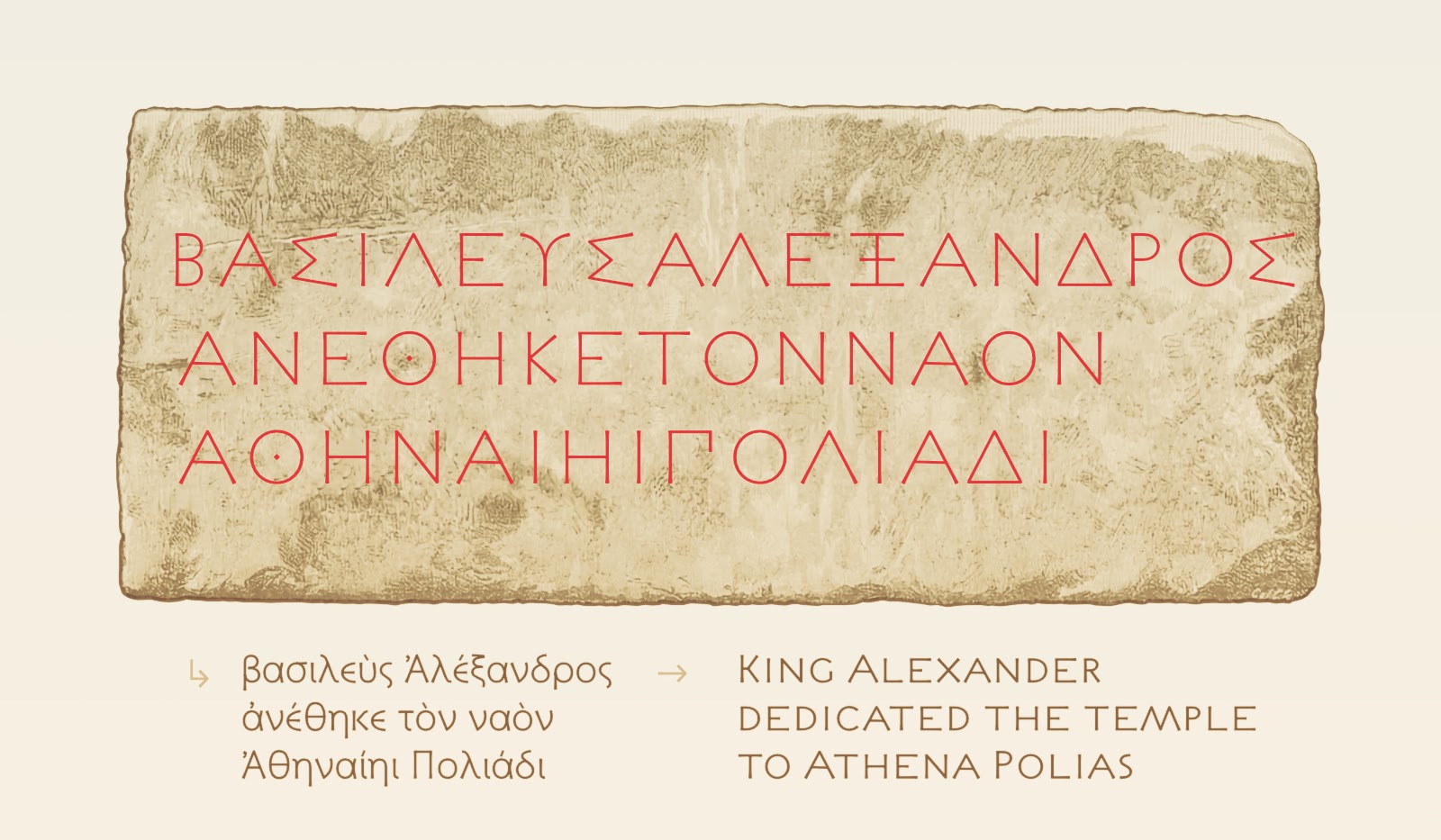
THE INSCRIPTION OF ALEXANDER THE GREAT ~ PRIENE, ASIA MINOR


Many inscriptions have been found in the ancient city of Priene, but only one of them is called the ‘Priene Inscription’. This inscription owes its fame largely to Alexander the Great and the story of Strabo.

First of all  of all, some archeology and geography notes on the subject:

The subject of our article takes place in the new city of Priene with a Hippodamian (grid) plan in the Hellenistic period. The exact location of old Priene, which was originally a Carian settlement before the Ionians, is unknown.

This temple is one of the rare Hellenistic temples that have survived (not standing) to the present day without being renovated by the Romans.

Another outstanding feature is that the Temple of Athena Polias is the work of Pythius of Priene, who was also the architect of the Halicarnassus Mausoleum.


It is accepted that each city state embraced one or more protective god or goddess cults in the stony-metallic ages, archaic and ancient periods, and they opened temples and altar-function areas or built structures for them inside or outside the city. The Goddess of Athens, Athena, is also the natural Goddess of the city of Priene, which is said to be an Athenian colony, but Minerva is the counterpart of Athena in Roman mythology. Therefore, the ‘Athena Polias’ and the ‘Minerva Polias’ are the same temple.

Judging by the Strabo narrative, the dedication by Alexander the Great of the new temple for Athena Polias in Priene is a rather interesting story. 

334 BCE: Alexander of Macedon, who inherited a large army from his father Philip II, after winning the battle with the Achaemenids on the banks of the Granikos River (modern Biga River) which opened the gates of Asia to his army, visits the nearby Troy. He asks for permission from the graves of the heroes of the Trojan war to bless the war he waged against the Persian domination in Asia Minor. From there, he proceeds his advance from the west coast to the south, and continues to repel the Persians and Persian defenders who stand in his way.


When he reaches Ephesus, he learns that a Temple of Artemis will be built. The story is that the previous Temple of Artemis was destroyed by fire on the very day he was born. He sends a message to the leaders of the city at once. He promises to pay all of the construction cost in exchange for the engraving of his name on the wall of the new temple to be built. His offer was wisely declined, saying, “It is not fit that a god should provide temples in honor of gods.” Flattered, Alexander says, ‘thank you’ and goes about his business. The Ephesians would not have denied the honor of Augustus in a similar later situation.


Continuing his campaign, Alexander stumbles upon the construction of the temple of Athena Polias in Priene. He must not have given up on his wish to have his name inscribed on a temple wall. His offer will be accepted this time. According to epigraphic sources, Alexander gave Priene its freedom in 334 BCE. “He showered gifts on the city and the temple”.

After the temple was excavated in 1869–70 by the Society of Dilettanti, this block and several others from the adjacent wall were removed to London. We learn from the publications that started with the book of Chandler in 1769 that the in situ location of the inscription block was one of the antae of the temple.  It is still in the British Museum.


This inscription is also remarkable in that it is the first known example of the name Alexander the Great carved into history on a stone because such examples will become more numerous in the future, and even cities are named with him.


The dedication inscription placed in the name of Alexander represents an innovation in the history of Greek architecture and religion. Temples were previously built by societies or individuals solely for the Gods, and although there are exceptions, their walls are usually not inscribed with the names, images, human qualities (such as heroism) or frailty (such as arrogance) of mortals. In Hellenistic culture, there is the concept of heroon (hero cult) for this. People can be heroized, but not deified. The concept of deification should not to be confused with sublimation. It is true that temples were built for the Gods. What leads to error is to interpret whether the tombs are temples or not, based on their external appearance. In Anatolia, the situation is just the opposite, and this inscription is not the only example attesting this.


Inscription:

ΒΑΣΙΛΕΥΣ ΑΛΕΞΑΝΔΡΟΣ ΑΝΕΘΗΚΕ ΤΟΝ ΝΑΟΝ ΑΘΗΝΑΙ ΠΟΛΙΑΔΙ

Translation:

King Alexander dedicated the Temple to Athena Polias.


EDITED FROM https://esintype.com/research/priene-inscription/


Friday, 22 November 2024

PANDAIE THE DAUGHTER OF HERACLES WHO BECAME QUEEN OF THE PANDYAN KINGDOM


In Greek Religion , Pandaie or Pandae (Ancient Greek: Πανδαίη) was a daughter of Heracles who was born in India, and became the ruler of a kingdom in South India. In the account of the historian Megasthenes, she was a queen of the Pandya dynasty.

Pandaie was said to have been assigned a kingdom in India by her father, who established specific laws for it, and to become its eponym. According to Megasthenes, she was also given by Heracles 500 elephants, 4000 horses and infantry of 130 000.

According to Pliny the Elder, Pandaie was the only female child of Heracles (which, however, contradicts the accounts that mention Macaria, Eucleia and Manto as his daughters), and was therefore especially favored by Him. For that reason He made her queen of the Pandae, who since then became the only nation throughout India to be ruled by women. Pandaie's descendants, Pliny relates, reigned over three hundred cities and commanded an army of 5,100 plus five hundred elephants.


Polyaenus informs that Heracles allotted to Pandaie the southern part of India which is by the sea, subdividing it into 365 cantons and imposing on each a yearly tax that was to be paid on a certain fixed day of the year. Should a canton refuse to pay, other ones would be obliged to compensate the loss.

Pandyas are also mentioned in the inscriptions of Maurya emperor Ashoka (3rd century BCE). In his inscriptions (2nd and 13th Major Rock Edict), Ashoka refers to the peoples of south India – the Cheras, Pandyas and Satiyaputras. These polities, possibly not part of the Maurya empire, were on friendly terms with Ashoka:

The conquest by dharma has been won here, on the borders, and even six hundred yojanas (5,400–9,600 km) away, where the Greek king Antiochos rules, beyond there where the four kings named Ptolemy, Antigonos, Magas and Alexander rule, likewise in the south among the Cholas, the Pandyas, and as far as Tamraparni river.
(Major Rock Edict No.13), Ven. S. Dhammika translation.

Everywhere within the conquered province of King Piyadasi (Ashoka), the beloved of the gods, as well as in the parts occupied by the faithful, such as Chola, Pandya, Satiyaputra, and Keralaputra, even as far as Tambapanni (Ceylon) and within the dominions the Greek (of which Antiochus generals are the rulers ) everywhere the heaven-beloved Raja Piyadasi’s double system of medical aid is established- both medical aid for men and medical aid for animals.
Major Rock Edict No.2), James Prinsep translation.

Edited from Wikipedia

Monday, 18 November 2024

ZEUS ~ SERAPIS ~ OHRMAZD WITH KUSHAN WORSHIPPER ~ BACTRIA


This rare Central Asian votive panel depicts a deity (with nimbus) being approached by a male worshiper, probably nonroyal but portrayed as of equal stature to the god. Compositionally, they follow scenes of homage and investiture from the post-Hellenistic West and from Iran in which a king and a god appear side by side. A majestic figure with a full beard and long wavy hair, who has been identified as the supreme deity Zeus/Serapis/Ohrmazd, receives a suppliant in the characteristic Iranian short tunic and leggings, hands clasped in adoration. Here, the rich intercultural style that developed in the Kushan realm is clearly displayed: Indian divine iconography; the Iranian type of two-figured composition; and Greco-Roman naturalism in the drapery and pose, as well as in the use of light and shadow to suggest modeling. The panel has holes at the corners and was probably set up, together with three others acquired by the Museum (MMA 2000.42.1, .3, .4), on the interior walls of a sanctuary, perhaps a family shrine. 

Source MET  Museum

Friday, 15 November 2024

THE GREEK KINGDOMS OF CENTRAL ASIA ~ FREE PDF


Greek rulers became involved in the power struggle for Central Asia from the mid-third century BCE. There remain few written records from this time, but archaeological excavations have revealed a fascinating legacy of Hellenistic artistic culture in Central Asia from this era.  Sites such as Taxila were ancient centers of international cultural exchange from the times of the earliest Greek conquests, when the great east-west trade routes were controlled by the Greeks.   

An article of 31 pages, written by P.Bernard, on the history of  Greeks  in the Central Asia. All credit goes to the author.

For those who wish to read it, it's available in pdf form for free , in the link below.

https://en.unesco.org/silkroad/knowledge-bank/greek-kingdoms-central-asia

HELLENISTIC STYLE HELMET ~ NISA TURKMENISTAN

A sculpted head of a Parthian soldier wearing a Hellenistic-style helmet, from the Parthian royal residence and necropolis of Nisa, Turkmenistan, 2nd century BCE


Monday, 5 August 2024

KOTINOS ~ THE PRIZE OF OLYMPIC EXCELLENCE IN ANCIENT GREECE


The Olympic Games were born in Ancient Greece, at the sacred site of Olympia, in 776 BCE. The Games, created by Heracles in honour of the Father of the Gods, Zeus, were held every four years and attracted great athletes and a lot of spectators. One of the most interesting aspects of the Games was that all these athletes competed and gave their all for one single prize. A kotinos, a wreath made from the branches of a wild olive tree which was near the Temple of Zeus in Olympia. No gold, no silver , no bronze medals. Just a wreath for the best athlete in each sport. And yet, this seemingly 'humble ' wreath was cherished more than any other material prize. 

  As we mentioned before, the kotinos was made from the branches of a wild olive tree called  Elaia Kallistephanos) . Hercules, who first laid out the Olympic track, also planted this sacred olive tree from which the wreaths were made. It is therefore clear that the wreath was not just a prize for athletic success; it was a sacred offering, imbued with cultural and religious significance. Hence , the process of making an olive wreath was a task of precision and reverence. Before the beginning of the Games, the branches of the sacred wild-olive tree were cut by a pais amphithales (Ancient Greek: παῖς ἀμφιθαλής, a boy whose parents were both alive) with a golden sickle. Then he took them to the temple of Hera and placed them on a gold-ivory table. From there, the Hellanodikai (the judges of the Olympic Games) would take them, and carefully weave them into wreathes, ensuring that each one was a perfect circle, symbolizing unity and eternity.

The use of olive tree branches as awards for the most important athletic event of the ancient worlds, reminds us once more of the special place the olive tree held in Hellenic Religion and culture. It is the sacred tree of Goddess Athena, who had gifted it to the city of Athens, winning the favor of its people over Poseidon. The  connection of the olive tree  to the Greek Goddess of Wisdom enhances its significance as a symbol of wisdom, peace, and prosperity.


The climax of the Olympic Games was the award ceremony, where victors were crowned with olive wreaths. This momentous occasion took place within the sanctuary of Zeus, adding a divine dimension to the athletes’ triumph. The ceremony was not just an athletic celebration but a religious and cultural festival, attended by thousands, including dignitaries and priests.

More Than Just a Prize

In the ancient Greek Olympic Games, there was only one winner per sport. Therefore, winning an olive wreath in Olympia was one of the truly highest honors for an ancient athlete. The fact that the kotinos wasn't an 'expensive' prize was unimportant. Its true value was that the victor had earned the glory of victory, the respect of his peers and his home town and most of all, the favour of the Gods.  The Kotinos  was also  a testament to the athlete’s physical prowess, dedication and discipline.

Famous Victors Who Received Olive Wreaths

The victorious athletes were honoured, feted, and praised. Their deeds were heralded and chronicled so that future generations could appreciate their accomplishments. In fact, the names of the Olympic winners formed the chronology basis of the ancient world, as arranged by Timaeus in his work, The Histories. Over the centuries, numerous athletes achieved glory in the Olympic Games and were honored with olive wreaths. Their victories became part of the rich tapestry of Greek history .Athletes like Diagoras of Rhodes, who won twelve crowns in the Olympics, and Milo of Croton, a renowned wrestler, were among those who received this prestigious honor. Their victories, celebrated with olive wreaths, elevated them to a near-mythical status, immortalizing their names in the annals of history.


A Symbol of Peace

The kotinos was not only a symbol of athletic victory ,but also of peace. The olive branch has traditionally been associated with peace and reconciliation, and its use in the wreaths at Olympia further emphasized the Olympic Truce, during which conflicts were suspended, and unity was celebrated.

Olive Wreaths in Modern Olympic Symbolism

Just like the Olympic Games themselves, which gloriously returned in the modern era, the tradition of the olive kotinos  has transcended the centuries, finding its place in the modern Olympic Games. While gold, silver, and bronze medals are awarded to modern day athletes, the olive wreath still appears in various symbolic forms. It is often seen in logos, emblems, and the ceremonial aspects of the Games, serving as a link to the ancient traditions and a reminder of the Olympic Games’ Greek historical roots. Olive wreaths were the official emblem of the 2004 Summer Olympics in Athens, where the athletes also received them  in honor of the ancient tradition.


For the conclusion of this short article about the history of the kotinos, it is worth mentioning an account given to us by Herodotus :  Xerxes was interrogating some Arcadians after the Battle of Thermopylae. He inquired why there were so few Greek men defending the Thermopylae. The answer was "All other men are participating in the Olympic Games". And when asked "What is the prize for the winner?", "An olive-wreath" came the answer. Then Tiritantaechmes, one of his generals uttered: "Good heavens! Mardonius, what kind of men are these against whom you have brought us to fight? Men who do not compete for possessions, but for virtue."'

Edited from : Wikipedia , peloponnesetravel.gr


Thursday, 11 January 2024

SILVER TETRADRACHM OF THE GREEK KING SELEUCUS I NICATOR


Silver Tetradrachm of the Greek King Seleucus I . 312-280.  Obv. Bridled horsehead looking right, with horns. Rev. ΒΑΣΙΛΕΩΣ ΣΕΛΕΥΚΟΥ ( of King Seleucus )  Elephant walking right and monograms below it. 


This tetradrachm is an emblematic issue of Seleucus I, the founder of the Seleucid dynasty, whose Kingdom extended from Thrace and Asia Minor in the West to Bactria in the East and from the Black Sea in the north to the borders of Egypt in the South at its peak. Seleucus was essentialy the only Successor of Alexander the Great who came closest to restoring the entirety of the Macedonian Empire, and this coin gives us an idea of how he achieved to create such a vast Kingdom. 

The obverse type depicts the head of a magnificent horse adorned with the horns of a bull. Ioannis Malalas, a Syrian chronicler of the byzantine times, tells us that in his day (the late 5th-early 6th centuries CE) there was still a statue in Antioch erected by Seleucus, depicting a horned horse. Seleucus commissioned this statue to honour his own steed who had saved him from destruction at the hands of Antigonos Monophthalmos in 315 BCE. Although Seleucus had been appointed satrap of Babylonia by an assembly of Alexander's former generals in 321 BCE, Antigonos, who was made strategos of Asia at the same time sought to remove the satraps that he could not control and thereby become the new master of Alexander's Empire. Realizing the danger, Seleucus took to his horse and escaped from Babylon to the Egyptian court of Ptolemy. With Ptolemy's assistance, Seleucus was able to return to Babylon-again on his horse-and reclaim his satrapy in 312 BCE.

 In 306/5 BCE,  he embarked upon an eastern campaign to gain control of the Upper Satrapies. However, the real benefit of this campaign was a peace treaty made with the Mauryan Emperor Chandragupta that involved the gift of 500 elephants. Elephants, such as the majestic creature depicted on the reverse of the tetradrachm, were the equivalent to the tank of the ancient Greek world, capable of great destruction and inspiring fear in infantry and cavalry alike ranged against them. 

Like the horse of the obverse, the elephants of Chandragupta had a pivotal role to play in Seleucus' reign. Thanks to their timely arrival at the Battle of Ipsos (301 BCE), it was possible for Seleucus and his allies to defeat and kill Antigonos, thereby ending an ever-present threat. With Antigonos gone, Seleucus could safely rule his eastern Kingdom. The tetradrachm itself gives us the end of the story. It was struck at Pergamon for Seleucus by a local dynast named Philetairos-the founder of the later Attalid dynasty. In 281 BCE, the year the coin was issued, Philetairos and other cities and rulers of western Asia Minor invited Seleucus to march west and destroy his sometime ally, Lysimachos, who had made himself very unpopular in the region. Seleucus accepted, and he defeated and killed Lysimacus at the Battle of Korupedion. This victory gained for Seleucus all of Lysimacus' former territory in Asia Minor and Thrace, but he did not have the chance to enjoy this new victory. Later in the year, as he marched through Thrace, Seleucus was murdered by a refugee from the Ptolemaic court. His name and legacy, however, remain immortal .


Saturday, 6 January 2024

SURKH KOTAL INSCRIPTION IN GREEK SCRIPT ~ ~ PULI KHUMRI ~ AFGHANISTAN


Displayed at the Kabul Museum, this limestone tablet is from the 2nd century CE and is inscribed with the Greek alphabet. It was found in Surkh Kotal, an ancient archaeological site about 18 km north of Puli Khumri, the capital of Afghanistan’s Baghlan province. Use of the Greek alphabet was common for centuries after the campaign by Alexander the Great in the 4th century BCE  and was used for a long time, together with other local alphabets.

Image source  ~ Wikipedia

Monday, 1 January 2024

THE GORGONEION A GREEK APOTROPAIC IMAGE FROM THE DEPTHS OF CENTURIES


In Ancient Greece, the Gorgoneion (Greek: Γοργόνειον) was a special apotropaic amulet showing the Gorgon head, which was used by  Athena and Zeus: Both are depicted wearing  the gorgoneion as a protective pendant.  Among other attributes, it was used by Alexander the Great himself and later by rulers of the Hellenistic age as a royal aegis to imply divine birth or protection, as shown, for instance, on the Alexander Mosaic and the Gonzaga Cameo. It is considered to be one of the most powerful protective images. 


Homer refers to the Gorgon on four occasions, each time alluding to the head alone, as if she had no body. The story of Perseus slaying Medusa is well-known, yet the centre of attention has since turned on the immensely apotropaic qualities that her head obtained after the beheading.Prior to the 5th century BCE, Medusa  was depicted as particularly ugly, with a protruding tongue, boar tusks, puffy cheeks, her eyeballs staring fixedly on the viewer and the snakes twisting all around her.


The direct frontal stare, especially expressing violent aggression, was highly unusual in ancient Greek art. (The common depiction of the evil eye on 6th century drinking vessels, and particularly, eye-cups, like Gorgoneia, are assumed apotropaics.) In some instances, what sometimes appears as a beard (probably standing for stylized hair or streaks of blood) was appended to her chin, making her appear as an orgiastic deity akin to Dionysus.


Gorgoneia that decorate the shields of warriors on mid-5th century Greek vases are considerably less grotesque and menacing. By that time, the Gorgon had lost her tusks and the snakes were rather stylized. The Hellenistic marble known as the Medusa Rondanini illustrates the Gorgon's eventual transformation into a beautiful woman.

Gorgoneia appear frequently in Greek art at the turn of the 8th century BCE. One of the earliest representations is on an electrum stater discovered during excavations at Parium. Other early 8th-century examples were found at Tiryns. Going further back into history, there is a similar image from the Knossos palace, datable to the 15th century BCE. Marija Gimbutas even argues that "the Gorgon extends back to at least 6,000 BCE, as a ceramic mask from the Sesklo culture illustrates", and in her book, Language of the Goddess, she also identifies the prototype of the Gorgoneion in Neolithic art motifs, especially in anthropomorphic vases and terracotta masks inlaid with gold.

In the 6th century, gorgoneia of a canonical "lion mask type" were ubiquitous on Greek temples, especially in and around Corinth. Pedimental gorgoneia were common in Sicily; probably the earliest occurrence being in the Temple of Apollo in Syracuse. Around 500 BCE, they ceased to be used for the decoration of monumental buildings, but were still shown on antefixes of smaller structures throughout the next century.


Apart from temples, the Gorgon imagery is present on garments, dishes, weapons, and coins found across the Mediterranean region from Etruria to the Black Sea coast. The Gorgon coins were struck in 37 cities, making her image on coins second in numismatic ubiquity only to several principal Olympian Gods and Goddesses. On mosaic floors, the Gorgoneion usually was depicted next to the threshold, as if guarding it from hostile intruders. On Attic kilns, the gorgoneion over the kiln door protected from mishaps.


SOURCE Wikipedia